Product Overview
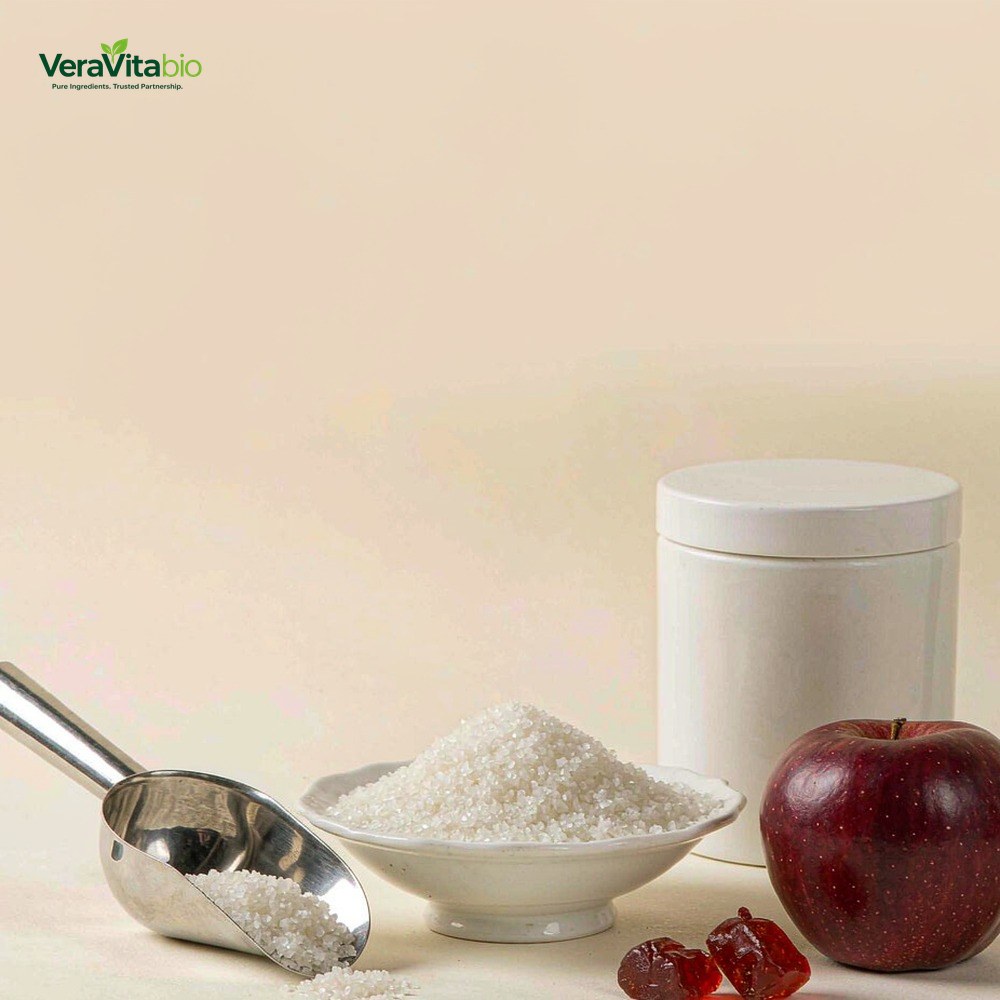
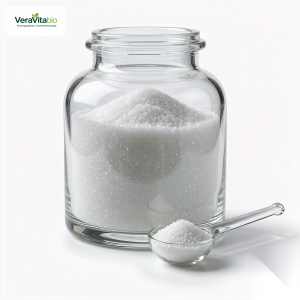
L-Malic acid (Chinese name L-苹果酸; 2-hydroxybutanedioic acid; CAS 97-67-6; EC(list) 230-022-8; C4H6O5, MW 134.09; E 296 / INS 296) is a white, odourless crystalline powder with a clean, tart, lingering acidity — the acid that gives apples, watermelons, cherries and pears their characteristic sourness (malic acid accounts for roughly 95% of the total acid in apples, ~99% in watermelon and ~94% in cherry). The name itself comes from the Latin malum, apple. It is a dibasic α-hydroxy acid with pKa1 3.40–3.46 and pKa2 5.10–5.11, a 1% aqueous solution reading about pH 2.3, readily soluble in water (36.3 g/100 g at 20 °C for the L-form; 55.8 g/100 g for the DL-form) and soluble in ethanol and acetone. The molecule carries one chiral centre: the L-isomer is the form nature makes and the form human metabolism handles, and it is the form that decides which national standard, which price tier and which end markets a lot can legally serve.
Commercially, malic acid is the second-largest hydroxy food acid after citric acid — global volume is estimated around 165,000 t/yr against roughly 225,000 t/yr of capacity, at an average market price near USD 2,100/t, with food and beverage taking about 75% of consumption and the top five producers (Changmao Biochemical, Fuso Chemical, Bartek, Polynt, Sealong) holding more than 70% of the market. The DL-form is roughly 95% of volume (petrochemical route, cost-driven); the L-form is the premium, bio-based niche, made from fumaric acid by enzymatic hydration or from carbohydrates by fermentation. China is the largest producing and exporting market. VeraVita Bio supplies both grades from that cluster — and we quote them separately, because they are not the same product.
Key Features
- Enantiomer is the first line of the specification, not the last. L-malic (CAS 97-67-6) and DL-malic (CAS 6915-15-7; racemic 50:50) are different products with different CAS numbers, different Chinese national standards, different routes and different legal permissions. A quotation that says only “malic acid 99%” is not comparable to anything. The fastest check: specific rotation — L-malic reads [α]D20 −1.6 to −2.6° (GB 1886.40-2025), while DL-malic reads −0.10 to +0.10° (GB 25544-2010). A COA headed “L-malic acid” with a rotation band around zero is a mislabelled DL lot — walk away.
- Two routes, two impurity fingerprints. DL-malic is made by hydration of maleic anhydride under high temperature and pressure (petrochemical C4 chain), which leaves fumaric and maleic acid as the characteristic residues — both Chinese and international standards therefore cap maleic acid ≤ 0.05% (a recognised irritant) and fumaric acid (≤ 1.0% for DL, ≤ 0.5% for L). L-malic is made by enzymatic hydration of fumaric acid (fumarase route) or by fermentation from glucose/starch; the 2025 edition of its Chinese standard additionally caps succinic acid ≤ 2.0% — the fermentation by-product that only a bio-route lot can carry. Read the impurity panel and you can tell the route, and often the plant, without asking.
- The new Chinese L-malic standard is live and changes the paperwork. GB 1886.40-2025 (published 2 September 2025, effective 2 March 2026, replacing GB 1886.40-2015) applies specifically to L-malic from enzymatic or fermentation routes and tightens the panel: assay ≥ 99.0%, moisture by Karl Fischer ≤ 1.0%, residue on ignition ≤ 0.10%, chloride ≤ 0.004%, sulfate ≤ 0.02%, Pb ≤ 2.0 mg/kg, As ≤ 1.0 mg/kg. Lots certified to the 2015 edition will not clear a 2026 inspection automatically — ask which edition your supplier’s COA references.
- Sourness that tastes like fruit, not like a laboratory. On a weight basis malic acid is perceived as about 1.2× the sourness of citric acid, but its real advantage is the profile: it builds slower, peaks lower and lasts longer than citric’s sharp spike, with a smoother, more “fruit-natural” mid-palate and a better aftertaste. Formulators use it alone in apple/grape/floral profiles and as a blend component with citric acid to round the attack and extend the finish — a common ratio is 30–50% of the total acid replaced by malic.
- A working chelator, not just an acid. The hydroxyl plus two carboxyls give malic acid real metal-ion complexing power against Ca2+, Mg2+, Fe3+, Cu2+ and Al3+ — the same chemistry that supports its use in descaling, industrial cleaning and water treatment, and in food it acts as a synergist for antioxidants by tying up pro-oxidant trace metals.
- Supply behaves like a commodity; the L/D split is where the margin hides. DL and L move with maleic-anhydride and fumaric-acid feedstock costs, and L-malic consistently trades at a substantial premium over DL because enzymatic and fermentation routes cost more. Quoting “malic acid” without the enantiomer invites exactly the substitution dispute you expect; we quote the CAS number on the face of the offer.
How It Works
Acidulation and taste physics. Dissolved in water, the first proton (pKa1 ≈ 3.4) dissociates almost completely at beverage pH and sets the titratable acidity; the second (pKa2 ≈ 5.1) buffers the mid-pH range, which is why malic-acid systems hold pH more evenly through the sour range than strong single-proton acids. Sourness is signalled through proton-sensitive ion channels (OTOP1/OTOP2) in taste-receptor cells; malic’s two-step dissociation and its higher effective proton delivery per gram than citric at equal pH produce the slower-onset, longer-tailing sour profile that confectioners call “lasting tartness”.
Metabolism — why the L-form matters. L-malate is a native intermediate of the citric acid (Krebs) cycle and of the malate–aspartate shuttle: human cells oxidise it directly via malate dehydrogenase to oxaloacetate. The D-isomer has no cycle role and is metabolised slowly and incompletely; this is the documented reason DL-malic acid is not permitted in baby food — infants cannot clear the D-form quickly and acidosis risk was the cited basis — and the reason wine practice accepts only L-malic for acidification. Everything the body does with malic acid, it does with the L-form; DL contributes sourness and nothing else.
Chelation. At formulation pH the doubly deprotonated malate anion binds divalent and trivalent metal ions through its hydroxyl and carboxylate arms. In food this sequesters the Fe/Cu that catalyse oxidation (a genuine antioxidant synergy with ascorbic-acid systems); in hard-surface and descaling applications it is why malic acid appears in boiler, heat-exchanger and metal-cleaning formulations at 3–8% of the blend, and in rinse-water treatment at mg/L levels as an anti-scalant.
Skin: a gentle α-hydroxy acid. As an AHA, malic acid lowers the pH at the stratum-corneum surface, loosens the corneocyte cohesion (reducing the Ca2+-dependent desmosome glue) and accelerates desquamation, with the same class effects as glycolic/lactic acids but a larger molecule and slower penetration — typically gentler and less stinging. Its cosmetic role is as much pH adjustment and buffer pairing (malate buffer, pH 3.5–5.0) as exfoliation. Consumer AHA practice — and the recommendation attached to the EU AHA review — is to keep leave-on products around pH ≥ 3.5 and total AHA ≤ 10% with sun-exposure warnings, because AHAs increase UV sensitivity.
L-Malic vs DL-Malic: The Distinction That Decides the Quote
- Identity: L-malic CAS 97-67-6 · D-malic CAS 636-61-3 · DL-malic CAS 6915-15-7 (also registered as 617-48-1). Melting point separates them physically: DL 131–132 °C versus L ~100–103 °C — a two-minute lab check that has caught many mislabelled lots.
- Route: L = fumarase hydration of fumaric acid, or fermentation of glucose/starch (bio-based). DL = maleic-anhydride hydration at high temperature/pressure (petrochemical). Hence the different impurity caps (fumaric ≤ 0.5% L vs ≤ 1.0% DL; succinic ≤ 2.0% L only).
- Standard: China runs GB 1886.40-2025 for L-malic and GB 25544-2010 for DL-malic (assay 99.0–100.5%, rotation −0.10 to +0.10°, water-insoluble ≤ 0.1%, As/Pb ≤ 2 mg/kg) — two documents, not one.
- End-market gates: DL is excluded from baby food (infant D-isomer metabolism) and from wine acidification (OIV practice accepts L-malic only); L-malic is the form for wine and cider acid adjustment, chiral pharmaceutical intermediates (the malate counter-ion in several APIs) and premium “natural-source” claims.
- Price: DL is the volume product; L trades at a premium. Any buyer comparing two offers must first match the CAS numbers — a 20% “discount” is often simply DL quoted against an L enquiry.
Typical Applications
- Beverages — still fruit drinks, nectars, sports and functional drinks, powdered mixes: typically 0.5–4 g/L, alone or blended with Citric Acid (E 330). Malic extends the sour finish and masks the “citric bite” in low-sugar and high-intensity-sweetener systems, pairing naturally with Xylitol (E 967), Erythritol or Sucralose (E 955).
- Confectionery — the classic home of malic acid: hard candy, gummies and sour coating powders at 0.5–2%. Its slower onset and longer tail are exactly the “sour then sweet” curve sour candy is engineered around; granular grades resist caking in the coating drum.
- Wine, cider and fermentation — L-malic only for acid adjustment (OIV practice); it is the grape’s own acid, and knowing your malic load also predicts the course of malolactic fermentation, which converts L-malic to lactic acid. DL-malic must not be substituted.
- Jams, jellies, fruit preparations and pickled vegetables — pH setting for pectin gels (pectin needs the right pH to gel) and flavour enhancement, typically 0.1–0.4%.
- Mineral malates — calcium, magnesium and zinc malate salts for supplements; malate is more soluble and reportedly gentler than many inorganic salts, and L-malic with a tight chiral spec is the correct entry material. Sold in sports-nutrition stacks for the Krebs-cycle “energy” story — position it as a nutrition narrative, not a clinical claim.
- Sugar-free confectionery and dry-mouth products — malic acid is a salivary stimulant used in lozenges and oral-care formats for xerostomia relief; combined with polyols (xylitol) it is the standard “moist mouth” lozenge architecture.
- Cosmetics — INCI Malic Acid: AHA exfoliation, pH adjustment and malate buffering in toners, peels, creams and shampoos, typically 0.5–5% (up to 10% in professional AHA products at pH ≥ 3.5). It also supports preservative efficacy by lowering system pH alongside Potassium Sorbate (E 202) and Sodium Benzoate (E 211), and pairs with acid-stable actives such as 3-O-Ethyl Ascorbic Acid.
- Mild surfactant systems — amino-acid surfactants such as Sodium Cocoyl Glutamate need their acid partner for the pH 5.0–6.0 window; malic acid is a clean-label citrate-free choice.
- Industrial — descaling and metal-cleaning blends (3–8%), circulation-water anti-scaling (5–20 mg/L), electroplating auxiliaries, gypsum/cement retardation — a real volume outlet that prices off the DL grade.
- Feed — acidifier in weaning animal diets, usually as part of a blended organic-acid package.
Key Specifications
| Parameter | L-Malic Acid (GB 1886.40-2025) | DL-Malic Acid (GB 25544-2010) |
|---|---|---|
| Chemical name | (S)-2-Hydroxybutanedioic acid (L-苹果酸) | (RS)-2-Hydroxybutanedioic acid (DL-苹果酸) |
| CAS No. | 97-67-6 | 6915-15-7 |
| E / INS number | E 296 / INS 296 | E 296 / INS 296 |
| Molecular formula / weight | C4H6O5 / 134.09 | C4H6O5 / 134.09 |
| Appearance | White crystals or crystalline powder; characteristic acid taste | White to near-white crystalline powder; characteristic acid taste |
| Assay (as C4H6O5) | ≥ 99.0% | 99.0–100.5% |
| Specific rotation [α]D | −1.6° to −2.6° (20 °C) — the identity gate | −0.10° to +0.10° |
| Moisture / water | ≤ 1.0% (Karl Fischer) | loss on drying per standard; water-insolubles ≤ 0.1% |
| Residue on ignition | ≤ 0.10% | ≤ 0.10% |
| Chloride / sulfate | Cl ≤ 0.004% · SO4 ≤ 0.02% | per standard, typically tighter than international spec |
| Fumaric acid | ≤ 0.5% | ≤ 1.0% |
| Maleic acid | ≤ 0.05% | ≤ 0.05% |
| Succinic acid | ≤ 2.0% (fermentation-route marker) | not listed |
| Pb / As | Pb ≤ 2.0 mg/kg · As ≤ 1.0 mg/kg | Pb ≤ 2 mg/kg · As ≤ 2 mg/kg |
| Solubility (20 °C) | Water: L 36.3 / DL 55.8 g per 100 g · freely soluble in methanol, ethanol, acetone · slightly soluble in ether · 1% solution pH ≈ 2.3 · pKa1 3.40–3.46, pKa2 5.10–5.11 · melting point: DL 131–132 °C, L ~100–103 °C | |
| Typical use level | Beverages 0.5–4 g/L · candy/gummies 0.5–2% · jams 0.1–0.4% · cosmetics 0.5–5% (AHA ≤ 10%, pH ≥ 3.5) · descaling blends 3–8% | |
| Packaging | 25 kg net multi-layer kraft-paper bags with PE/foil liner, or fibre drums; palletised, moisture-barrier wrapped | |
| Shelf life | 24–36 months unopened, cool, dry, sealed against humidity | |
Handling, Stability & Formulation Notes
- Humidity is the enemy. Malic acid is hygroscopic and can cake in high-humidity warehouses; crystals pick up surface moisture at the seam first. Keep bags sealed, palletised under moisture-barrier wrap, below ~25 °C, and rotate stock. In powder blends destined for humid markets, use the granular grade and line the drum — caked malic acid reads as a quality failure even when the assay is perfect.
- Effervescent and dry-blend work: with sodium bicarbonate, malic acid reacts cleanly to the malate salt; keep both streams below ~30% RH and add 0.1–0.3% fumed silica to the blend. For direct compression, granular or spray-crystallised grades flow better than milled powder.
- Heat behaviour: stable through normal food processing (pasteurisation, hot fill, candy boiling temperatures below its dehydration range). Above roughly 180 °C malic acid dehydrates toward fumaric acid and the anhydride — which is precisely why fumaric/maleic are the standard’s impurity markers. Avoid unnecessary high-heat holds on concentrated acid streams.
- Beverage workflow: dissolve fully in the water phase before citrate/malate-sensitive components; add trace-metal-chelating duties early so ascorbic acid and colours are protected through heat treatment. Confirm compatibility with your protein or stabiliser system — at low pH, protein beverages can destabilise whatever the acidulant.
- Incoming-goods check, five minutes: (1) specific rotation — is it the enantiomer on the invoice; (2) melting point — 131 °C band says DL, ~101 °C says L; (3) HPLC for fumaric/maleic; (4) Karl Fischer water. A rotation value around zero on an “L” COA is a mislabelled racemate — reject before it enters your blends.
- Cosmetic formulation: add in the cool-down or water phase at the final pH target; the malate buffer window is pH 3.5–5.0. Keep finished leave-on products at pH ≥ 3.5 with total AHA ≤ 10% and carry the sunburn-alert statement where required.
- Storage: dry, sealed, away from strong oxidisers and bases. Food-grade liner bags only — the acid is aggressive toward plain metal contact over time.
Regulatory Position
European Union. Malic acid is the permitted food additive E 296 (acidulant) under Regulation (EC) No 1333/2008, in most categories at quantum satis; the purity specification sits in Regulation (EU) No 231/2012 (assay ≥ 99.0%, fumaric ≤ 1.0%, maleic ≤ 0.05%, sulphated ash ≤ 0.1%, lead ≤ 2 mg/kg). Infant foods carry their own restrictions on acidulants — and the DL-form’s infant-metabolism issue is the reason the D-isomer must not be used there. In cosmetics, Malic Acid is listed in CosIng with no Annex II–VI restriction; AHA-containing products follow the pH ≥ 3.5 / ≤ 10% consumer practice from the SCC opinions, with UV-sensitivity labelling.
United States. Malic acid is an affirmed GRAS direct food ingredient (21 CFR 184.1069) as a pH control agent, flavouring agent and adjuvant, with current GMP use; DSHEA applies to supplement use of malate salts. Cosmetic use is accepted under MoCRA; claims must stay cosmetic, not drug.
China. Acidulant under GB 2760, permitted at use-per-production-need (GMP) levels across most food categories — verify the current edition for category-level notes and infant exclusions. Product standards are split: GB 1886.40-2025 for L-malic (effective 2 March 2026) and GB 25544-2010 for DL-malic. In cosmetics, malic acid is listed in the IECIC inventory; any brightening/exfoliation claim positioning must pass the applicable safety-assessment route.
Safety anchor. JECFA evaluated malic acid and set the ADI as “not specified” — the classification for additives of no toxicological concern at food-use levels (long history of use, rapid metabolism of the L-form). Concentrated acid is an eye/skin irritant as supplied (GHS H302/H315/H319 warnings on SDS); this is handling risk, not dietary risk.
Customs classification. Malic acid is classified under HS 2918.19 (“carboxylic acids with alcohol function but without other oxygen function, other than lactic, tartaric, citric and gluconic acids”). The US HTSUS subheading is 2918.19.6000 at 4% general duty — CBP ruling NY N347668 (5 May 2025) covers both DL (6915-15-7) and L (97-67-6) forms — with China-origin Chapter 99 additional duties stacked on top (as of the 2025 measures: 20% IEEPA under 9903.01.24 plus 25% Section 301 under 9903.88.03); the stack changes with trade-policy revisions, so confirm the current total at booking. China MFN import duty 6.5%, VAT 13%. Confirm the 10-digit Chinese export code and rebate status with your broker before the first shipment.
Why Choose VeraVita Bio
VeraVita Bio (Xi’an VeraVita Biotech Co., Ltd.) supplies both L- and DL-malic acid from the Chinese production cluster, with the enantiomer, route and standard edition stated on the face of every offer. We are deliberately specific about what matters in this product: CAS number and specific rotation (the identity gate), the GB 1886.40-2025 transition that changes L-grade paperwork from March 2026, the fumaric/maleic/succinic impurity panel that fingerprints the route, the particle form that decides whether your coating drum or blender runs cleanly, and the destination-market gates (baby food, wine, AHA limits) that decide which grade your formula needs. When you send an enquiry, please tell us: (1) grade — L or DL, food / cosmetic / industrial; (2) application and target use level; (3) destination market, for the documentation pack (COA, SDS, ISO/HACCP certificates, HALAL/KOSHER on request); and (4) pack size and annual volume. We reply with pricing on a stated CAS and assay basis, the current lot’s COA and a sample lead time.
Email: info@veravitabio.com | WhatsApp: +86 157 7194 0528
VeraVita Bio — Xi’an VeraVita Biotech Co., Ltd. | Botanical & Functional Ingredient Sourcing Partner
Email: info@veravitabio.com | WhatsApp: +86 157 7194 0528 | veravitabio.com
Need pricing, a sample or full documentation?
Send your specification, target volume and destination country — our team replies within one business day.
Disclaimer: The information provided is for general technical and commercial reference only and does not constitute regulatory, legal, medical or formulation advice. Malic acid’s regulatory status, permitted use levels, permitted claims and customs classification vary by market and change over time — including the GB 1886.40-2025 transition effective 2 March 2026 and the Chapter 99 duty measures applicable to China-origin goods — and must be verified against the requirements in force in the destination market before any product is formulated, labelled, marketed or shipped. DL-malic acid is not suitable for infant foods and is not accepted for wine acidification; L-form selection does not by itself support any clinical, energy-metabolism or skin-transformation claim. AHA-related cosmetic guidance (pH ≥ 3.5, ≤ 10%) reflects consumer-product practice and SCC recommendations and does not replace a product-specific safety assessment. Specifications are subject to batch confirmation from the lot COA, and grade must be confirmed by CAS number and specific rotation. HS-code classification practice varies by destination, grade and registration status and must be confirmed with a licensed customs broker. Malic acid is a raw material supplied to qualified business customers, not a finished consumer product. Responsibility for finished-product safety, stability, shelf-life, labelling, claims and regulatory compliance in the destination market remains with the manufacturer.
Reviews
There are no reviews yet.