Product Overview
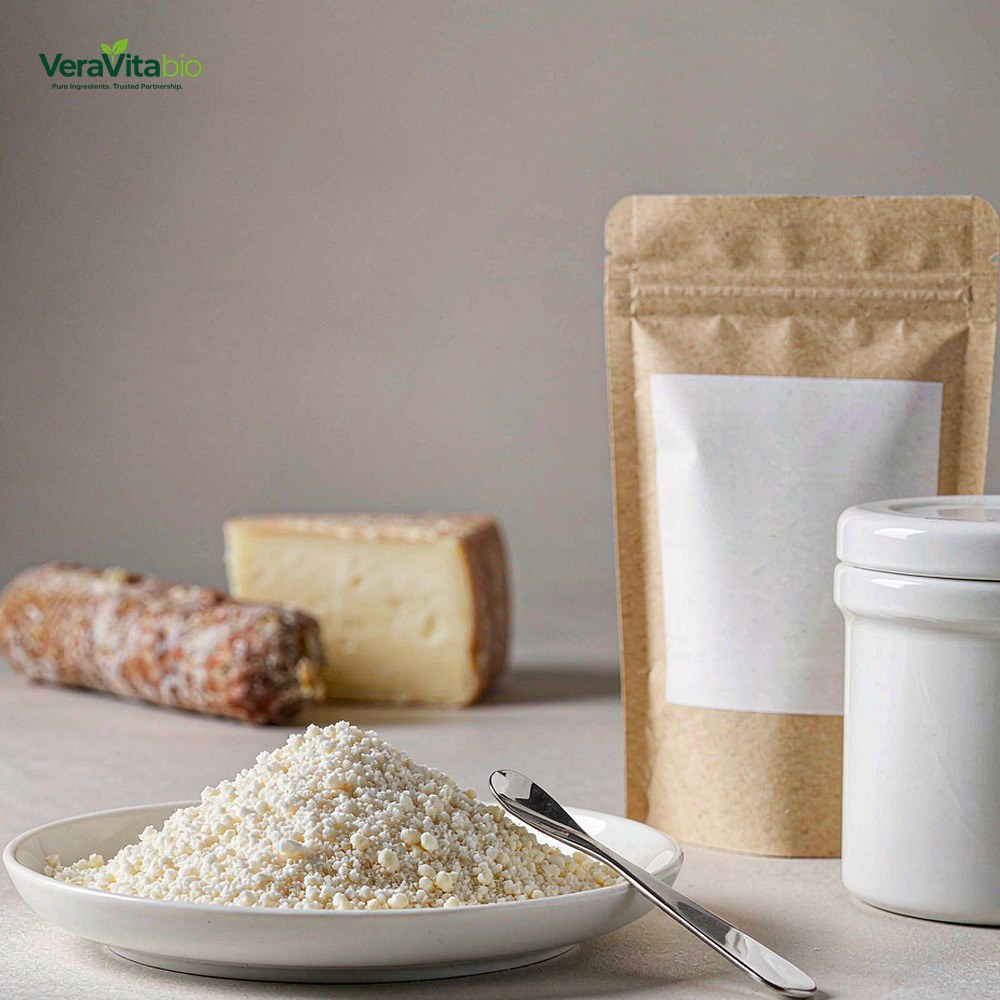
Natamycin (also called pimaricin; E 235 / INS 235; Chinese name 纳他霉素, CNS 17.030) is a polyene macrolide antifungal — a tetraene, with four conjugated double bonds in its macrolactone ring — produced by submerged aerobic fermentation of Streptomyces natalensis and related strains (S. chattanoogensis, S. gilvosporeus). CAS 7681-93-8, EINECS 231-683-5, formula C33H47NO13, molecular weight 665.73. It is a white to cream-coloured crystalline powder, practically odourless, and it crystallises as a trihydrate — a small detail that decides how its purity must be read (see below).
Its commercial identity is narrower and more useful than the word “preservative” suggests: natamycin inhibits moulds and yeasts only. It has no antibacterial activity at all — minimum inhibitory concentrations against Staphylococcus aureus, Bacillus, Escherichia coli, Salmonella and Pseudomonas all sit above 250 mg/kg — because its target, ergosterol, does not exist in bacterial membranes. In a yoghurt, a raw ham or a salami, that means the mould and yeast spoilage is stopped while the lactic-acid starter cultures continue to acidify and ripen. Almost no other preservative can make that claim.
The molecule is also almost insoluble in water (30–100 mg/L). Formulators initially read this as a limitation; in practice it is the reason the additive works. Applied as a spray or dip, natamycin stays as a crystalline depot on the surface, dissolves slowly, penetrates only 1–4 mm, and keeps releasing active molecule for weeks to months — exactly the geometry of the problem on a cheese rind or a sausage casing, where the mould actually lands and where a migrating preservative would either fail or interfere with the ripening flora.
Regulatory history: approved as a food preservative in the United States in 1982 (21 CFR 172.155) and in China in 1996, and now permitted in more than 40 countries. JECFA set an ADI of 0–0.3 mg/kg bw, based on observations of gastrointestinal effects in humans rather than an animal NOEL — a consequence of the molecule’s negligible absorption (5–7% in rats; undetectable plasma levels in humans after a 500 mg oral dose).
VeraVita Bio supplies natamycin ≥ 95% (on the dried basis) and the conventional 50% preparations on lactose, glucose or salt carriers, with COA, SDS, non-GMO and HALAL / KOSHER documentation. We quote the four parameters that actually separate one fermentation plant from another: assay on the dried basis, carrier identity, loss on drying, and the heavy-metal block.
Key Features
- An antifungal specialist — and that is the whole value proposition. Natamycin inhibits moulds and yeasts at 1–10 mg/kg, where potassium sorbate typically needs on the order of 500 mg/kg for a comparable surface effect. Because bacteria are untouched, it is compatible with starter cultures, probiotic strains and ripening flora — the property that makes it usable on fermented foods where a broad-spectrum preservative would destroy the process itself.
- Insolubility is engineered into the application, not a defect to work around. At 30–100 mg/L in water, a sprayed natamycin suspension deposits micro-crystals that redissolve slowly. Surface activity persists for the shelf life of a cheese rind or a dried sausage, with penetration limited to 1–4 mm. The same physics is why natamycin cannot be used as a bulk liquid preservative: drop it into a beverage and the active substance sits on the bottom of the tank.
- The dose is an area dose, and that changes the arithmetic. The EU authorisation is 1 mg/dm² of surface for cheese, with the requirement that natamycin is not detectable at a depth of 5 mm. China expresses the same use as 0.3 g/kg applied to the surface, residue < 10 mg/kg. These are not interchangeable numbers: a 10 cm cube of cheese has about 6 dm² of surface per kilogram, so 1 mg/dm² becomes roughly 6 mg/kg — while a large 20 kg block carries far less surface per kilogram. Small units, shredded products and casings sit at the high end of the effective range.
- Selectivity is structural, which is why resistance has not become a practical problem. Polyenes bind membrane sterols; natamycin’s affinity for ergosterol is far higher than for cholesterol, which is the origin of its antifungal selectivity and its low mammalian toxicity. Bacteria contain no sterols, so they are simply not targets. JECFA’s review found no evidence of resistance selection after more than 20 years of industrial use on cheese and dry sausage — surveys of factory and warehouse fungal populations showed unchanged sensitivity, resistant mutants are difficult to induce in vitro and revert to sensitivity when the polyene is withdrawn. EFSA’s 2009 opinion reached the same conclusion and saw no concern for the induction of antimicrobial resistance.
- Purity must be read on the dried basis — the molecule is a trihydrate. The Chinese product standard (GB 1886.58-2023, formerly GB 25532-2010) requires assay ≥ 95.0% on the dried basis (HPLC, 303 nm), loss on drying ≤ 8.0%, residue on ignition ≤ 0.5%, pH (1% suspension) 5.0–7.5, specific rotation +250° to +295° and lead ≤ 2 mg/kg. Because roughly 7–8% of the powder’s mass is water of crystallisation, a genuine ≥95% dried-basis material reads about 87–88% as-is. A supplier quoting “99%” without stating the basis is describing a number that cannot be compared with anyone else’s.
- The carrier is where price and allergens hide. Standard commercial grades are 50% natamycin on a carrier — lactose, glucose or salt. Lactose is milk-derived, so a lactose-carrier grade can trigger milk-allergen labelling and introduces a reducing sugar that browns at bakery temperatures; a salt carrier adds sodium and chloride; a glucose carrier adds reducing sugar. Ask for active content and carrier identity on the COA, and specify the carrier-free ≥95% grade where a clean label or a clear-coloured surface matters.
- Stable dry, fragile in solution — light is the dominant degradation route. In the dry state the powder is stable for years. In aqueous systems at pH 6.3, JECFA’s data show about 13% decomposition in the dark versus roughly 80% under illumination; strongly acid (below about pH 3) and strongly alkaline (above about pH 9) conditions also destroy activity, and oxidants — hydrogen peroxide, hypochlorite, ozonated water — inactivate it on contact. Practical working window: pH 4–7, opaque packaging, no co-mingling with sanitisers.
- Three different legal maps for the same molecule. In the EU, E 235 is authorised only for external surface treatment of uncut hard, semi-hard and semi-soft cheese at 1 mg/dm², with no detectable natamycin at a depth of 5 mm, and for surface treatment of dried cured sausages at the applicable maximum level. Confirm the current Union-list entry and conditions for the exact food category before use. The US permits it in cheese at ≤ 20 mg/kg (21 CFR 172.155) and has issued GRAS no-questions letters for yoghurt at ≤ 5 ppm and ready-to-drink tea, fruit-flavoured, energy and sports drinks at ≤ 0.5 ppm — company-specific notices, not a general authorisation. China’s GB 2760-2024 runs a broader surface list (cheese, pastry, several cooked-meat categories, mayonnaise, wine) at 0.3 g/kg surface application, residue < 10 mg/kg, and — the change most quotations still miss — deleted the former permission for fruit and vegetable juice (14.02.01).
How It Works
1. Ergosterol binding and inhibition of membrane transport. Natamycin inserts into the fungal plasma membrane and binds ergosterol, the sterol that gives fungal membranes their rigidity. Natamycin does not act by forming membrane pores; it binds ergosterol and disrupts the function of ergosterol-dependent membrane transport proteins. A key observed effect is the rapid inhibition of amino-acid and glucose transport across the fungal plasma membrane. This transport inhibition is attributed to reversible, ergosterol-specific effects on membrane transport proteins rather than membrane permeabilisation. Because the same molecule is much less attracted to cholesterol, mammalian membranes are largely spared — the basis of its clinical use as a 5% ophthalmic suspension for fungal keratitis.
2. The target is the surface, where mould actually starts. Mould spoilage of cheese, sausage, pastry and dressed products begins with airborne conidia landing on the surface and germinating there. Natamycin is applied as a suspension by spray, dip or immersion, deposits crystals on that surface, and meets the germinating conidium exactly where it is most vulnerable. Its low water solubility is the delivery mechanism: the crystal is a reservoir that keeps the surface concentration at the effective level for weeks, rather than a dose that dissolves once and diffuses away.
3. Why it cannot simply be replaced by sorbate. Potassium sorbate is water-soluble and mobile: it distributes through the product, which is desirable in a beverage or a dressing but wrong in a mould-ripened cheese, where it suppresses the Penicillium that the product exists to grow. Natamycin stays at the surface and does not disturb the interior ripening flora. This is the standard technical argument for natamycin on blue cheese rinds, surface-ripened cheeses and dried sausages, and it is why regulators have authorised it as a surface treatment rather than an ingredient.
4. What happens after ingestion — the reason the ADI is generous relative to use levels. Orally administered natamycin is very poorly absorbed: in rats only 5–7% of the dose leaves the gastrointestinal tract, and about 90% is excreted unchanged in faeces; in humans, plasma levels are undetectable after a 500 mg oral dose. In simulated gastric fluid roughly half the molecule hydrolyses within an hour, and the degradation products are more hydrophilic still, without producing systemic exposure. JECFA’s ADI of 0–0.3 mg/kg bw is therefore anchored on gastrointestinal observations in humans, and the committee calculated that intakes from authorised cheese and meat uses remain well below it.
5. The limits of the molecule. Natamycin does not touch bacteria, viruses or parasites; it is not an antioxidant; it does not detoxify mycotoxins that have already formed (it prevents the mould growth that would have produced them); and it does not replace refrigeration, a validated thermal process or hygienic design. Formulate it as one hurdle in a system — typically paired with a bacterial hurdle such as nisin and, where pH allows, an acid preservative.
Typical Applications
- Cheese rind — the global flagship use. External treatment of uncut hard, semi-hard and semi-soft ripened cheese and cheese products, applied by spray or dip; EU maximum 1 mg/dm² with no detectable residue at 5 mm depth, US ≤ 20 mg/kg, China 0.3 g/kg surface application with residue < 10 mg/kg. Use on shredded or grated cheese must be assessed separately under the rules of the destination market; this statement is not an EU authorisation for those products.
- Dried cured sausages and salami casings. Dip or spray of the casing after stuffing: EU maximum 1 mg/kg, China 0.3 g/kg for the 08.03 sausage and cured-meat categories. The mould-free surface is what keeps the casing attractive through months of drying, and the starter cultures inside are unaffected.
- Pastry, cakes and mooncakes (China). GB 2760-2024 category 07.02 at 0.3 g/kg as a surface treatment by suspension spray or immersion, residue < 10 mg/kg — the classic application for high-moisture, high-aw fillings and glazes in warm climates. Choose the carrier with the bake schedule in mind: lactose and glucose carriers brown.
- Mayonnaise and salad dressings. GB 2760-2024 category 12.10.02.01 at a notably lower cap of 0.02 g/kg, residue ≤ 10 mg/kg — yeast and mould control in acidified emulsified dressings.
- Wine and fermented beverages (China). Category 15.03 at 0.01 g/L, used to suppress yeast growth and refermentation risk in sweet and semi-sweet wines without disturbing the bacterial malolactic process.
- Yoghurt, sour cream and fresh dairy surfaces. Widely used in the Middle East, Latin America and parts of Asia to hold surface mould away from cultured products; the US route is a GRAS no-questions letter at ≤ 5 ppm, and the EU does not authorise it for this use — verify the destination’s position before quoting.
- Ready-to-drink beverages (US route only). GRAS notices cover tea, fruit-flavoured, energy and sports drinks at ≤ 0.5 ppm. Note the practical constraint: at 0.5 ppm in a clear beverage you need a delivery system (a dispersion or an encapsulated grade), because the raw crystal will not dissolve. China’s GB 2760-2024 no longer permits natamycin in fruit/vegetable juice (14.02.01).
- Processing-equipment and packaging surfaces. Suspensions are used on mould-prone contact surfaces and on casings and wraps in some markets; these are food-contact applications with their own rules, not food-additive uses.
- Adjacent regulated uses. Ophthalmic 5% suspension (fungal keratitis) as a pharmaceutical; feed and cosmetic preservative niches. Each is regulated separately and cannot be supported by a food-grade dossier alone.
Key Specifications
| Parameter | Specification |
|---|---|
| Product name | Natamycin (pimaricin); E 235 / INS 235; Chinese name 纳他霉素, CNS 17.030 |
| Identity | CAS 7681-93-8; EINECS 231-683-5; C33H47NO13; MW 665.73; polyene macrolide (tetraene) from Streptomyces natalensis / S. chattanoogensis; crystallises as a trihydrate |
| Appearance | White to cream-yellow crystalline powder, practically odourless |
| Assay | ≥ 95.0% on the dried basis (HPLC, UV detection at 303 nm). Because the molecule is a trihydrate, this corresponds to roughly 87–88% as-is — always confirm the basis on the COA |
| Purity criteria (CN standard) | Loss on drying ≤ 8.0% (vacuum drying); residue on ignition ≤ 0.5%; pH 5.0–7.5 (1% suspension); specific rotation +250° to +295°; lead ≤ 2 mg/kg |
| Product standards | China: GB 1886.58-2023 (superseding GB 25532-2010); EU: Commission Regulation (EU) 231/2012 (E 235); assay anchored to the JECFA monograph (WHO Food Additives Series 48) |
| Solubility | Practically insoluble in water — 30–100 mg/L at room temperature; slightly soluble in methanol; soluble in glacial acetic acid and dimethylformamide; insoluble in most non-polar solvents |
| Stability | Very stable dry. In solution: pH 4–7 working window; at pH 6.3 about 13% loss in the dark versus ~80% under illumination; destroyed below ~pH 3 and above ~pH 9; inactivated by oxidants (H2O2, hypochlorite, ozone) and sensitised by heavy metals |
| Spectrum | Moulds and yeasts: Aspergillus niger ≈1–1.8 mg/kg, Penicillium spp. ≈0.6–13 mg/kg, Saccharomyces cerevisiae ≈2.5 mg/kg, Candida albicans ≈1.5–3.3 mg/kg, Fusarium solani ≈4.2 mg/kg. No activity against bacteria (MIC > 250 mg/kg), viruses or parasites |
| Typical use levels | Surface application as a 0.05–0.2% suspension (China’s classic dip is 200–300 mg/kg suspension); effective surface loading of roughly 1–10 mg/dm² depending on substrate and target organism |
| Regulatory — China (GB 2760-2024) | CNS 17.030: 0.3 g/kg for cheese and processed cheese (01.06), pastry (07.02), braised meat products (08.03.01), roasted/grilled meats (08.03.02), fried meats (08.03.03), western-style hams (08.03.04), sausage products (08.03.05) and fermented meat products (08.03.06); 0.02 g/kg mayonnaise and salad dressing (12.10.02.01); 0.01 g/L fermented wine (15.03). Surface use only, residue < 10 mg/kg. The 2024 edition removed the former fruit/vegetable juice (14.02.01) permission — confirm in the current database before formulating |
| Regulatory — EU / US / JECFA | EU: E 235 in Annex II of Reg. (EC) 1333/2008, as amended (Commission Regulation (EU) 2015/647) — external treatment of uncut hard, semi-hard and semi-soft ripened cheese and cheese products at 1 mg/dm² (not present at 5 mm depth) and surface of dried cured sausages at 1 mg/kg; no other food use is authorised. US: 21 CFR 172.155, antimycotic on cheese at ≤ 20 mg/kg; GRAS no-questions letters cover yoghurt at ≤ 5 ppm and certain ready-to-drink beverages at ≤ 0.5 ppm (company-specific). JECFA: ADI 0–0.3 mg/kg bw, based on human gastrointestinal observations; EFSA 2009: no safety concern at the proposed surface uses, no concern for antimicrobial resistance. Codex GSFA lists INS 235 |
| Market position | China is the largest fermentation source for food-grade natamycin, alongside European and Indian producers; trade estimates put the global food-grade market in the USD 100–130 million range with mid-to-high single-digit growth, driven by clean-label substitution of synthetic surface preservatives. Price is set by active content and carrier, not by tonnage — a 50% lactose-carrier grade and a 95% purified grade are not comparable per kilogram |
| Allergen / carrier note | 50% grades are standardised on lactose (milk-derived — allergen-labelling consequences), glucose (reducing sugar — browning) or salt (sodium load). Specify the carrier explicitly; carrier-free ≥95% grade available |
| HS code | Commonly declared under HS 2941.90 (“other antibiotics”) — classification and documentation practice varies by destination and by whether the goods are a preparation or the pure substance; agree the code with your broker before shipping |
| Shelf life | 24 months in sealed original pack, cool, dry and protected from light; re-test assay on aged or repeatedly opened stock — potency, not colour, is the ageing parameter |
| Packaging | 500 g / 1 kg foil bags or HDPE bottles; 10 kg and 25 kg fibre drums with food-grade liner; light-protective inner packaging recommended; evaluation sample with current-lot COA |
| Documentation | Lot COA (assay on dried basis, loss on drying, residue on ignition, pH, specific rotation, Pb, micro limits); SDS; non-GMO statement; carrier and allergen statement; HALAL / KOSHER certificates on request |
Formulation & Handling Notes
- Wet the powder before you disperse it. Natamycin is hydrophobic enough to float. Pre-wet the weighed powder with a small amount of ethanol or propylene glycol, or make a paste, then dilute into water under stirring. A suspension made by dumping powder into water will contain lumps that never wet out and will under-dose the surface.
- Keep the suspension moving and use it the same shift. Crystals settle quickly, so agitate the dip tank or spray reservoir continuously, and do not hold a working suspension for days: light exposure, microbial contamination of the water and settling all degrade performance. Prepare only what the shift will use.
- Cover the whole surface, and count the surface you are covering. Efficacy is a coverage question. Spray patterns that miss the folds of a casing or the rim of a cheese leave exactly the spots where mould will appear. Because the regulated dose is per unit area, check coverage before you tune concentration — the arithmetic in the Key Features section shows why small units sit at the high end of the ppm range.
- Do not co-mingle with sanitisers or oxidants. Residual chlorine, peracetic acid, hydrogen peroxide and ozone inactivate natamycin on contact. Rinse and drain equipment before preparing the suspension, and use a separate tank or sprayer from the one used for CIP chemicals.
- Respect the pH window. Formulate and apply at pH 4–7. Strongly acid dips (below about pH 3) and alkaline wash waters (above about pH 9) strip activity; heavy-metal contamination accelerates degradation, so use demineralised water where the local supply is hard or high in iron.
- Choose the carrier for the job, not for the price list. Lactose carrier: milk allergen and Maillard browning — avoid on pale baked surfaces and in milk-free claims. Glucose carrier: browning, hygroscopicity. Salt carrier: sodium declaration and possible corrosion. Carrier-free ≥95%: needed for clear or lightly coloured systems and for tight clean-label briefs, but harder to disperse.
- Build the hurdle system deliberately. Natamycin covers mould and yeast only; pair it with a bacterial hurdle — nisin for Gram-positive and spore-formers, or an acid preservative such as potassium sorbate or sodium benzoate where the pH allows — and use citric acid to hold the system inside the preservatives’ active pH band.
- Validate residues, not just applications. China caps residue at < 10 mg/kg; the EU requires that natamycin is not detectable at 5 mm depth. Both are analytical obligations: sample the surface representatively, extract and quantify by HPLC at 303 nm, and keep the method and the sampling plan in the technical file. Over-spraying to “be safe” is the most common way to fail a residue specification.
- Label and claim discipline. “Surface treatment to inhibit mould growth” is the defensible frame. Natamycin is an antibiotic in pharmaceutical use; consumer-facing “antibiotic-free” or “preservative-free” positioning from a customer brand sits awkwardly beside it, so expect retailer questionnaires and answer them with the regulatory citation, the surface-only geometry and the JECFA ADI rather than with marketing language.
Storage & Handling
Store sealed in the original light-protective pack below 25 °C, dry and away from direct sunlight. The dry powder is robust — 24 months is a realistic shelf life under those conditions — but light and moisture are its two real enemies, and an opened drum left on a sunny loading dock is no longer the same material. Reseal immediately after sampling. Treat it as an organic dust: gloves, eye protection and local exhaust at weighing stations, per your site’s standard practice. Spilled powder is slippery on hard floors and should be swept, not washed into drains.
Why Choose VeraVita Bio
- We quote the numbers that actually differ between suppliers: assay on the dried basis, carrier identity and active content, loss on drying, residue on ignition, pH, specific rotation and lead — not a bare “50% powder” or an as-is percentage that cannot be compared.
- Documentation that survives an audit on the first pass: lot COA, SDS, non-GMO statement, carrier and allergen declaration, micro limits and HALAL / KOSHER certificates, supplied as one file pack with the quotation.
- China-based sourcing from the fermentation centre of gravity. We work the Chinese fermentation producers directly, which matters for a product where the 50% grades and the ≥95% purified grades come from the same plants and the price gap is mostly carrier and purification.
- A complete preservation system on one purchase order: natamycin for mould and yeast, nisin for Gram-positive bacteria and spores, potassium sorbate and sodium benzoate for acidified systems, and citric acid for pH control — matched documentation, one shipment.
- Regulatory reality-check before you commit a formula: the EU’s surface-only authorisation, the US 20 mg/kg cheese cap versus the company-specific GRAS notices, and China’s 2024 deletion of the fruit-juice permission are all flagged at quotation stage.
- Sample to container: evaluation packs with current-lot COA, 1–25 kg packs for trials, drum and pallet volumes for production, and annual-programme pricing for container quantities.
Request a Quote
Send us five things and the quote will be specific rather than generic: (1) the grade — ≥95% carrier-free or a 50% preparation, and which carrier; (2) the application and substrate — cheese rind, casing, pastry surface, dressing, wine — because the legal cap and the effective dose both follow from it; (3) the destination market, so the dossier, residue limits and allergen position match the rules in force; (4) the process — spray, dip or immersion, and the pH and temperature of the suspension; and (5) pack size and annual volume. We reply with pricing, the current-lot COA and a sample lead time.
Email: info@veravitabio.com | WhatsApp: +86 157 7194 0528
VeraVita Bio — Xi’an VeraVita Biotech Co., Ltd. | Botanical & Functional Ingredient Sourcing Partner
Email: info@veravitabio.com | WhatsApp: +86 157 7194 0528 | veravitabio.com
Disclaimer: The information provided is for general technical and commercial reference only and does not constitute regulatory, legal, medical or formulation advice. Natamycin’s regulatory status, permitted food categories, maximum use levels, residue limits, carrier and allergen-labelling obligations and permitted claims vary by market and change over time; they must be verified against the requirements in force in the destination market before any product is labelled, marketed or shipped. Lactose-carrier grades may carry milk-allergen labelling consequences. Natamycin is an antimicrobial substance with pharmaceutical uses; consumer-facing claims must be reviewed against the destination market’s rules. HS-code classification practice varies by destination and form and must be confirmed with a licensed customs broker. Specifications are subject to batch confirmation from the lot COA. Natamycin is a raw material supplied to qualified business customers, not a finished consumer product. Responsibility for finished-product safety, stability, shelf-life, labelling, claims and regulatory compliance in the destination market remains with the manufacturer.
Need pricing, a sample or full documentation?
Send your specification, target volume and destination country — our team replies within one business day.
Reviews
There are no reviews yet.