Product Overview
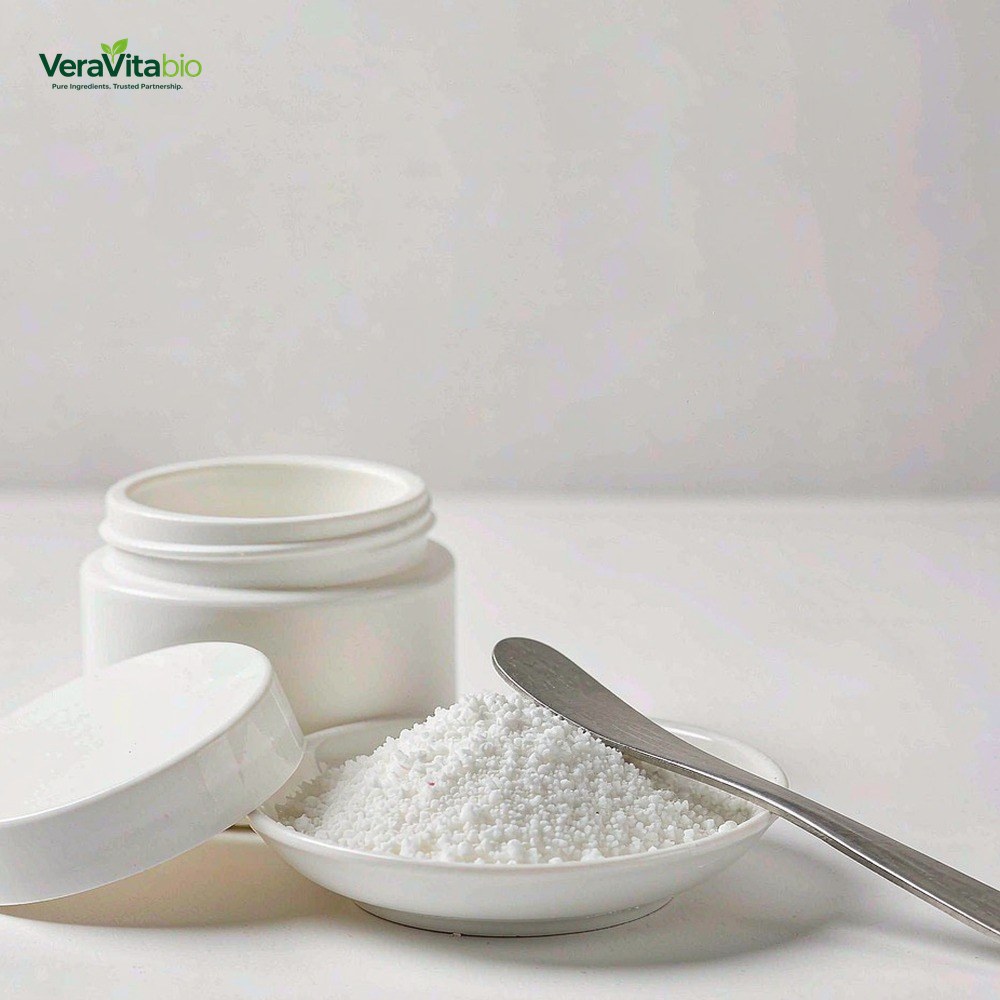
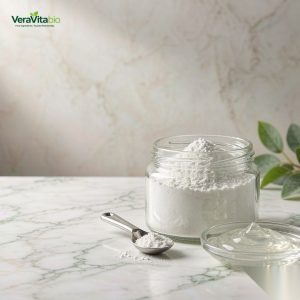
Tranexamic acid (TXA; INCI: Tranexamic Acid; Chinese inventory name 凝血酸; also known in trade as 传明酸 or by its drug name 氨甲环酸) is trans-4-(aminomethyl)cyclohexane-1-carboxylic acid, CAS 1197-18-8, EC (EINECS) 214-818-2, C8H15NO2, molecular weight 157.21. It is a synthetic lysine analogue and a zwitterionic amino-acid derivative: white or almost white crystalline powder, freely soluble in water, and practically insoluble in acetone and ethanol (96%).
Developed as an antifibrinolytic drug (trade names include Cyklokapron, Lysteda and — in Japan — Transamin), it entered dermatology through an incidental observation published by Sadako in 1979: patients taking TXA for chronic urticaria showed marked lightening of melasma. Forty-five years later it is one of the most widely used brightening actives in Asian skin care, listed across Japanese quasi-drug and Korean formulations, and supplied globally from Chinese capacity.
Its commercial value lies in acting upstream of tyrosinase. Almost every conventional brightener — arbutin, kojic acid, most vitamin C derivatives — tries to slow the enzyme that makes melanin. Tranexamic acid intervenes earlier: UV exposure raises plasmin activity in keratinocytes, and plasmin drives the arachidonic-acid / prostaglandin cascade that tells melanocytes to up-regulate tyrosinase. Block plasminogen activation and the signal itself never reaches the melanocyte.
VeraVita Bio supplies cosmetic-grade tranexamic acid, with the option of pharma-grade (Ph. Eur. / BP / JP / USP) material for customers who want the full pharmacopoeial impurity package. We quote the numbers that actually separate one supplier from another: the complete EP impurity profile, halides as chloride, heavy metals, and — critically — the method behind the purity figure.
Key Features
- Mechanism that survives alongside the actives you already use. TXA blocks the lysine binding sites on plasminogen, preventing conversion to plasmin, which down-regulates the activators of melanogenesis and reduces melanosome transfer through PAR-2. Because it neither inhibits tyrosinase nor relies on reducing power, it does not compete with your existing tyrosinase inhibitors or antioxidants — it complements them. Claims remain cosmetic (“appearance of dark spots”, “more even skin tone”), not therapeutic.
- The hardest comparability trap in this ingredient: the assay method. The Ph. Eur. assay is a potentiometric titration — dissolve 0.140 g in anhydrous acetic acid, titrate with 0.1 M perchloric acid, where 1 mL ≡ 15.72 mg C8H15NO2 — expressed on the dried basis, 99.0–101.0%. Yet most cosmetic COAs quote “HPLC ≥99%”. Underivatised tranexamic acid has very little UV absorbance above ~200 nm, so a low-wavelength HPLC method without pre-column derivatisation can quietly integrate baseline noise as product. Ask for the wavelength and whether derivatisation was used; then compare like with like.
- The EP impurity list is a route fingerprint. Ph. Eur. names six impurities, and each one points at the synthesis: Impurity B is the cis-isomer (CAS 1197-17-7) — the molecule that does not match the trans monograph; Impurity D is 4-(aminomethyl)benzoic acid, the aromatic starting material left behind when catalytic hydrogenation is incomplete; Impurity C is the cyclohexene analogue; A and E are dimers/amide condensation products; F is the N-formyl derivative. Limits: A ≤0.1%, B ≤0.2%, total impurities ≤0.2–0.5% depending on the monograph version. A COA quoting only “purity 99.5%” has told you nothing.
- Halides as chloride ≤140 ppm — the number nobody asks for and everybody should. The industrial route hydrogenates 4-(aminomethyl)benzoic acid to a cis/trans mixture, then isomerises and crystallises the trans isomer; chloride residue tracks how cleanly that sequence was finished. It is a mandatory Ph. Eur. line item and one of the fastest ways to tell a manufacturer with process control from a repacker.
- The CAS number itself is a specification. 1197-18-8 is the trans isomer — the cosmetic and pharmacopoeial substance. The stereo-unspecified cis/trans mixture carries CAS 701-54-2. If a quotation, SDS or customs declaration cites 701-54-2, the stereochemistry your product depends on has not been asserted.
- Stable where the classics are not. Kojic acid browns and loses potency; L-ascorbic acid oxidises and needs low pH and oxygen-free processing. Tranexamic acid is reported stable across roughly pH 4.5–7.5 and tolerates normal thermal processing without discolouration, which is why it is a routine choice for clear aqueous essences, toners, gels and emulsions where ascorbic acid would fail.
- Neutral-to-slightly-alkaline rather than acidic. A 5% aqueous solution reads pH 7.0–8.0 per Ph. Eur. — so it does not drag your formula acidic the way vitamin C does, but it does nudge weakly buffered systems upward. Measure pH after addition, not before.
- Non-photosensitising. Unlike AHAs, retinoids and — with formulation caveats — kojic acid, TXA carries no phototoxicity signal in the literature, so it is used morning and night. This removes a whole class of label warnings from the finished product.
- Safety margins are wide at cosmetic use levels, and the drug risk does not transfer. The well-known thromboembolic cautions attach to oral and intravenous tranexamic acid (a prescription antifibrinolytic) — not to a leave-on cosmetic applied to intact skin, where systemic uptake is minimal. Keep that statement honest in both directions: do not imply cosmetic TXA carries the drug’s risks, and never borrow the drug’s clinical efficacy for a cosmetic claim.
How It Works
1. The plasmin pathway. Ultraviolet exposure increases plasminogen activator in keratinocytes. Plasmin then liberates arachidonic acid from membrane phospholipids and drives prostaglandin E2 synthesis — the signal that tells neighbouring melanocytes to increase tyrosinase activity and melanin output. Tranexamic acid occupies the lysine binding sites on plasminogen, blocks its activation to plasmin, and thereby down-regulates the whole cascade before it starts. This is why it is described as acting upstream of tyrosinase rather than on the enzyme itself.
2. Downstream effects that matter for real skin. Beyond the pigment cascade, TXA is reported to reduce PAR-2-mediated melanosome transfer from melanocytes to keratinocytes, to dampen the inflammatory component that drives post-inflammatory hyperpigmentation, to reduce the vascular and angiogenic component visible in melasma lesions, and — through structural analogy to tyrosine — to interfere with tyrosinase directly as a secondary route.
3. What the clinical data actually showed. The frequently cited head-to-head is Janney et al., Journal of Cutaneous and Aesthetic Surgery 2019 (12:63): 100 patients with melasma randomised to topical 5% tranexamic acid solution versus 3% hydroquinone cream for 12 weeks. Mean MASI fell from 12.39 ± 3.34 to 9.47 ± 2.79 in the TXA arm and from 11.63 ± 3.72 to 9.24 ± 3.26 in the hydroquinone arm — 27.0% versus 26.7% reduction, a difference that was not statistically significant. Adverse effects separated the arms clearly: erythema in 10/50 (20%) and irritation in 9/50 (18%) with hydroquinone, versus no erythema and 3/50 (6%) irritation with TXA (P < 0.05), with correspondingly better patient satisfaction in the TXA group (P = 0.03). In short: comparable brightening, materially better tolerability.
4. The penetration problem, and the encapsulation answer. TXA is hydrophilic, and passive skin penetration is correspondingly modest. Two trials make the point about delivery design: Kondou et al. 2007 reported improvement in roughly 80% of patients using a 2% TXA emulsion, and Atefi et al., J Cosmet Dermatol 2015 ran a 12-week split-face comparison of 5% liposomal TXA versus 4% hydroquinone (23 completers): MASI fell significantly on both sides (P = 0.001), with a numerically larger decrease on the liposomal TXA side and irritation in three hydroquinone patients but no serious adverse events with TXA. If you are relying on a plain aqueous solution at 2%, a liposomal or penetration-enhanced system is the lever, not a higher percentage.
5. What it is not. Tranexamic acid is not a preservative, not a chelator, not an antioxidant and not a sunscreen. It contributes nothing to preservation or stability, and every product containing it still needs a validated preservative system confirmed by ISO 11930 challenge testing. It also does nothing to prevent new pigment formation without daily photoprotection — a claim you cannot make for it.
Typical Applications
- Brightening serums, essences and ampoules — the flagship format; 2–3% in a clear aqueous or lightly thickened system, often paired with niacinamide, alpha-arbutin or 3-O-ethyl ascorbic acid for multi-pathway coverage.
- Melasma-oriented leave-on creams and emulsions — typically 2–5%, where the tolerance profile over months of daily use matters more than speed.
- Post-inflammatory hyperpigmentation and post-acne mark treatments — arguably the strongest commercial fit, because the anti-inflammatory half of the mechanism targets PIH specifically, and because TXA suits skin that cannot tolerate acids or hydroquinone.
- Toners, masks and sheet masks — high water content suits TXA’s solubility profile; note that it is practically insoluble in ethanol, so high-alcohol formulations are not its natural home.
- Post-procedure care — after lasers, chemical peels and microneedling, where reactivity and rebound pigmentation dominate the brief; choose a preservative and vehicle appropriate to compromised skin.
- Scalp and body formats — an emerging and largely unrated outlet; there is far less published support than for facial leave-on use.
- Oral care — TXA is used as an anti-bleeding agent in toothpaste, a practice that drew wide public attention in China during the 2018 Yunnan Baiyao episode. Mainland China has not set a statutory limit for it in dentifrice; Hong Kong limits tranexamic acid to 0.05% in toothpaste, restricted to pharmacy sale. Since 2023-12-01, toothpaste in mainland China is regulated under the Measures for the Supervision and Administration of Toothpaste, and any efficacy claim requires evaluation.
- Pharmaceutical — the same molecule is an essential medicine in its own right (WHO Model List), dosed orally or intravenously for menorrhagia, surgical and trauma bleeding, and hereditary angioedema. Supplying this route requires drug-GMP documentation and a licensed pharmaceutical buyer; it is not a cosmetic trade.
Key Specifications
| Parameter | Specification |
|---|---|
| Product name | Tranexamic Acid, cosmetic grade (INCI: Tranexamic Acid; Chinese inventory name 凝血酸 / 传明酸; drug synonym 氨甲环酸) |
| Chemical name | trans-4-(aminomethyl)cyclohexane-1-carboxylic acid — the trans configuration is mandatory; the cis isomer is a controlled impurity, not an acceptable variant |
| Identity | CAS 1197-18-8 (trans isomer); EC/EINECS 214-818-2; cis/trans mixture CAS 701-54-2; C8H15NO2; MW 157.21; identification by IR conforming to tranexamic acid CRS |
| Grades | Cosmetic grade (IECIC-listed, full impurity set available); Pharma grade to Ph. Eur. / BP / JP / USP for customers requiring the pharmacopoeial monograph, with drug-GMP documentation |
| Appearance | White or almost white crystalline powder; practically odourless |
| Assay | 99.0–101.0% on the dried basis by potentiometric titration with 0.1 M perchloric acid in anhydrous acetic acid (Ph. Eur.; 1 mL ≡ 15.72 mg C8H15NO2). Where a COA reports an HPLC figure, request wavelength and derivatisation details |
| Related substances (Ph. Eur.) | Impurity A (trans,trans-dimer) ≤ 0.1%; Impurity B (cis-isomer, CAS 1197-17-7) ≤ 0.2%; Impurity C (cyclohexene analogue) ≤ 0.05%; Impurity D (4-(aminomethyl)benzoic acid — unhydrogenated aromatic precursor) ≤ 0.05%; Impurity E (amide dimer) ≤ 0.05%; Impurity F (N-formyl) ≤ 0.05%; unspecified each ≤ 0.05–0.10%; total ≤ 0.2–0.5% by monograph version |
| Halides as chloride | ≤ 140 ppm (Ph. Eur. 2.4.4) — the process-cleanliness marker most often missing from cosmetic COAs |
| Heavy metals | ≤ 10 mg/kg as Pb by Ph. Eur. 2.4.8; cosmetic buyers commonly request tighter element-specific results (Pb, As, Cd, Hg) aligned to ICH Q3D thinking — specify these up front |
| Loss on drying | ≤ 0.5% (105 °C) — report together with the assay, since assay is expressed on the dried basis |
| Sulphated ash | ≤ 0.1% |
| pH (5% aqueous solution) | 7.0–8.0 (Ph. Eur.) — neutral to mildly alkaline; not an acidifying active |
| Solubility | Freely soluble in water and in glacial acetic acid; practically insoluble in acetone and ethanol (96%) — the single most consequential solubility fact for formulation |
| Melting behaviour | Decomposes at about 300 °C; some commercial listings quote lower apparent values — use it as an identity indicator, not a purity measure, and confirm by IR |
| Particle size (optional) | Standard D90 ≤ 80 µm; micronised D90 ≤ 25 µm for faster dissolution and reduced risk of crystal speckle in film-forming systems |
| Microbiology (cosmetic grade) | Total viable count ≤ 100–500 CFU/g; yeasts and moulds ≤ 100 CFU/g; E. coli, Salmonella, S. aureus, P. aeruginosa absent (specify against your own internal standard) |
| Regulatory position — China | Listed in the Inventory of Existing Cosmetic Ingredients in China (2021 edition) under No. 04866, 凝血酸. Mainland China has no statutory maximum use level for it; industry formulations commonly anchor to the 3% reference ceiling used in Japan, Taiwan and ASEAN, justified through safety assessment rather than by regulation. Freckle-whitening / spot-fading claims make a product a special-use cosmetic requiring registration under the Cosmetics Supervision and Administration Regulations |
| Regulatory position — Asia-Pacific | Japan: approved by MHLW as a quasi-drug (医薬部外品) whitening active. Taiwan: announced 2005-03-24 as an effective whitening ingredient, limit 3% (listings also cite the 2–3% band), requiring contained-drug cosmetic registration. ASEAN Cosmetic Directive Annex III, entry A10: maximum 3% in skin products; not to be used in products intended to come into contact with mucous membranes |
| Regulatory position — EU / UK / US | EU: in CosIng (entry 80291) with the function skin conditioning; no entry in Annexes II–VI of Regulation (EC) 1223/2009, no SCCS opinion and no CIR assessment — safety must be established by the Responsible Person’s CPSR using published data. Claims must be cosmetic in character. US: not on FDA’s prohibited or restricted ingredient lists, but TXA is an approved prescription drug (oral and injectable) — a “treat melasma” claim risks classifying the product as an unapproved new drug; MoCRA facility registration and product listing apply |
| HS code | 2922.49 — China customs subheading 2922491100 (出口退税 13%, MFN import duty 6.5%, general 20%; import/export commodity inspection applies). EU/UK CN typically 2922 49 85. Some authorities scrutinise cosmetic-declared shipments against this API-adjacent heading — agree the classification with your broker before shipping |
| Shelf life | 24–36 months in the sealed original pack, cool, dry and protected from light; re-test assay, loss on drying and related substances on aged stock |
| Packaging | 1 kg aluminium foil bags; 25 kg fibre drum with double PE liner and desiccant; 500 g evaluation sample with lot COA |
| Documentation | Lot COA with full impurity set; SDS; non-animal-testing statement; TSE/BSE statement; allergen and GMO declarations; ISO 9001 / EFfCI-GMP or ISO 22716 manufacturing; HALAL and KOSHER on request |
Formulation & Handling Notes
- Put it in the water phase, and plan around the fact that it is not soluble in ethanol. Dissolve TXA in the aqueous phase at room temperature up to about 50–60 °C; it dissolves readily and is thermally robust, so heat is not required and time–temperature abuse is not the enemy it is for ascorbic acid. High-alcohol toners are the wrong vehicle for it.
- Re-read pH after addition. A TXA solution sits at pH 7.0–8.0. In a weakly buffered system it will lift the final pH slightly, which can matter for polyacrylate thickening and for acid-dependent partners. Add, then adjust, then re-measure on the finished batch.
- Crystallisation is the most common field complaint, and it is a formula problem. Because TXA is highly water-soluble and practically insoluble in ethanol, a leave-on product that dries down on skin can leave a whitish crystalline film — “speckle” or grittiness — especially at or above 3%. Mitigations: hold use level at 2–3%, add humectants (glycerin, betaine, propanediol, butylene glycol) to slow evaporation, add a film-former, and specify micronised material.
- Check your rheology: TXA is a zwitterion, and zwitterions behave like electrolyte. Added ionic strength can thin carbomer and acrylate-based thickeners. If you lose viscosity on trial batches, move to electrolyte-tolerant rheology (hydroxyethylcellulose, xanthan gum, ammonium acryloyldimethyltaurate-based polymers) or compensate — do not assume the thickener failed for other reasons.
- Build a multi-pathway system rather than pushing one number up. Runs combining TXA with niacinamide, alpha-arbutin, 3-O-ethyl ascorbic acid or bakuchiol cover plasmin, transfer and tyrosinase simultaneously; this is standard Korean practice. Raising TXA above roughly 3–5% is not supported by better published outcomes and increases the crystallisation and tolerance risks.
- Think about penetration before you think about percentage. The most convincing comparative trials used either an emulsion or a liposomal system at 2–5%, not a bare aqueous solution. If your benchmark is a marketed 5% liposomal product, a simple solution at the same label number will not perform like it.
- Preservation: TXA is not one. It has no relevant antimicrobial activity. Use a normal broad-spectrum system appropriate to your pH and water activity, verify with ISO 11930, and check compatibility on a case-by-case basis — as a primary amine it is a poor conceptual match with aldehyde-releasing preservatives, which is a reason to prefer a phenoxyethanol-based system and to confirm by challenge test rather than by assumption.
- Claims discipline. In the EU, keep copy in appearance territory (“reduces the appearance of dark spots”, “evens skin tone”). In the US, avoid all therapeutic framing — TXA is a prescription drug for other routes, and a treatment claim invites drug classification. In Japan and Taiwan, quasi-drug / contained-drug registration governs what may be said.
- Where not to use it. Not for products intended to contact mucous membranes under the ASEAN listing; not for anyone expecting an immediate result within two weeks — study durations are 8–12 weeks; and not as a substitute for daily photoprotection, without which any brightening programme fails.
Storage & Handling
Keep the original packaging sealed, below 25 °C, dry and away from light. With a loss-on-drying limit of 0.5%, TXA is far less hygroscopic than many botanical powders, but a part-used drum standing open in a humid warehouse will still pick up moisture and cake; reseal immediately and protect the liner. Several commercial SDS list H315 (skin irritation), H319 (serious eye irritation) and H335 (may cause respiratory irritation) — treat the powder accordingly: local extraction at weighing stations, gloves, eye protection and a dust mask or respirator as your site rules require, and avoid generating dust during transfer. Use FIFO rotation and re-test assay, loss on drying and related substances on any stock past roughly two-thirds of its shelf life.
Why Choose VeraVita Bio
- We quote cosmetically relevant impurity data, not just a purity headline. Every offer carries the full related-substances set — including the cis-isomer (Impurity B) and the aromatic precursor 4-(aminomethyl)benzoic acid (Impurity D) — plus halides as chloride ≤ 140 ppm and heavy metals, because those are the lines that distinguish a controlled process from a repack.
- Straight answer on the purity number. We tell you which method produced it — Ph. Eur. perchloric-acid titration on the dried basis, or HPLC — and under which conditions. If your QA compares our COA against a supplier quoting “HPLC 99.8%” at 210 nm without derivatisation, you should know that the two numbers are not the same measurement.
- Trans-specific identity, CAS 1197-18-8, every lot. No ambiguity with the cis/trans mixture registry number, and IR identification against the CRS.
- Cosmetic and pharma grades from one source. Whether you need IECIC-compliant cosmetic material or monograph-grade with the full drug-GMP documentation trail, we supply from the same qualified manufacturing route and will say plainly which one you are buying.
- Regulatory support for your destination market. We flag China’s special-use registration trigger for spot-fading claims, the Taiwan 3% ceiling, the ASEAN mucosa restriction and the EU/US claim boundaries at quotation stage — so the dossier, not just the drum, is right.
- Complete brightening systems on one purchase order. Quote tranexamic acid together with our alpha-arbutin, ferulic acid and plant-derived squalane — three complementary mechanisms from one COA pack and one shipment, with a single point of accountability.
- Sample to container. 500 g evaluation packs with the current lot COA, 25 kg drums for production, and annual-programme pricing for container volumes.
Request a Quote
Send us five things and we will quote precisely rather than generically: (1) the grade — cosmetic or pharmacopoeial, and which monograph; (2) the destination market, so the documentation, impurity limits and claim boundaries match the rules in force; (3) the product format and use level — serum, emulsion, toner or dentifrice — which determines whether we quote standard or micronised particle size; (4) the partner actives already in the formula, so we can flag pH, rheology and crystallisation interactions before your first trial batch; and (5) the pack size and annual volume. We reply with pricing, the current lot COA and a sample lead time.
Email: info@veravitabio.com | WhatsApp: +86 157 7194 0528
VeraVita Bio — Xi’an VeraVita Biotech Co., Ltd. | Botanical & Functional Ingredient Sourcing Partner
Email: info@veravitabio.com | WhatsApp: +86 157 7194 0528 | veravitabio.com
Disclaimer: The information provided is for general technical and commercial reference only and does not constitute regulatory, legal, medical, pharmaceutical or formulation advice. Tranexamic acid is an approved medicinal product when administered orally or by injection; those uses are prescription-only and are outside the scope of cosmetic supply. Import duties, tariff classification, HS codes, regulatory status, inventory listings, maximum use levels and permitted claims vary by market and change over time; they must be verified against the requirements in force in the destination market before any product is labelled, marketed or shipped. Safety beyond published cosmetic literature has not been assessed by SCCS or CIR, and the Responsible Person must establish cosmetic product safety under Regulation (EC) 1223/2009 in the EU, or the equivalent in other jurisdictions. Specifications are subject to batch confirmation from the lot COA. Tranexamic acid is a raw material supplied to qualified business customers, not a finished consumer product and not a prescription product. Responsibility for finished-product safety, stability, efficacy, labelling, claims, registrations and regulatory compliance in the destination market remains with the manufacturer.
Need pricing, a sample or full documentation?
Send your specification, target volume and destination country — our team replies within one business day.
Reviews
There are no reviews yet.