Product Overview
Ferulic acid (4-hydroxy-3-methoxycinnamic acid, C10H10O4, MW 194.18; trans-isomer CAS 1135-24-6) is a hydroxycinnamic acid that occurs ubiquitously in the plant kingdom as a structural cross-link of plant cell walls, where it esterifies arabinoxylans and other hemicelluloses. Its richest commercial sources are rice bran, wheat bran and corn, and it is also a marker constituent of Angelica sinensis (dang gui). The name literally comes from Ferula (asafoetida). Chemically it is the antioxidant that the plant uses to hold its own cell walls together — and that is a fair summary of what it does in a formula: it holds other, more fragile antioxidants together.
Worldwide consumer awareness of ferulic acid is almost entirely built on one formulation: the antioxidant serum combining 15% L-ascorbic acid + 1% α-tocopherol + 0.5% ferulic acid, established by Lin et al. in the Journal of Investigative Dermatology (2005). That single paper created a permanent, defensible market position for the ingredient, and cosmetic-grade ferulic acid has since become a stock item for every serious antioxidant, brightening and photoprotection formula. China is the dominant global producer, with ferulic acid manufactured both by extraction from rice bran (a by-product of rice bran oil processing) and by chemical synthesis from vanillin and malonic acid (Doebner condensation).
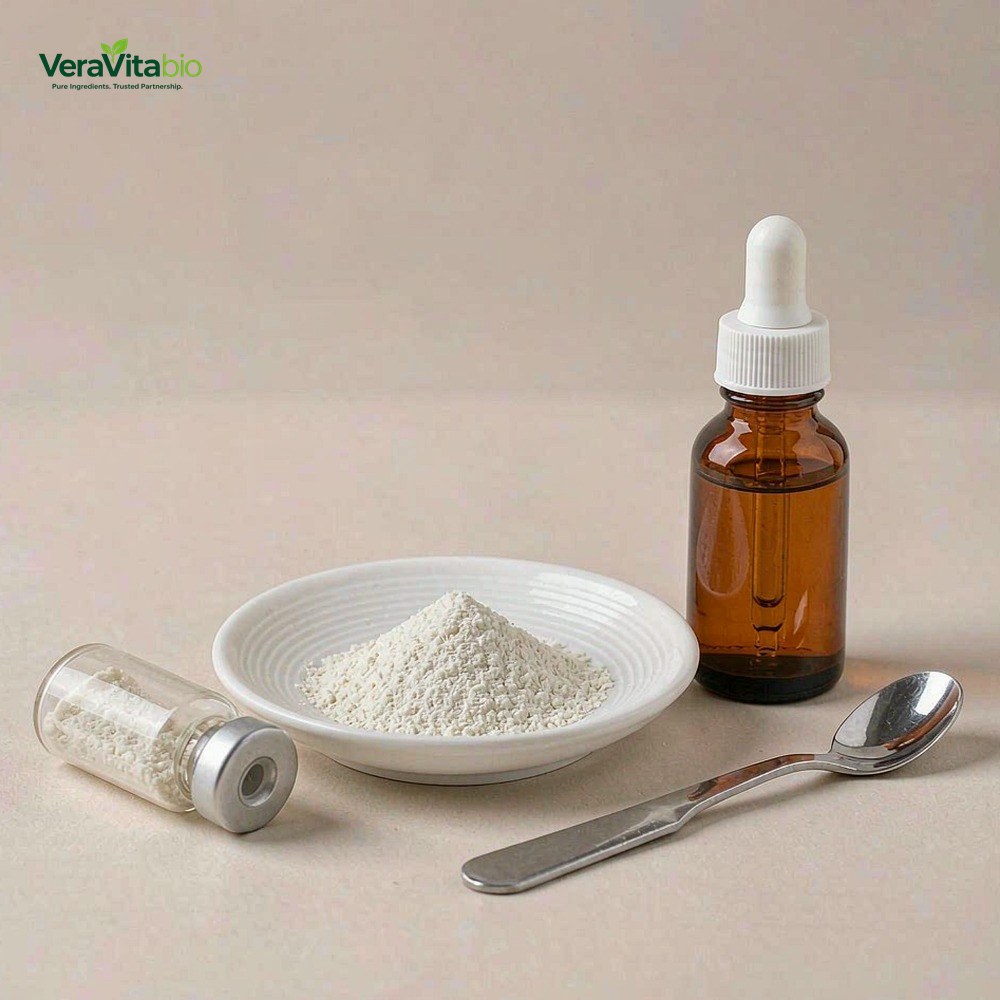
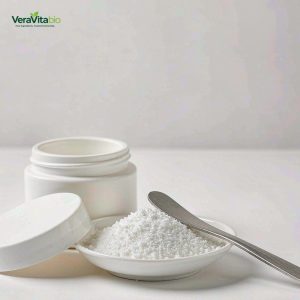
VeraVitabio supplies cosmetic-grade trans-ferulic acid at ≥ 98% and ≥ 99% HPLC assay as a white to very slightly off-white crystalline powder, packed in opaque foil-lined fibre drums with a per-lot COA that states assay, colour, trans-isomer purity, heavy metals and microbiology — the four parameters that decide whether a ferulic acid lot survives your serum, your warehouse and your brand.
Key Features
- The C+E+Ferulic synergy is the commercial anchor. In the landmark human study, adding 0.5% ferulic acid to 15% L-ascorbic acid + 1% α-tocopherol doubled the photoprotective effect of the vitamin solution against UV-induced erythema and sunburn-cell formation, and stabilised vitamins C and E against oxidation in the bottle. Any antioxidant-serum project that quotes “CE Ferulic” is sourcing this exact trio.
- Sunscreen booster with clinical numbers. Ferulic acid absorbs UV in the 290–320 nm band (trans-isomer maxima at approx. 284 and 307 nm) and, in an in vivo study with ethylhexyl triazone and bis-ethylhexyloxyphenol methoxyphenyl triazine, raised SPF by 37% and UVA-PF by 26% at low concentration — a photoprotection claim that does not require reformulating the filter system.
- Sacrificial antioxidant and regeneration partner. Its phenolic hydroxyl donates electrons preferentially, quenching radicals before they reach vitamin C; vitamin E in turn regenerates oxidised ferulic acid, and vitamin C regenerates oxidised vitamin E — a self-reinforcing antioxidant cycle that extends the shelf life of the whole system.
- Independent antioxidant and soothing activity. Ferulic acid is not merely a stabiliser: it directly scavenges superoxide, hydroxyl and peroxyl radicals, chelates transition metals, inhibits lipid peroxidation and shows mild anti-inflammatory activity in UV-stressed skin models — relevant to photoaging, post-inflammatory hyperpigmentation and anti-pollution positioning.
- Trans-isomer purity declared. Only the (E)-trans isomer carries the activity described in the literature; the (Z)-cis form is a degradation product with substantially reduced antioxidant activity. Our COA specifies a method that separates trans from cis, not just a pooled “ferulic acid” assay.
- Source route disclosed. Rice-bran-extracted material (natural, predominantly trans, supports “plant-derived” claims) or synthetic material (vanillin + malonic acid, Doebner condensation) — declared per lot, because the route affects isomer profile, price and the marketing story you can defend.
- Water-activity-light stability engineered into the pack. Opaque foil-lined drum, nitrogen-flush option, desiccant for humid routes, and a specification written for white to very slightly off-white powder — not the “white to yellow” spec some suppliers use to pass degraded stock.
- Clean regulatory position. Listed in the EU CosIng database with no restriction and not listed in Annexes II–V of the EU Cosmetics Regulation; no SCCS restriction; used at 0.5–1.0% (up to about 2% for targeted formulas) with a long history of safe topical use and a food-component heritage. Listed in China’s IECIC (inventory of used cosmetic ingredients).
- Not a photosensitiser. Unlike retinoids or some AHAs, ferulic acid is designed for morning use alongside sunscreen; there is no phototoxicity concern at cosmetic use levels.
- Full documentation pack. Per-lot COA (assay HPLC, trans-isomer, colour, melting range, water, heavy metals by element, microbiology), SDS in the destination language, allergen, vegan, non-GMO and HALAL/KOSHER statements on request.
How It Works
1. A structurally optimised radical scavenger. Ferulic acid’s antioxidant power comes from four structural features working together: the phenolic hydroxyl that donates an electron to neutralise reactive oxygen species; the 3-methoxy group, which stabilises the resulting phenoxy radical by hydrogen bonding and resonance; the conjugated vinyl side chain, which delocalises the unpaired electron and anchors the carboxylic acid; and the carboxyl group, which contributes protection against lipid peroxidation. The result is a phenoxy radical stable enough that the donation is a sacrifice the molecule survives — which is exactly what “sacrificial antioxidant” means.
2. The C+E+Ferulic regeneration cycle. In the classic trio, ferulic acid absorbs incoming oxidative stress first, extending the lifetime of both vitamins. Vitamin E handles the lipid phase and regenerates oxidised ferulic acid; vitamin C handles the water phase and regenerates oxidised vitamin E. Each partner spends more time in its active form than it would alone, and the formula stays colourless for measurably longer — which is also the number-one consumer-visible quality marker of a premium vitamin C serum.
3. UV absorption and photoprotection. The conjugated cinnamic acid chromophore absorbs in the UVB/UVA-II region (trans maxima approx. 284 and 307 nm). In sunscreen systems this adds real, measurable protection — the +37% SPF / +26% UVA-PF in vivo result — while the antioxidant layer suppresses the free-radical cascade that filters alone cannot fully stop. It also reduces the UV-induced inflammatory response (erythema, sunburn cells) in human and ex vivo studies.
4. Stability of the molecule itself — and why it needs help. The same conjugated phenolic structure that makes ferulic acid a good antioxidant makes it sensitive to light (photoisomerisation from trans to the less-active cis form), oxygen, heat and trace metals. Above about pH 6 and elevated temperature it decarboxylates to 4-vinylguaiacol and forms coloured dimeric oxidation products. None of this is a defect — it is formulation physics, and it is the reason serious brands specify ferulic acid grade, packaging and pH window together. See Formulation Notes.
5. Brightening and anti-glycation signals. Ferulic acid shows tyrosinase inhibition and melanogenesis modulation in vitro, and inhibits protein glycation; in human work the pigmentation endpoints are almost always delivered by combination formulas (ferulic + vitamin C, plus or minus other brighteners), so it is best positioned as a synergist in a brightening stack rather than a stand-alone skin-whitening agent.
Typical Applications
- Antioxidant day serums (C+E+Ferulic systems) — the flagship application: 0.5% ferulic acid with 10–20% L-ascorbic acid (or stable derivatives such as 3-O-ethyl ascorbic acid / AA2G) and tocopherol, at pH 3.0–3.5, in opaque airless or amber glass packaging.
- Sunscreens and day creams — 0.1–0.5% as a UV-filter synergist and antioxidant booster, documented to raise SPF and UVA-PF and to delay erythema development.
- Brightening / anti-spot products — stacked with niacinamide, tranexamic acid and alpha-arbutin (all compatible; no interaction), typically 0.5–1.0%.
- Anti-pollution and city-proof positioning — ferulic acid is a stock antioxidant in urban-defense formulas, where it counters particulate-matter-induced oxidative stress.
- Anti-aging and night repair creams — 0.5–1.0% for collagen protection and MMP modulation claims supported by in vitro data.
- Eye care — low-dose antioxidant support in eye serums and creams, well tolerated at 0.2–0.5%.
- Hair and scalp care — antioxidant protection for colour-treated hair and scalp-serum formulations where an oil-soluble-compatible phenolic is useful.
- Food and nutrition (separate grade) — natural antioxidant for oils, fats and functional foods, and a precursor for vanillin; supplied under food documentation on request.
Key Specifications
| Parameter | Specification |
|---|---|
| Chemical name | (E)-3-(4-hydroxy-3-methoxyphenyl)prop-2-enoic acid (trans-ferulic acid; 4-hydroxy-3-methoxycinnamic acid) |
| CAS number | 1135-24-6 (trans-ferulic acid) |
| INCI name | Ferulic Acid |
| Molecular formula / weight | C10H10O4 / 194.18 g/mol |
| Appearance | White to very slightly off-white crystalline powder (colour is a quality gate — see Formulation Notes) |
| Assay (HPLC) | ≥ 98.0% (cosmetic grade); ≥ 99.0% (premium grade); trans-isomer purity stated per lot |
| Melting range | 168–174 °C (literature 170–174 °C for the trans isomer) |
| pH (1% suspension) | Approx. 3.5–4.5 |
| Solubility | Slightly soluble in water (<1 g/L at room temperature); soluble in ethanol, propylene glycol, propanediol, butylene glycol, DMSO, ethyl acetate; soluble in hot water; effectively oil-insoluble |
| Recommended use level | 0.5–1.0% in leave-on skin care; up to approx. 2% for targeted formulas; 0.1–0.5% in sunscreens |
| Optimal formulation pH | 3.0–5.5 (sweet spot 3.5–4.5 for vitamin C systems); formulate below pH 6.0 always |
| Loss on drying | ≤ 0.5% |
| Sulfated ash | ≤ 0.1–0.5% (grade-dependent) |
| Heavy metals | ≤ 10 ppm as Pb; Pb ≤ 2 ppm; As ≤ 1 ppm; Cd ≤ 1 ppm; Hg ≤ 0.1–1 ppm |
| Particle size | 98% through 80 mesh (typical); finer grades on request |
| Microbiology | TAMC ≤ 1,000 cfu/g; TYMC ≤ 50–100 cfu/g; E. coli absent; Salmonella absent |
| Stability guidance | Light-sensitive (trans→cis photoisomerisation); oxygen- and heat-sensitive; stable as dry powder ≥ 24 months correctly packed; formulated solutions require opaque/airless packaging and <25 °C |
| Regulatory position | EU: CosIng listed, no restriction, not in Annexes II–V; no SCCS limit. US: used at 0.5–1.0% with industry maximum use levels around 1.5% in finished products; no dedicated stand-alone CIR monograph. China: IECIC listed |
| HS code | 2918.29 (carboxylic acids with additional oxygen function — hydroxycinnamic acid and its salts; US HTS 2918.29.20, general duty 6.5%) |
| Shelf life | 24 months (36 months achievable) unopened in the original opaque, sealed packaging |
| Packaging | 1–5 kg aluminium foil bags (evaluation), 25 kg fibre drum with double PE / foil liner; nitrogen-flush and desiccant options; opaque containers mandatory |
| Certifications | ISO 9001 / GMP manufacturing; HALAL and KOSHER on request; vegan, allergen and non-GMO declarations |
Formulation Notes
- An assay of ≥98% is not evidence of trans content — the single most important sourcing point. Total HPLC assay pools all isomers; only a method that separates trans from cis (or an explicit trans-isomer purity declaration) confirms the active form. UV exposure and heat drive trans→cis conversion during storage and shipping, so degraded stock can still show a “passing” COA. Specify trans-isomer purity on the PO, and treat a supplier who cannot measure it as a trader, not a manufacturer.
- Colour is the fastest incoming-QC gate. Fresh cosmetic-grade material is white to very slightly off-white. Pale cream is acceptable but declining. Any visible yellow warrants HPLC reanalysis before use. Orange or brown material is oxidised beyond cosmetic-grade use — reject it. A COA that reads “white to yellow powder” is written to accommodate degraded stock; the spec threshold has been set below your quality bar.
- Never dump ferulic acid into water. At <1 g/L solubility, powder added directly to an aqueous phase floats and recrystallises. Pre-dissolve in propanediol, butylene glycol or ethoxydiglycol (5–10× by weight) at 35–50 °C with stirring until a clear solution forms (typically 5–10 minutes), then add to the cool-down phase at <40 °C, before vitamin C where a CEF system is being built.
- Respect the pH window. Work between pH 3.0 and 5.5 (sweet spot 3.5–4.5, and approx. 3.2–3.5 for classic CEF serums matching L-ascorbic acid’s stability range). Above pH 6.0 and elevated temperature, decarboxylation produces 4-vinylguaiacol plus coloured dimers — the orange-brown discolouration that no amount of “natural colour variation” language will excuse to a consumer. Verify pH with a calibrated meter, before and after addition; litmus strips are not precise enough for this formula.
- Trace iron turns ferulic acid black overnight. Phenolic antioxidants are metal-catalysed oxidisers’ favourite substrate. Include 0.1% disodium EDTA in the water phase, run on deionised water, and check that plant pipework is not shedding iron. This single measure removes the majority of “our ferulic serum went dark” field complaints.
- Package like a vitamin C serum, because it degrades for the same reasons. Opaque airless pumps or amber glass; minimise headspace; store finished goods below 25 °C. Bulk powder: opaque foil-lined drum, desiccant for humid shipping routes, nitrogen-flush available, RH <65–70% in the warehouse, opened bags resealed immediately.
- Known incompatibilities. Strong oxidisers (benzoyl peroxide, hydrogen peroxide) destroy its activity — do not co-formulate. Alkaline systems (>pH 6.5) are out of window. Standard brightening stacks (niacinamide, tranexamic acid, alpha-arbutin) and barrier lipids (ceramides, squalane, panthenol) are compatible; ferulic acid pairs directly with our vitamin C derivatives and tocopherol grades.
- Dose discipline. 0.5–1.0% is the validated range for leave-on; going to 2% adds cost without demonstrated benefit and is above typical industry maximum use levels (approx. 1.5% in finished products). In CEF serums the classic ratio is 0.5% ferulic / 1% tocopherol / 15% L-ascorbic acid — deviate only with stability data.
- Natural vs synthetic is a procurement decision, not a marketing nuance. Rice-bran-extracted material (from rice bran oil processing by-products) is predominantly trans, supports plant-derived and natural positioning, and carries a price premium; synthetic material (vanillin + malonic acid, Doebner condensation) can yield mixed isomers depending on process. If you claim “naturally derived” on the label, buy extracted material and keep the route declaration per lot — the claim must survive your customer’s own audit.
- Sunscreen synergy is real and quantified. In the in vivo study combining ferulic acid with ethylhexyl triazone and bis-ethylhexyloxyphenol methoxyphenyl triazine, SPF rose 37% and UVA-PF 26% with good skin biocompatibility — a meaningful claim for a “multifunctional photoprotection” platform without adding filters. Confirm the effect in your own filter system before making comparative claims.
- Storage of the raw material. <25 °C, dry, dark; RH above about 70% causes moisture uptake, agglomeration and accelerated oxidation even through “sealed” woven bags — which is why we pack in foil-lined drums with desiccant for humid destinations. Dry powder tolerates brief excursions to 40 °C; formulated solutions do not (keep <30 °C).
- Regulatory reminders. EU: listed in CosIng with no restriction and absent from Annexes II–V; no SCCS restriction — but your finished-product safety assessment (CPSR) still needs to cover it at your use level. US: no dedicated stand-alone CIR monograph; safety positioning rests on long use history and food-component status, so keep your literature file current. China: IECIC listed. Claims discipline: photoprotection and brightening endpoints in humans come almost entirely from combination formulas; position ferulic acid as the stabiliser and synergist, and avoid stand-alone drug-like claims.
Storage & Handling
Store in the original opaque, sealed packaging in a cool (<25 °C), dry (RH <65%), dark warehouse, away from direct sunlight, UV sources, strong oxidisers and alkaline materials. Protect from light at every stage — transparent bags and open drums are the two fastest routes to trans→cis isomerisation and yellowing. Reseal opened containers immediately; never leave material open during weighing. Handle with gloves, goggles and dust mask; avoid dust inhalation. Use FIFO stock rotation, and keep a retained sample from each lot for colour comparison at goods-in. For formulated products, the same rules apply downstream: opaque or airless packaging, cool filling, minimal headspace and EDTA in the water phase.
Why Choose VeraVitabio
- Trans-isomer transparency. We state trans-isomer purity per lot and use a method that separates the isomers — the specification most quotations quietly omit, and the one that decides whether your serum works.
- Colour specification that protects your brand. White to very slightly off-white, colour-checked and photographed per lot; orange stock never ships.
- Route disclosure. Rice-bran-extracted or synthetic declared per lot, with the documentation to support natural-derivative claims where you make them.
- Formulation support, not just powder. Pre-dissolution protocols (propanediol 5–10×, cool-down <40 °C), pH window and EDTA guidance, CEF ratio benchmarks, and compatibility notes for your brightening stack.
- Packaging engineered for the molecule. Opaque foil-lined drums, desiccant for humid routes, nitrogen-flush option, 1–5 kg evaluation bags through 25 kg production drums.
- Stack-friendly portfolio. Quote ferulic acid together with our vitamin C derivatives, tocopherol, niacinamide, tranexamic acid, alpha-arbutin, squalane and ergothioneine — the complete antioxidant and brightening shelf from one supplier.
- Documentation pack per lot. COA (assay, trans-isomer, colour, melting range, heavy metals by element, microbiology), SDS in the destination language, allergen, vegan, non-GMO and HALAL/KOSHER statements on request.
- From sample to container. 1 kg evaluation packs for lab validation, 25 kg drums for production, container-load pricing for annual programmes.
Request a Quote
Send us four things and we will quote precisely rather than generically: (1) the grade — ≥98% cosmetic or ≥99% premium, extracted (rice bran) or synthetic; (2) the application — CEF serum, sunscreen or brightening system, since it changes our packaging and documentation recommendations; (3) the pack size; and (4) the destination market and volume. We reply with pricing, the current lot’s COA including trans-isomer purity and colour, a sample lead time, and our pre-dissolution and stability notes — so your lab can verify solubility, pH behaviour and colour retention before committing to tonnage.
Email: info@veravitabio.com | WhatsApp: +86 157 7194 0528
VeraVita Bio — Xi’an VeraVita Biotech Co., Ltd. | Botanical & Functional Ingredient Sourcing Partner
Email: info@veravitabio.com | WhatsApp: +86 157 7194 0528 | veravitabio.com
Disclaimer: The information provided is for general technical and commercial reference only and does not constitute regulatory, legal or formulation advice. Regulatory status, use levels and maximum concentrations vary by market and change over time; they must be verified against the requirements in force in the destination market before labelling or claims are finalised. Specifications are subject to batch confirmation from the lot COA. Ferulic acid is a raw material supplied to qualified business customers, not a finished consumer product. Responsibility for finished-product safety, stability, labelling, claims and regulatory compliance in the destination market remains with the manufacturer.
Need pricing, a sample or full documentation?
Send your specification, target volume and destination country — our team replies within one business day.
Reviews
There are no reviews yet.