
Product Overview
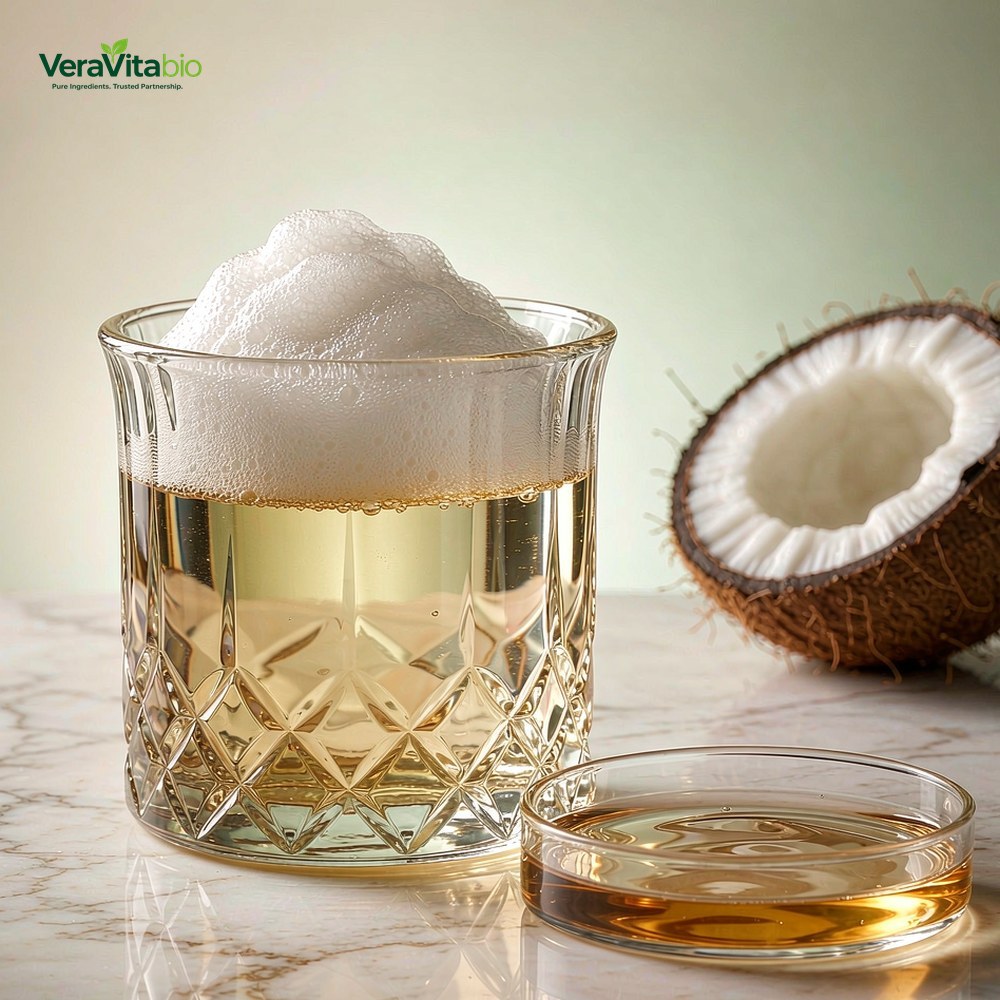
Cocamidopropyl Betaine (CAPB) is a fatty-acid amidopropyl betaine derived from coconut oil — the single most widely used secondary surfactant in personal care. Supplied as a 30% active aqueous solution, it is a zwitterionic (amphoteric) surfactant: the molecule carries both a quaternary ammonium cation and a carboxylate anion, so its charge behaviour changes with pH. That dual character is exactly why it is dosed into almost every shampoo, body wash, shower gel, hand soap and foaming cleanser on the shelf — it boosts foam, builds viscosity with a pinch of salt, and measurably softens the irritation profile of the anionic surfactants it sits next to.
Key Features
- Cosmetic-grade CAPB at 30% active — clear to slightly hazy, pale-yellow viscous liquid
- Primary role in formulation: secondary surfactant, foam booster and foam stabiliser alongside SLES, SLES-free glucosides or soap bases
- Strong mildness-enhancer — the recognised workhorse for reducing the irritation potential of sulphate systems
- Salt-thickenable — viscosity responds predictably to NaCl addition, which keeps thickeners and gums out of the cost sheet
- Compatible with anionic, non-ionic and cationic surfactants, and with the usual amphoteric / amino-acid surfactant blends
- Stable in the pH 4.5–9 window; hard-water tolerant and readily biodegradable
- Available in standard grade or low-amidoamine / low-colour grade for premium and baby-care lines
How It Works
- Mixed-micelle formation: CAPB inserts between anionic surfactant molecules to form mixed micelles. This lowers the critical micelle concentration and slows the penetration of anionic monomers into the stratum corneum — the mechanism behind the well-documented drop in eye and skin sting when SLES is partly replaced by CAPB.
- Foam boosting and stabilisation: the amphoteric head group adds surface activity without competing with the anionic phase, giving higher foam volume and a longer-lived, creamier lather.
- Viscosity building: the betaine’s salt sensitivity allows rod-like micelle growth on addition of NaCl or ammonium chloride, so target viscosities are reached without carbomer or gums.
- Conditioning and antistatic effect: below its isoelectric region the molecule behaves more cationically, giving a light conditioning and slip benefit and helping cut the squeaky, over-stripped after-feel of high-anionics formulas.
- Hard-water tolerance: CAPB is not calcium-sensitive in the way soaps and some anionic surfactants are, which keeps lather performance consistent in hard-water markets.
Typical Applications
- Hair care: shampoos, anti-dandruff shampoos, 2-in-1 and sulphate-free cleansers, baby shampoo, scalp tonics with foaming action
- Body & bath: body wash, shower gel, liquid hand soap, foam hand wash, bubble bath, syndet bars, bath salts with surfactant
- Facial cleansing: foaming cleansers, gel and mousse cleansers, micellar gels, makeup-remover foams
- Oral & personal hygiene: toothpaste and mouthwash surfactant systems, intimate wash, wet wipes and cleansing lotions
- Household & other: dish liquids, car-wash foam, pet and horse shampoo, textile wash-off formulations
- OEM / ODM: full-formula development and private label for shampoo, body wash and cleanser lines
Key Specifications
| INCI Name | Cocamidopropyl Betaine |
|---|---|
| Trade Name | CAPB / CAPB 30% |
| CAS Number | 61789-40-0 |
| EINECS / EC | 263-058-8 |
| Chemical Type | Amphoteric (zwitterionic) surfactant, coconut-oil derived |
| Active Matter | 30% (28–32% typical range) |
| Appearance | Clear to slightly hazy, pale-yellow to light-amber viscous liquid |
| Odour | Slight characteristic, free of ammonia / amine off-notes |
| pH (10% aqueous) | 4.5–6.5 |
| Sodium Chloride | ≤ 6% (typically 4.5–5.5%) |
| Free Amidoamine | ≤ 0.5% (low-amidoamine grade available, ≤ 100 ppm on request) |
| Solids | 30–32% |
| Colour | ≤ 150 Klett, or Gardner ≤ 3 |
| Typical Use Level | 4–20% as supplied (8–15% most common in shampoo and body wash) |
| Shelf Life | 24 months in unopened original packaging |
| Packaging | 200 kg drums / 1,000 kg IBC / ISO tank (available on request) |
| MOQ | Available on request |
Formulation Notes
- Cold-processable — add directly to the water phase at room temperature with moderate agitation; no heating required.
- For SLES-based systems, a typical starting ratio is 8–12% SLES active with 3–5% CAPB active; adjust for the target foam profile and mildness claim.
- Thicken with sodium chloride in 0.5–2.0% increments, measuring the viscosity plateau — over-salting causes the curve to fall back and the formula to thin.
- For sulphate-free concepts, pair CAPB with glucosides (Coco-Glucoside / Decyl Glucoside) or amino-acid surfactants (Sodium Cocoyl Glycinate, SCI) to restore foam body and viscosity response.
- Add pH-sensitive actives and preservatives before final CAPB/pH adjustment; CAPB itself buffers gently in the mildly acidic range preferred for skin and hair.
- Low-colour / low-amidoamine grades are recommended for clear gels, white emulsions, baby products and any formula with a mildness or low-odour claim.
Storage & Handling
Store in the original, tightly closed container in a cool, dry, well-ventilated place, protected from direct sunlight and freezing. Recommended storage temperature is 5–35 °C; do not allow the material to freeze. Reseal partially used drums promptly. Handle with standard personal protective equipment — gloves and eye protection — and avoid prolonged skin contact with the concentrate, which is a known contact-allergen sensitiser in some individuals.
Why Choose VeraVitabio
- Bulk B2B supply of surfactants, actives and functional ingredients — from sample quantities to full container loads
- Full documentation — COA, MSDS, TDS and specification sheets available on request
- OEM / ODM support — shampoo, body wash, cleanser and private-label finished product development
- Export experience to the US, EU, Middle East and Southeast Asia, with documentation support for importers and brand owners
- Stable supply chain — vetted manufacturing partners with batch-level traceability and pre-shipment verification
Request a Quote — Sourcing Cocamidopropyl Betaine (CAPB 30%) for a shampoo, body wash or cleanser line? Send your specification, required grade and target volume to info@veravitabio.com or WhatsApp +86 157 7194 0528. Samples and full documentation are available for qualified B2B buyers. Web: veravitabio.com
Need pricing, a sample or full documentation?
Send your specification, target volume and destination country — our team replies within one business day.
For cosmetic and personal care formulation use. This product is not intended to diagnose, treat, cure, or prevent any disease. Specifications shown are for general reference; full Certificate of Analysis and supporting documentation are available upon request. Formulators are responsible for confirming permitted use levels and claim language in their target markets. Cocamidopropyl betaine is classified as a skin sensitiser; observe the use restrictions applicable in your market.
Reviews
There are no reviews yet.