Product Overview
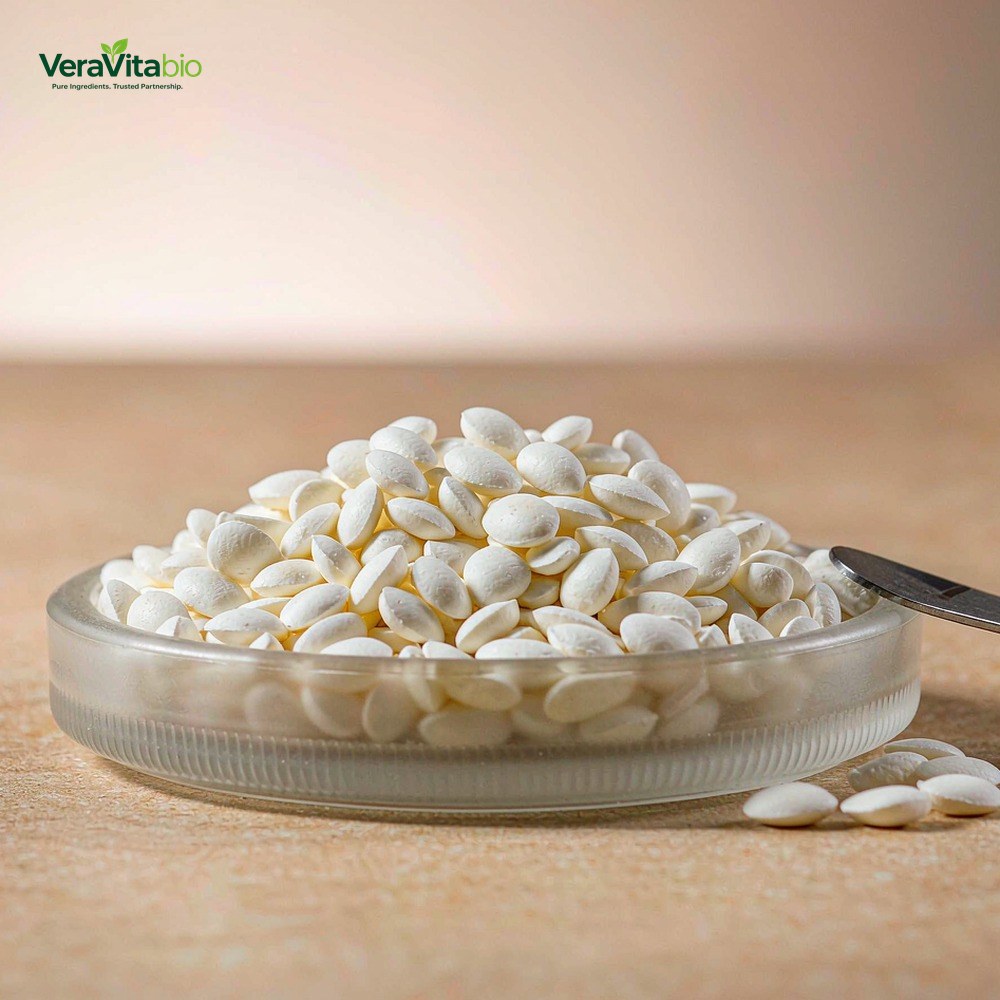
BTMS-50 is the trade shorthand for a roughly 50/50 blend of Behentrimonium Methosulfate (a C22 behenyl-chain quaternary ammonium salt with a methosulfate counter-ion, CAS 81646-13-1) and Cetyl Alcohol (CAS 36653-82-4), supplied as free-flowing white pastilles. It is the cosmetic industry’s reference cationic conditioning emulsifier: a single raw material that simultaneously emulsifies the oil phase, builds viscosity and body, and deposits a softening, anti-static conditioning layer on hair and skin. That combination is why BTMS-50 sits at the heart of most modern rinse-off conditioners, hair masks, leave-in creams, curl creams and detangling sprays — and why demand keeps climbing as brands reformulate to silicone-free and, in parallel, chase the gentle conditioning performance that monomeric quats such as cetrimonium chloride cannot deliver on their own.
Two design choices define the material. First, the quaternary carries a long C22 behenyl tail and a single permanent positive charge: the tail gives affinity for the lipid-cuticle surface and a waxy, cushiony feel, while the charge gives substantivity to the negatively charged surface of damaged hair. Second, the counter-ion is methosulfate, not chloride — a deliberate upgrade that improves mildness and dispersibility and removes the chloride-ion corrosion and harshness associated with behentrimonium chloride. The cetyl alcohol fraction is not a filler: it is the co-structurant that lets BTMS-50 self-emulsify and build a proper lamellar gel network (see How It Works).
VeraVitabio supplies BTMS-50 pastilles in evaluation packs through full container loads, with per-lot COA (active quat content by titration, free amine, pH, moisture), MSDS/SDS and compliance documentation on request.
Key Features
- All-in-one conditioning emulsifier — emulsifier, thickener/structurant, conditioner and anti-static agent in one pastille; replaces separate quat + fatty alcohol + emulsifier systems and simplifies the INCI list.
- Silicone-free conditioning benchmark — delivers the slip, softness and detangling that formulators otherwise reach for dimethicone to provide; enables clean “silicone-free” claims without sacrificing sensory performance.
- Lamellar gel network former — builds yield value, cushion and stability in emulsions, and physically suspends actives, pigments, exfoliating particles and pearlisers (see How It Works).
- C22 substantivity — the behenyl chain anchors to the hair cuticle far better than short-chain quats, so conditioning survives rinsing and a light residue persists on dry hair instead of washing off completely.
- Methosulfate counter-ion — milder skin feel and better dispersibility than the chloride analogue; eliminates chloride-driven pitting corrosion of stainless-steel processing equipment.
- Works at hair-friendly acidic pH — optimal performance window pH 3.5–5.5, which aligns exactly with the isoelectric point of hair keratin and maximises electrostatic substantivity.
- Solid pastilles: cleaner logistics — no water, no preservation required in the raw material, low microbiological risk, non-flammable, and materially cheaper to ship than liquid quat solutions.
- Non-irritating profile vs monomeric quats — behentrimonium methosulfate is widely regarded in the industry as one of the gentlest conditioning quats; CIR has reviewed the behentrimonium salts as safe in the present practices of use (cosmetic use; still follow your own safety assessment).
- Multi-category flexibility — the same grade covers rinse-off conditioners, masks, leave-ins, styling creams, body lotions and low-dose 2-in-1 shampoos, reducing the number of raw materials a factory must stock.
- System synergy — pairs with cationic polymers (Polyquaternium-10, guar hydroxypropyltrimonium chloride) for targeted deposition and with proteins (hydrolysed keratin, hydrolysed rice/wheat protein) for repair claims — all available from the same supplier.
How It Works
1. The lamellar gel network (LGN) is the real engine. When BTMS-50 is melted into the oil phase and emulsified, the behentrimonium quat and cetyl alcohol co-crystallise into lamellar gel phase bilayers that hydrate and swell on cooling. This network is what gives a conditioner or cream its yield stress: body without stickiness, a cushioned rub-out, stable suspension of particles, and a “rich but rinseable” feel. This is also why BTMS-50 systems are unusually robust to process variation compared with polymer-thickened emulsions — and why the 50/50 ratio matters: shifting the quat-to-alcohol balance changes the gel network, not just the “conditioning dose”.
2. Electrostatic deposition on damaged hair. Healthy hair carries a slight negative charge (keratin isoelectric point around pH 3.6–3.7); bleaching, colouring, heat and mechanical damage strip the 18-MEA lipid layer and multiply negative sites. The permanently cationic behentrimonium adsorbs onto those anionic sites preferentially — more where hair is more damaged — laying down a thin C22 waxy layer that reduces inter-fibre friction. Wet combing, dry combing, flyaway and “squeaky” feel all improve measurably, which is why BTMS conditioning reads as “repair-like” without any protein or silicone in the INCI.
3. Why methosulfate, not chloride. The counter-ion barely participates in deposition but strongly influences handling: methosulfate salts disperse and rinse more cleanly, are regarded as milder on skin and eyes, and avoid the chloride ion that pit-corrodes stainless steel and tightens regulatory handling. Practically, methosulfate grades let a factory run the same tanks used for anionic shampoos without dedicating chloride-resistant equipment.
4. Charge management is the formulation skill. Because the charge is permanent and pH-independent, everything is about how much cationic material meets anionic material. In leave-on and rinse-off conditioner formats, the quat pairs with fatty alcohols to build structure. In a 2-in-1 shampoo, the quat meets an anionic surfactant (SLES/SLS, or milder isethionate/glutamate systems): dosed correctly, the pair forms a transient coacervate in the lather on dilution that deposits conditioners onto hair; overdosed, it crashes out as dull film, kills foam and leaves residue. That is why BTMS-50 is dosed at a fraction of a percent in shampoos but 2–5% in conditioners.
Typical Applications
- Rinse-off conditioners — 2–4% as supplied: the flagship use; provides emulsification of the oil phase, body, wet/dry combing and softness in one raw material, typically with cetearyl alcohol and a small quat or polymer boost for premium slip.
- Hair masks and intensive treatments — 3–6%: higher wax phase for cushion and “mask” texture; pairs with butters and oils for deep-conditioning positioning.
- Leave-in creams, curl creams and detanglers — 0.5–2%: lighter dosage avoids build-up on repeated no-rinse use; combine with cationic guar for slip on wet hair.
- 2-in-1 shampoos — 0.3–1%: low-dose conditioning; the coacervate mechanism does the work on dilution (validate the ratio against your specific anionic system — see Formulation Notes).
- Silicone-free and clean-label reformulations — the primary technical route to replace dimethicone/cyclopentasiloxane claims while keeping sensory parity.
- Body lotions and creams — 1–3%: the same LGN gives elegant body and a soft after-feel; the cationic charge also reduces static and improves skin feel on dry skin.
- Styling waxes, pomades and texturising creams — 2–5% for structure and anti-static performance.
- Men’s grooming (beard conditioners, shave creams) — 1–3%: softening and cushion at acidic pH.
- Bar-form and solid formats — conditioner bars and anhydrous sticks use BTMS-50 as both structurant and conditioner (melt-and-pour process).
Key Specifications
| Parameter | Specification |
|---|---|
| INCI | Behentrimonium Methosulfate (and) Cetyl Alcohol |
| CAS | Behentrimonium methosulfate 81646-13-1; cetyl alcohol 36653-82-4 |
| Chemistry | C22 (behenyl) trimethyl quaternary ammonium methosulfate + C16 fatty alcohol; cation C25H54N+, single permanent positive charge |
| Form | Free-flowing white to off-white pastilles / pellets |
| Active quat content | 48–52% behentrimonium methosulfate (balance cetyl alcohol); determined by two-phase titration — always confirm by titration, never by datasheet (see Formulation Notes) |
| Grade variants | BTMS-50 (approx. 50% quat) standard; BTMS-25 (approx. 25% quat / 75% cetyl alcohol) available for waxier, higher-dose systems |
| Free amine | ≤ 1.0% (typically ≤ 0.5%) — free tertiary amine drives amine odour and pH drift on storage |
| pH | 4.0–6.0 (1% dispersion in water, 25 °C) |
| Moisture | ≤ 1.0% |
| Melt-in process temperature | Add to oil phase at 70–75 °C, hold 10–15 min until fully melted; avoid prolonged heating above 85 °C (yellowing, amine odour) |
| Recommended product pH | 3.5–5.5 (optimum); conditioning performance declines above pH 6 |
| Heavy metals | Pb ≤ 5 ppm, As ≤ 2 ppm, Hg ≤ 1 ppm (per lot, destination-market limits) |
| Microbiology | TAMC ≤ 100 cfu/g; TYMC ≤ 50 cfu/g; absence of Staphylococcus aureus, Pseudomonas aeruginosa, Candida albicans in 1 g (low-water-activity product) |
| Residual solvents | Controlled per grade specification; statement supplied per lot |
| Regulatory position | EU: behentrimonium methosulfate not listed in the restricted annexes (CosIng); US: CIR-reviewed as safe in present practices of use; China: listed in IECIC. REACH registered. Verify aquatic-hazard classification (H400/H410) on the supplier SDS for your transport and EHS documentation |
| HS code | 2923 90 (quaternary ammonium salts and hydroxides; lecithins and other phosphoaminolipids excluded) |
| Shelf life | 24–36 months unopened in original sealed packaging, stored cool and dry |
| Packaging | 25 kg paper bag / fibre drum with PE liner; 1 kg / 5 kg evaluation packs; full container loads |
| Certifications | HACCP / ISO 9001 manufacturing; HALAL / KOSHER on request; vegan / animal-origin-free declaration available |
Formulation Notes
- Buy on titrated active content and free amine — “BTMS-50” is not a standardised name. Because there is no pharmacopoeial monograph, suppliers market anything from ~35% to ~50% quat as “BTMS-50”, and some even ship BTMS-25 as BTMS-50 at BTMS-25 prices. Require active content by two-phase titration (48–52%) and free amine (≤ 0.5% typical) on the lot COA. Free amine is the marker that predicts amine odour development and pH drift in your finished product.
- Melt it completely or the batch will be gritty. BTMS-50 must reach 70–75 °C in the oil phase and be held long enough for full melting (10–15 min); unmelted pastilles survive homogenisation and appear weeks later as “fish eyes” or grittiness in the finished cream. With high wax loads, verify melt-out visually before emulsification. Do not hold above 85 °C for extended periods — heat ageing yellows the quat and generates amine odour.
- The 50/50 ratio is part of the performance, not just the price. Cetyl alcohol is the co-structurant of the lamellar gel network. Substituting a purer quat plus less fatty alcohol does not reproduce BTMS-50 behaviour: body, cushion, suspension and “mask” texture all come from the combined system. When cost-engineering, reformulate the whole network rather than swapping the quat alone.
- Formulate at pH 3.5–5.5 and stay there. Hair’s negative charge (and therefore conditioning substantivity) is maximal near and below keratin’s isoelectric point; the quat itself is most stable and least odorous in this window. Above about pH 6, conditioning performance drops, amine odour can develop, and interactions with anionic thickeners worsen. Carboxylic acid thickeners (carbomer-type) in the same batch will neutralise and complex with the cationic quat — if you must combine them, expect viscosity loss and validate at final pH.
- Anionic compatibility is a ratio question — especially in 2-in-1 shampoos. At conditioning doses BTMS-50 is fully compatible with mild non-amphoteric systems, but in true anionic shampoo bases the quat:anionic-surfactant ratio decides whether you get the desirable coacervate-on-dilution effect or an incompatibility crash (stringy gel, precipitation, foam kill, dull residue). Screen the exact ratio on your own surfactant blend at use concentration before scale-up; do not assume another supplier’s 2-in-1 ratio transfers.
- Electrolyte sensitivity: do not salt-thicken a BTMS system. Adding NaCl (or high-electrolyte actives) compresses and can collapse the lamellar gel network, thinning viscosity unpredictably. Build viscosity with the fatty alcohol fraction (cetearyl/cetyl alcohol), a cationic-compatible polymer, or additional BTMS — not with salt.
- Preservative choice matters in cationic systems. Anionic preservatives and many organic-acid systems can be partially inactivated by adsorption onto the cationic network. Phenoxyethanol/ethylhexylglycerin and other cation-compatible systems are the practical default; challenge-test the finished formulation rather than relying on raw-material data.
- Charge-based deposition is self-targeting but not unlimited. The quat deposits preferentially on damaged (more negatively charged) sites — excellent for repair positioning — but over-dosing in leave-on formats causes build-up, dullness and heavy feel on fine hair. Keep leave-in doses at 0.5–2% and validate with repeated-use (not single-use) combing tests.
- Heat-process is mandatory; cold-process is not an option. Unlike some cationic polymers, BTMS-50 needs the melt. If your process cannot reach 70–75 °C (some contract fillers or bar lines), consider pre-molten supply or reformulating with a lower-melting conditioning system — tell us your process ceiling and we will spec accordingly.
- Environmental/SDS documentation: check before you promise “biodegradable”. Quaternary ammonium compounds adsorb strongly to sludge and some suppliers’ SDS carry aquatic-toxicity classifications (H400/H410) with corresponding transport and waste-handling obligations. If your brand narrative depends on environmental claims, ask for the SDS and, where needed, ready-biodegradability data up front — we supply documentation per lot for the grades we ship.
- Position it correctly against the alternatives. Versus behentrimonium chloride: BTMS’s methosulfate counter-ion is milder and corrosion-free. Versus cetrimonium chloride: the C22 chain is more substantive and far less irritating per unit conditioning. Versus silicones: no build-up reputation and clean INCI, but volatility-dependent “dry touch” effects of light silicones need partial compensation with esters or light oils in the oil phase.
Storage & Handling
Store pastilles in the original sealed packaging in a cool (<30 °C), dry area away from direct sunlight. The product is a low-water-activity solid: microbiological risk in storage is minimal, but heat in warehouses above the pastille softening range can cause lumping and caking — do not stack pallets against heat sources, and re-dry any product that has been exposed to a heat excursion before use (melt-and-filter check). Use FIFO stock rotation; opened bags should be resealed promptly to exclude moisture and foreign matter. Standard PPE for molten processing applies during manufacture: molten BTMS is above 70 °C and, like all quats at high concentration, is an eye irritant — use face/eye protection when handling the melt. Shelf life is 24–36 months unopened; re-test appearance, odour, pH and active content before use beyond the stated date.
Why Choose VeraVitabio
- Specification you can enforce. Every lot ships with COA covering active quat content by titration (48–52%), free amine, pH, moisture and microbiology — the numbers that actually predict finished-product performance, not just a generic datasheet.
- Both grades, one source. BTMS-50 and BTMS-25 quoted side by side, with guidance on which ratio suits rinse-off, leave-in, 2-in-1 and bar formats.
- Complete conditioning toolkit. Pair BTMS-50 with cationic polymers (Polyquaternium-10, cationic guar), proteins (hydrolysed keratin, rice/wheat protein) and mild anionic surfactants (SCI, sodium cocoyl glycinate) from the same supplier — build the full 2-in-1 or conditioner system and pre-screen the charge ratios with us before scale-up.
- Documentation for regulated markets. MSDS/SDS, REACH statement, IECIC listing reference, HALAL/KOSHER and vegan declarations available on request; aquatic-hazard classification confirmed in writing per grade.
- Trial-to-tonnage formats. 1 kg and 5 kg evaluation packs for formulation screening, 25 kg bags for production, container-load pricing for contract programmes.
- Formulation support included. Process temperature profiles, pH windows, preservative compatibility and 2-in-1 ratio screening guidance provided during evaluation — before the order, not after the complaint.
Request a Quote
Tell us your format (rinse-off conditioner, mask, leave-in, 2-in-1 shampoo, bar or body care), target dosage, pH and annual volume, and we will respond with a quotation, the current lot’s COA (titrated active content and free amine included) and a sample lead time. Evaluation packs ship quickly so you can validate melt behaviour, LGN body and combing performance in your own process.
Email: info@veravitabio.com | WhatsApp: +86 157 7194 0528
VeraVita Bio — Xi’an VeraVita Biotech Co., Ltd. | Botanical & Functional Ingredient Sourcing Partner
Email: info@veravitabio.com | WhatsApp: +86 157 7194 0528 | veravitabio.com
Disclaimer: The information provided is for general technical and commercial reference only and does not constitute medical, regulatory or legal advice. BTMS-50 is a cosmetic raw material supplied to qualified business customers, not a finished consumer product. Specifications are subject to batch confirmation from the lot COA. Cosmetic use only; safety, preservative efficacy, stability, claims and regulatory compliance of finished formulations remain the responsibility of the manufacturer. Permitted claims and classifications must be verified against the regulations of the destination market.
Need pricing, a sample or full documentation?
Send your specification, target volume and destination country — our team replies within one business day.
Reviews
There are no reviews yet.