Product Overview
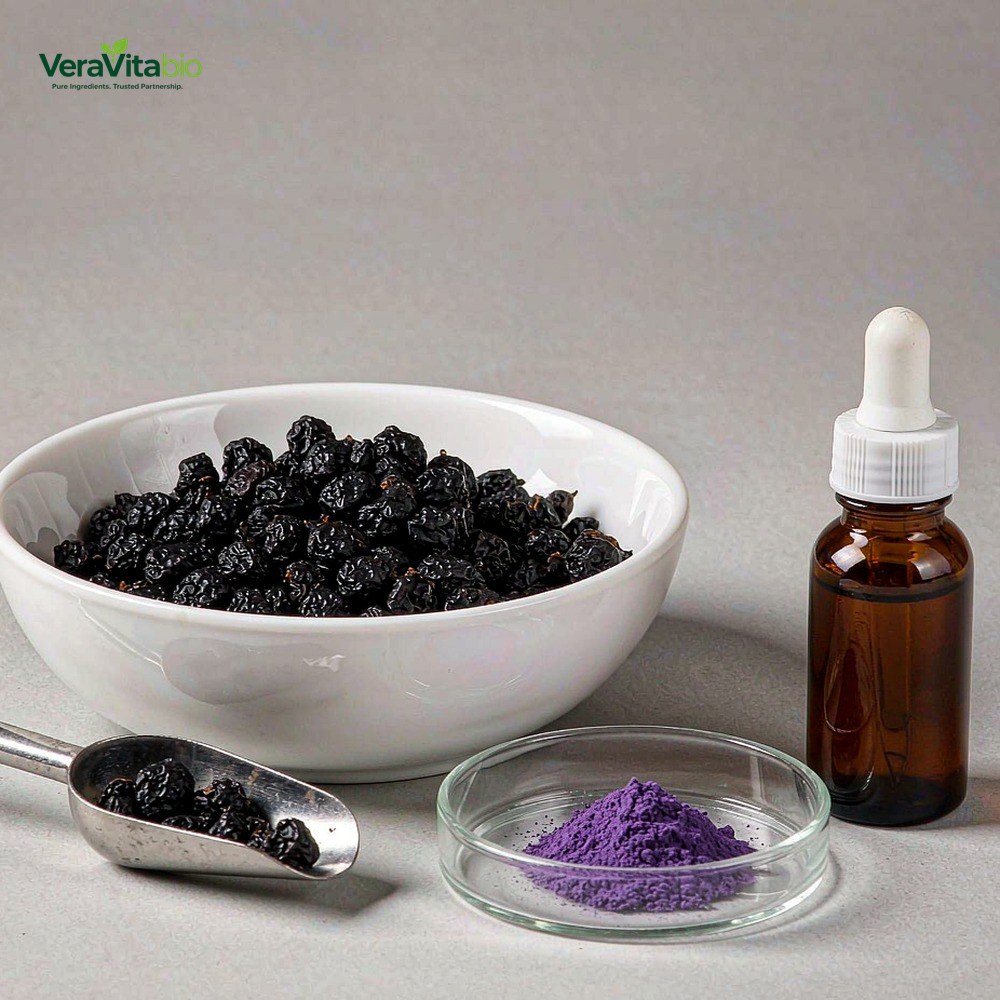
Black goji berry (black wolfberry, Chinese hei guo gou qi) is the fruit of Lycium ruthenicum Murray (family Solanaceae), a thorny desert shrub native to the high-altitude (c. 2,600–3,000 m) saline-alkali basins of northwest China — above all the Qaidam Basin in Qinghai, plus Tibet, Xinjiang, Gansu and Inner Mongolia — and across Central Asia. The berries ripen to an intense blue-black: their skins are packed with anthocyanins at roughly 2.3% of the dried fruit (with high values up to ~24 mg/g reported), among the richest anthocyanin loads of any commercial fruit — an order of magnitude above raspberries or grapes.
What makes black goji chemically unique is which anthocyanins: the profile is dominated (>95%) by petunidin (CAS 1429-30-7 as the chloride) 3,5-diglycosides, many acylated with p-coumaric, caffeic or ferulic acid — about 39 individual anthocyanins identified, with the single major compound being petunidin-3-O-[6-O-(4-O-(trans-p-coumaroyl)-α-L-rhamnopyranosyl)-β-D-glucopyranoside]-5-O-β-D-glucopyranoside, alone accounting for up to ~80% of total anthocyanins. Cyanidin-3-glucoside — the dominant anthocyanin of nearly every other berry — is not a significant component, which turns the HPLC fingerprint itself into an identity test. The fruit also carries Lycium-type polysaccharides, flavonoids such as rutin (CAS 153-18-4) and quercetin glycosides, and betaine (CAS 107-43-7), with a carotenoid fraction far lower than red goji.
VeraVitabio supplies freeze-dried whole-fruit powder, spray-dried juice powder, 4:1 / 10:1 water extracts and anthocyanin-standardized extracts — each specified the way this category is actually bought: petunidin-dominant HPLC fingerprint, anthocyanin assay with the method stated, carrier percentage disclosed, SO2 residue per lot, and an honest per-market regulatory read.
Key Features
- A petunidin-type anthocyanin, not a generic “anthocyanin” product. Where elderberry is cyanidin-based, blueberry and maqui are delphinidin-heavy, and blackcurrant is mixed, black goji is >95% petunidin 3,5-diglycosides with a single acylated marker at up to ~80% of the total. Any “black goji extract” whose fingerprint is led by cyanidin or delphinidin glycosides is not (or is not only) black goji — the HPLC profile is the spec.
- Acylation is the stability story. Aromatic acylation (p-coumaroyl, caffeoyl, feruloyl groups, with cis/trans isomer pairs) sterically shields the flavylium core: acylated anthocyanins measurably retain colour and activity better against heat, light and pH shift than the non-acylated anthocyanins of most berries. The trans-p-coumaroyl isomers dominate colour expression and stability.
- The fingerprint is the authenticity test. Petunidin-dominant, 3,5-diglycoside, mono-acylated profile; no significant cyanidin-3-glucoside; and effectively no zeaxanthin dipalmitate — the carotenoid that colours red goji (Lycium barbarum). Cheap substitutes and blends (black rice, black bean, mulberry, grape skin, blackcurrant; or red goji adulteration) all fail this screen, and DNA barcoding (ITS2) settles the residue.
- pH-switchable colour chemistry. Black goji anthocyanins shift from red-magenta (pH < 3.5) through violet (pH 4–6) to blue (pH > 7) — the reason formulators pick acidic matrices for beverage colour, and the reason the extract is a leading candidate for smart/intelligent packaging pH-indicator films in food-science programs.
- More than pigment. The same fruit supplies Lycium-type polysaccharides, rutin and quercetin glycosides, betaine and phenolic acids — supporting the “beauty-from-within” and healthy-ageing positioning that drives the category, expressed as structure/function claims, never drug claims.
- Wild-harvest origin with premium economics. Wild Qaidam fruit commands a multiple of red goji pricing; cultivated (seedling/irrigated) black goji from Qinghai, Gansu and Xinjiang narrows the price but varies the anthocyanin load. Wild vs cultivated, and harvest year, move assay and price — ask per lot, not per catalogue.
- Carrier disclosure is not optional. Spray-dried juice powders routinely carry 20–40% maltodextrin; a “juice powder” quoted without a declared carrier type and percentage cannot be compared with any other quote. Whole-fruit freeze-dried powder should be 100% fruit solids, no carrier.
- Full documentation pack. Per-lot COA (HPLC anthocyanin fingerprint and assay, moisture, ash, heavy metals, SO2, microbiology), SDS, TDS, botanical-origin statement, non-GMO and allergen declarations; HALAL/KOSHER on request.
How It Works
1. Flavylium equilibria — the pH colour switch. Anthocyanins exist as an equilibrium of forms: the red flavylium cation dominates at low pH; deprotonation gives the purple quinoidal base; further hydration and deprotonation yield colourless chalcones and blue quinonoid species. This is the molecular basis of black goji’s red→violet→blue progression and the first formulation variable to control: keep the matrix below ~pH 4 for red-magenta beverages, and expect progressive blue-shift and fading as pH rises.
2. Acylation shields the chromophore. In the major petunidin 3,5-diglycosides, the aromatic acyl group (trans-p-coumaric acid is dominant) stacks intramolecularly over the flavylium ring (“copigmentation in one molecule”), blocking water attack at C-2 and reducing chalcone formation. The practical consequence: colour retention through pasteurisation, storage and light exposure that non-acylated berry anthocyanins cannot match at equal dose.
3. Radical scavenging and downstream targets. The catechol-bearing B-ring of petunidin (and delphinidin-type neighbours) donates phenolic hydrogen to peroxyl and hydroxyl radicals; in vitro and animal work additionally reports α-glucosidase inhibition, insulin-sensitising and anti-inflammatory signals. These are mechanism and literature narratives for B2B positioning — the marketed claims must remain structure/function (or cosmetic) claims per destination market.
4. The matrix beyond the pigment. Lycium polysaccharides (water-extractable, high-molecular-weight, protein-associated) are the fraction red goji is famous for; black goji carries them alongside the anthocyanin fraction. A hot-water extract moves both; an acidified ethanol extract concentrates anthocyanins and leaves most polysaccharide behind — which is why “what is your extraction route?” is a specifying question, not a curiosity.
5. In cosmetics. Anthocyanin-rich extracts position as natural antioxidant/colorant candidates for masks, serums and rinse-off colour; pH near-neutral emulsions push the colour toward violet-blue, and the polyphenol fraction contributes antioxidant capacity in vitro. Claims stay cosmetic; stability testing at the finished-product pH is mandatory because the hue is pH-dependent by mechanism.
Typical Applications
- Beauty-from-within and healthy-ageing supplements — stick packs, sachets, capsules and gummies pairing the petunidin fraction with collagen, hyaluronic acid or vitamin C formulas.
- RTD beverages and juices — acidic (pH 3–4) systems give the signature red-magenta hue; black goji powder or juice powder at 0.2–1% delivers colour and polyphenol load in one ingredient.
- Tea and infusion blends — the traditional format: dried berries steeped to a violet-blue cup; pH-responsive colour is part of the consumer story (lemon juice flips the cup from blue to pink).
- Natural food colouring — whole-powder or juice-powder use positions as a colouring food/food ingredient; selectively extracted anthocyanin preparations move into the E 163 “anthocyanins” regulatory space in the EU — the distinction must be settled before the label is written.
- Smart packaging R&D — pH-indicator films and labels built on black goji anthocyanins are a fast-growing food-science application (freshness/spoilage visualisation).
- Cosmetics — antioxidant and natural-colour candidate for masks, serums and rinse-off formats; verify hue and stability at the finished product’s pH.
- Bakery, dairy and confectionery — yogurt, granola, energy bars and chocolate inclusions; low-water matrices protect the anthocyanin fraction best.
Key Specifications
| Parameter | Specification |
|---|---|
| Product name | Black Goji Berry Powder / Extract (black wolfberry, hei guo gou qi) |
| Botanical origin | Lycium ruthenicum Murray, Solanaceae — not a variety of red goji (Lycium barbarum L.); wild harvest and cultivation in Qinghai (Qaidam Basin), Tibet, Xinjiang, Gansu, Inner Mongolia |
| Reference CAS | Petunidin (chloride) CAS 1429-30-7; rutin CAS 153-18-4; betaine CAS 107-43-7; zeaxanthin CAS 144-68-3 (absence in black goji = red-goji-adulteration screen) |
| Grades | Freeze-dried whole-fruit powder (80–100 mesh, 100% fruit solids); spray-dried juice powder (carrier declared, typically 20–40% maltodextrin); 4:1 / 10:1 water extract; anthocyanin-standardized extract 5% / 10% / 25% |
| Appearance | Violet-purple to dark-purple free-flowing powder; dried berries blue-black, wrinkled; aqueous solution red-magenta (acid) to violet (neutral) |
| Anthocyanin content | Whole dried fruit ~2.3% typical (literature up to ~24 mg/g); powder grades 1–3%; extracts standardized 5–25%. Assay method stated on COA: UV-Vis pH-differential (AOAC 2005.02, as cyanidin-3-glucoside equivalents) or HPLC quantified against the petunidin marker — the two methods give different numbers and must not be compared across suppliers |
| Identity / purity screen | HPLC fingerprint: petunidin derivatives >95% of total anthocyanins, major acylated petunidin 3,5-diglycoside ~80%; no significant cyanidin-3-glucoside; zeaxanthin below detection (red-goji screen); DNA barcoding (ITS2) available on request |
| Moisture | Powder ≤ 8%; dried berries ≤ 13% |
| Ash | Total ash ≤ 6% |
| Heavy metals | Lead ≤ 2–5 mg/kg, cadmium ≤ 1 mg/kg as working benchmarks (Chinese Pharmacopoeia goji limits: Pb ≤ 5.0, Cd ≤ 1.0 mg/kg); arsenic and mercury per lot; destination-market limits govern |
| Sulfur dioxide | Target < 10 mg/kg — the EU allergen-labelling threshold for sulfites; sulphur-fumigated goji is a documented industry problem and self-defeating for anthocyanin value (SO2 bleaches anthocyanins) |
| Microbiology / mycotoxins | Standard food plate counts; aflatoxin B1 controlled (Chinese goji benchmark ≤ 5 µg/kg); EU Reg. 2023/915 contaminant limits and Reg. 396/2005 pesticide MRLs apply for EU-bound lots |
| Solubility | Water-dispersible (juice powder, extracts); whole-powder partially suspends (fibre fraction); colour compounds readily extract into acidified aqueous systems |
| Regulatory position | EU: the Novel Food Catalogue recognises Lycium barbarum berries as food; L. ruthenicum is not on the Union list — placing it on the EU market as a food/ingredient requires a Novel Food determination/authorization under Reg. (EU) 2015/2283 (a traditional-food notification under Art. 14 is the realistic route, given documented consumption history in China; member-state practice varies). US: dietary supplement ingredient under DSHEA — structure/function claims with the Section 403(b) disclaimer; confirm NDI position because US market history is red goji. China: red goji (gou qi zi) is on the medicine-food homology list; black goji is a different species — provincial (Qinghai) standards govern food use. Taiwan: black goji is listed as a non-traditional food raw material pending application. Always verify the destination-market status before product launch |
| HS code | 0813.40 (dried fruit) — note EU/UK CN line 0813 40 95 10 is worded “Goji berries (wolfberries) (Lycium barbarum L.)”; L. ruthenicum consignments declare under the “other” goji line — align with your broker. Extracts and standardized powders: 1302.19 |
| Shelf life | 24 months sealed, cool, dark and dry; anthocyanin assay with retest interval on the COA — anthocyanins degrade, so the retest date is part of the spec |
| Packaging | 1–5 kg foil bags (evaluation), 25 kg fibre drum with inner PE liner; nitrogen-flush and oxygen-absorber options for premium anthocyanin grades |
| Certifications | ISO 9001 / GMP manufacturing; organic (EU / USDA NOP) chains available from contracted Qinghai collection areas — organic certification also guarantees unsulphured processing; HALAL and KOSHER on request; vegan, non-GMO and allergen declarations |
Formulation & Handling Notes
- Method transparency is the price of entry. “Anthocyanin 25%” means nothing without the method: UV-Vis pH-differential reports cyanidin-3-glucoside equivalents — a crude proxy for a petunidin fruit with different molar absorptivity — while HPLC against the acylated petunidin marker reports what is actually in the drum. Two lots both labelled “25%” can differ by a third in true content. Buy the method, not the number.
- Protect the molecule. Anthocyanins degrade with heat, light, oxygen and time; processing below 60 °C, oxygen-barrier packaging, nitrogen flush or oxygen absorbers, and opaque retail formats measurably extend colour and assay retention. Retest intervals belong on the COA.
- pH is the colour dial. Acidify to pH 3–4 for red-magenta beverages; near-neutral dairy or plant-milk matrices trend violet; alkaline systems (some plant proteins, baking) push blue and accelerate degradation. Vitamin C fortification needs accelerated stability work — ascorbic acid can accelerate anthocyanin degradation in the presence of oxygen and trace metals.
- SO2 is a quality and compliance gate in one. Sulphur fumigation (a documented practice in low-end goji drying to beautify colour) bleaches anthocyanins while leaving residues: above 10 mg/kg the EU requires sulfite allergen labelling, and organic certification prohibits the treatment outright. Specify unsulphured processing and test per lot.
- Ask wild or cultivated — and which year. Wild Qaidam fruit is the premium, higher-assay, more variable source; cultivated fruit is tighter and cheaper. Wild harvest also means lot-to-lot variance in anthocyanin load, and a heavier due-diligence burden on heavy metals and pesticides (remote but not zero-exposure environments). Origin and harvest year on every COA.
- Adulteration screen for goods-in. Low quotes on “high-anthocyanin black goji” should trigger the fingerprint check: petunidin-dominant profile, no cyanidin-3-glucoside peak family, no zeaxanthin (red goji), and no grape/berry-skin anthocyanins (delphinidin/malvidin balance inconsistent with the acylated petunidin signature). For powders, microscopy plus FTIR or DNA barcoding settles species-level doubt.
- Carrier honesty. For juice powders, declare carrier type and percentage (maltodextrin, acacia, tapioca); for standardized extracts, declare the extraction solvent system (acidified water/ethanol) and residual ethanol. This is what makes quotes comparable and labels accurate.
- Pairing logic. Black goji pairs naturally with the site’s elderberry, maqui, sea buckthorn and goji lines for anthocyanin/polyphenol blends, and with citric acid (E 330) as the acidity tool that locks the red-magenta hue in beverages.
Storage & Handling
Store sealed in a cool (<25 °C), dark, dry warehouse; powders are hygroscopic and anthocyanins are photolabile — reseal opened foil bags immediately or decant into airtight containers, and prefer nitrogen-flushed packs for standardized grades. Keep away from heat sources and strong oxidants; avoid direct sunlight on work surfaces and finished goods. Use FIFO rotation and retain samples from each lot for colour and HPLC comparison at goods-in. In production, add the powder in the cool-down phase where possible and validate finished-product colour stability at the intended storage temperature and light exposure.
Why Choose VeraVitabio
- Specified like a chemist buys it. Petunidin-dominant HPLC fingerprint, assay with method stated, carrier percentage, SO2, heavy metals and retest interval per lot — the exact screen that separates true black goji from the blends and dyes in this category.
- Origin transparency. Wild Qaidam and contracted Qinghai/Gansu cultivation, harvest year and organic-chain options, with botanical-origin documentation on every file.
- Regulatory honesty. We tell you where black goji sits in your market — the EU Novel Food question, the DSHEA/NDI position, the provincial-standard situation in China — before you build a launch on it, not after.
- Stack-friendly portfolio. Quote black goji together with our elderberry, maqui, sea buckthorn, red goji, citric acid and plant extracts — anthocyanin systems and superfood powders from one supplier, one COA pack, one shipment.
- From sample to container. 1 kg evaluation packs with fingerprint chromatograms, 25 kg drums for production, container-load pricing for annual programs.
Request a Quote
Send us four things and we will quote precisely rather than generically: (1) the format — whole freeze-dried powder, juice powder, 4:1/10:1 extract or a standardized anthocyanin grade; (2) the assay and method you need (UV-Vis as C3G equivalents or HPLC against the petunidin marker); (3) the pack size; and (4) the destination market and volume — we will confirm the documentation and regulatory position required there, including the EU Novel Food question, before you commit. We reply with pricing, the current lot’s COA and HPLC fingerprint, and a sample lead time.
Email: info@veravitabio.com | WhatsApp: +86 157 7194 0528
VeraVita Bio — Xi’an VeraVita Biotech Co., Ltd. | Botanical & Functional Ingredient Sourcing Partner
Email: info@veravitabio.com | WhatsApp: +86 157 7194 0528 | veravitabio.com
Disclaimer: The information provided is for general technical and commercial reference only and does not constitute regulatory, legal, medical or formulation advice. Regulatory status (including Novel Food, dietary-supplement and food-ingredient classifications), use levels and permitted claims vary by market and change over time; they must be verified against the requirements in force in the destination market before labelling or claims are finalised. Specifications are subject to batch confirmation from the lot COA. Black goji berry products are raw materials supplied to qualified business customers, not finished consumer products. Responsibility for finished-product safety, stability, labelling, claims and regulatory compliance in the destination market remains with the manufacturer.
Need pricing, a sample or full documentation?
Send your specification, target volume and destination country — our team replies within one business day.
Reviews
There are no reviews yet.