Product Overview
Guar hydroxypropyltrimonium chloride (cationic guar; CAS 65497-29-2; EC 613-809-4) is the quaternised derivative of guar gum, the galactomannan polysaccharide milled from the endosperm of the guar bean (Cyamopsis tetragonoloba), a drought-hardy legume grown almost entirely in India (Rajasthan, Gujarat, Haryana — roughly 80% of world supply) and Pakistan. The natural gum — a backbone of D-mannose with D-galactose side branches at an approx. 2:1 mannose:galactose ratio — is reacted with a quaternary ammonium epoxide, grafting permanently positive 2-hydroxypropyltrimethylammonium groups onto the polysaccharide. The result is a water-soluble, positively charged polymer that behaves like a conditioner derived from a bean: substantive to hair and skin, film-forming, antistatic, thickening — and biodegradable.
It is the workhorse conditioning polymer of the mass-market shampoo industry, and its position has only strengthened as the market splits into two directions it serves equally well: sulfate-free and amino-acid surfactant systems, where it is frequently the primary conditioning agent, and 2-in-1 shampoos, where it acts as the deposition aid that carries silicones and antidandruff actives onto the hair. Commercial reference materials include the Jaguar® series (Rhodia/Solvay, charge densities from ~0.6 meq/g in Jaguar C-17 to 1.7 meq/g in borate-free BF-17 grades, molecular weights from ~0.5 to 2.2 million g/mol) and the N-Hance™ series (ASI/Ashland) — and the same parameter space is exactly how Chinese-made cationic guar grades are specified.
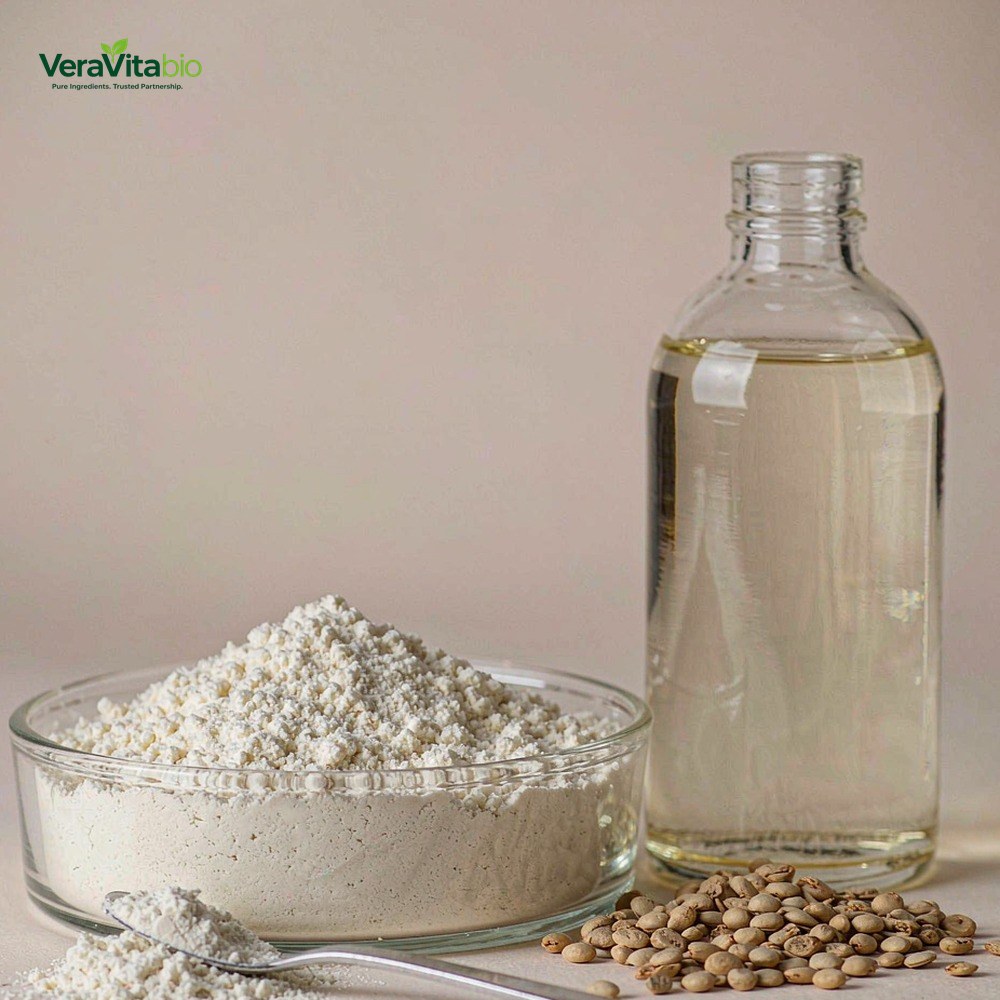
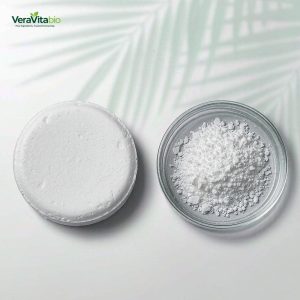
VeraVitabio supplies cosmetic-grade guar hydroxypropyltrimonium chloride as a white to pale-yellow free-flowing powder in multiple viscosity and charge-density grades, including boron-free and clarity grades for transparent systems, with a per-lot COA stating viscosity, nitrogen content, particle size, heavy metals and microbiology — the parameters that decide whether a cationic guar lot hydrates cleanly, deposits correctly and keeps your clear shampoo clear.
Key Features
- Plant-derived conditioning with a certified-clean profile. Guar-based, vegan, readily biodegradable, COSMOS-authorised for natural and organic cosmetics, HALAL-compatible, and assessed safe by the CIR — the sustainability story is built into the molecule, not added on top. For brands replacing synthetic cellulosic conditioners (polyquaternium-10) or reducing quats, cationic guar is the standard first substitution.
- The coacervate mechanism is self-targeting. In the bottle, the cationic polymer is solubilised by the anionic surfactant system. During rinsing, dilution below the surfactant’s critical micelle concentration collapses the polymer–surfactant complex into an insoluble coacervate phase that deposits preferentially where hair carries the most negative charge — the oxidised, bleached and mechanically damaged cuticle zones. Conditioning is delivered where it is needed, and washed off where it is not (Hössel et al., Int. J. Cosmet. Sci. 2000).
- Measurable performance. Reductions of 30–60% in wet-combing force, antistatic flyaway control, improved dry feel and shine, and a light, non-building film that does not weigh hair down at the recommended use levels.
- Deposition aid for your hero actives. Cationic guar increases the deposition and retention of silicones, conditioning oils, and antidandruff actives (piroctone olamine, climbazole, zinc pyrithione) from wash-off systems — the reason most premium antidandruff and 2-in-1 platforms specify it alongside the surfactant base.
- Mildness and skin feel. On skin it forms a thin, breathable polysaccharide film that reduces the stripped, tight after-feel of sulfate and soap-based cleansers, improves post-wash softness in body wash and facial cleansers, and supports “gentle / baby-shampoo / sensitive-scalp” positioning at low use levels.
- Genuine thickening, not just feel. High-molecular-weight grades build real, electrolyte-tolerant viscosity in surfactant systems — usable as a co-thickener that also conditions, or in low-viscosity grades purely as a conditioner where rheology is managed by salt and other thickeners.
- Grade space you can actually specify. Molecular weight ~0.5–2.2 million Da, cationic charge density ~0.6–1.7 meq/g, degree of substitution ~0.08–0.30, viscosity (1% aq.) from ~25–65 mPa·s (low-MW clarity grades) to 3,000–6,000 mPa·s (standard conditioning grades) — quoted and supplied against your application, not a single anonymous powder.
- Boron-free grades available. Traditional “boronised” guar grades are crosslinked with borate; because borates and boric acid salts are prohibited as intentionally added cosmetic ingredients in the EU (Annex II), we default EU-bound programmes to boron-free grades and document the absence of borate residuals.
- Permanently cationic. The quaternary ammonium charge is pH-independent across the whole cosmetic window (pH 3–9), so conditioning performance does not fade in acidic scalp-care systems or alkaline soap-based bars.
- Full documentation pack. Per-lot COA (viscosity method, nitrogen, DS/charge density, particle size, moisture, heavy metals, microbiology), SDS in the destination language, TDS with hydration protocol, plus botanical-origin, vegan, non-GMO, allergen and HALAL/KOSHER statements on request.
How It Works
1. Electrostatic substantivity. Keratin fibre surfaces carry a net negative charge — the more so the more they are bleached, permed, or mechanically abraded. The trimethylammonium groups of cationic guar adsorb onto those sites by simple electrostatics, and because the quaternary nitrogen never loses its charge, adsorption works at any cosmetic pH. The adsorbed galactomannan film flattens cuticle scale edges, reduces inter-fibre friction, neutralises static and leaves a smooth, light after-feel.
2. The coacervate engine. In the surfactant phase, anionic surfactant molecules complex with the cationic chain into soluble polymer–micelle aggregates. Dilution during rinsing drops the system below the critical micelle concentration; the aggregates desolvate into a separate coacervate phase whose deposition onto hair is both mass-driven and charge-targeted. This is the same deposition engine used by polyquaternium conditioning polymers — cationic guar simply runs it on a natural, biodegradable backbone, and its galactomannan stiffness gives a distinctively light, non-tacky feel.
3. Deposition aid and rheology. The same cationic network co-deposits suspended oils, silicones and particulate actives — which is why cationic guar appears in 2-in-1 and antidandruff patents as the deposition polymer (typical charge densities specified at ≥0.4 meq/g, with 0.7–0.8 meq/g the classic shampoo sweet spot for balancing conditioning with lather creaminess). In the bottle, high-MW grades also build viscosity through chain entanglement; unlike polyacrylate thickeners the viscosity is tolerant of electrolyte, so salt curves stay usable.
4. Hydration physics — and why process matters. Fine guar-derivative powders hydrate from the particle surface inward; dropped carelessly into water they form gel-skinned lumps (“fish eyes”) that never dissolve. Correct hydration — dispersion first, then time under shear — is a process requirement, not a quality option. See Formulation Notes.
5. Skin conditioning. On stratum corneum the polymer deposits the same thin cationic film, reducing transepidermal irritation signalling from anionic surfactants and leaving a soft, powdery-smooth after-feel — the reason body wash, intimate wash and facial cleanser formulators use it at 0.1–0.3% purely for mildness perception.
Typical Applications
- 2-in-1 shampoos — the flagship use: 0.2–0.5% as the conditioning/deposition polymer with SLES or SLE1S bases; pairs with silicone emulsions or amodimethicone where higher conditioning is wanted.
- Sulfate-free and amino-acid surfactant shampoos — often the sole conditioning agent at 0.3–0.6%; in weakly anionic systems specify higher charge-density grades, since coacervate formation is weaker without strong sulfate surfactants.
- Clear and crystal shampoos — low-viscosity, high-clarity grades (including hydroxypropyl guar hydroxypropyltrimonium chloride) maintain transparency in transparent 2-in-1 and micellar systems where standard grades haze.
- Body wash and shower gels — 0.1–0.3% for post-wash softness, reduced tightness and a creamy skin feel without a slippery residue.
- Facial cleansers and cleansing conditioners (co-wash) — light conditioning and mildness at 0.1–0.3%.
- Antidandruff shampoos — as the deposition aid for piroctone olamine, climbazole and zinc pyrithione, improving active retention on the scalp between washes.
- Rinse-off and leave-in conditioners, hair masks — 0.5–1.0% in rinse-off conditioners, up to ~1.5% in intensive masks, usually alongside BTMS-type emulsifiers or cationic surfactants.
- Liquid soaps, syndet and soap bars — mildness and slimy-free smooth feel; the pH-independent charge keeps it functional even in true soap systems.
- Baby shampoos and sensitive-skin cleansing — low-dose mildness and conditioning with a plant-derived, low-irritation profile.
Key Specifications
| Parameter | Specification |
|---|---|
| INCI name | Guar Hydroxypropyltrimonium Chloride |
| CAS number | 65497-29-2 (EC 613-809-4) |
| Botanical origin | Cyamopsis tetragonoloba (guar bean) endosperm galactomannan; mannose:galactose approx. 2:1; bean origin India / Pakistan, cationised and finished in China |
| Appearance | White to pale-yellow free-flowing fine powder, faint characteristic odour |
| Polymer type | Quaternised galactomannan; permanently cationic at all cosmetic pH |
| Molecular weight | Approx. 0.5–2.2 million g/mol depending on grade |
| Cationic charge density | Approx. 0.6–1.7 meq/g depending on grade (0.7–0.8 meq/g classic shampoo grades) |
| Degree of substitution | Approx. 0.08–0.30 by grade |
| Nitrogen content | 1.0–2.1% (grade-dependent; declared per lot) |
| Viscosity (1% aq., 25 °C) | Grade-dependent: ~25–65 mPa·s (low-MW clarity grades) to 3,000–6,000 mPa·s (standard conditioning grades); Brookfield method declared per grade |
| pH (1% solution) | Grade-dependent, approx. 5.0–10.5 (boron-free grades typically 5.0–7.5) |
| Particle size | ≥ 95–99% through 100 mesh; ~90% through 200 mesh |
| Loss on drying | ≤ 10–12% |
| Solubility | Readily soluble/hydrating in cold and warm water; insoluble in organic solvents; electrolyte-tolerant grades available |
| Boron status | Boron-free grades supplied as standard for EU-bound programmes; boronised (borate-crosslinked) grades disclosed per lot if supplied |
| Recommended use level | Shampoo 0.2–0.5%; body wash / cleanser 0.1–0.3%; rinse-off conditioner 0.5–1.0%; masks up to ~1.5%; leave-on 0.1–0.5% |
| Microbiology | TAMC ≤ 500–1,000 cfu/g; TYMC ≤ 100 cfu/g; pathogens absent |
| Stability | Stable pH 3–9, heat-stable to ~80 °C; degraded by strong acid/alkali and by microbial glycanases — preserve finished products accordingly |
| Regulatory position | EU: CosIng-listed (ref 34171/34177 family), functions antistatic / film-forming / skin-conditioning / viscosity-controlling; not restricted in Annexes II–VI. US: CIR galactomannans assessment — safe as used (up to 2% in reported products). China: IECIC 2021 listed (No. 02592; max historical use 7% rinse-off, 1.2% leave-on) |
| HS code | 1302.32 (mucilages and thickeners, whether or not modified, derived from guar seeds; EU/UK CN 1302 32 90) |
| Shelf life | 24 months sealed, cool and dry; hygroscopic — reseal opened bags immediately |
| Packaging | 1–5 kg foil bags (evaluation), 25 kg fibre drum or paper bag with inner PE liner |
| Certifications | ISO 9001 / GMP manufacturing; COSMOS-authorised raw-material route; HALAL and KOSHER on request; vegan, non-GMO and allergen declarations |
Formulation Notes
- Hydration is the whole process game. Sprinkle the powder slowly into the vortex of rapidly agitated water, or — more reliably — pre-slurry it in glycerin, propanediol or a dry blend before adding to water. Let it hydrate fully (15–20 minutes with stirring) before adding high surfactant loads and salt. Many grades develop full viscosity after the water is acidified to pH ~5.5–6.0 with citric acid; follow the grade TDS. Skip this and you get fish eyes, low viscosity and inconsistent conditioning — the three most common field complaints.
- Order of addition for clear systems. Polymer into water first; adjust pH; add amphoteric and non-ionic surfactants; then add anionic surfactants last. Adding cationic guar directly into a concentrated anionic surfactant base can form local over-concentrated complexes that never redissolve — visible as haze or strings in the finished shampoo.
- Match the grade to the system, not the datasheet price. High-MW, standard-charge grades (~0.6–0.8 meq/g, 3,000–6,000 mPa·s) for classic 2-in-1 SLES shampoos; low-MW clarity grades for transparent systems; higher charge density (~1.1–1.7 meq/g) where the anionic surfactant content is low (sulfate-free, amino-acid, APG systems) because coacervate formation is weaker. Blending a high-MW grade with a low-MW grade is a standard trick to combine conditioning with lather creaminess.
- Dose discipline. 0.2–0.4% is the shampoo sweet spot; above ~0.8% in a shampoo, fine or low-porosity hair can feel coated and flake-like residue may appear. In leave-on products stay at 0.1–0.5%.
- Anionic polymer incompatibility is real. Cationic guar precipitates with carbomer and other anionic synthetic thickeners — do not thicken a cationic-guar system with carbomer; use salt, high-MW grades or cellulosic/amphoteric thickeners instead. Also verify interactions with high levels of anionic actives (e.g. salicylate salts) during stability testing.
- Preserve for glycanases, not just bacteria. Polysaccharides are microbial food; the polymer itself is degraded by microbial glycanases, which shows up as slow viscosity loss in marginal products. Standard cosmetic preservative systems are adequate, but challenge-test the finished formula — aqueous polymer solutions without surfactant are the worst case.
- Electrolyte behaviour is grade-specific. Standard grades lose some viscosity at high salt; explicitly electrolyte-tolerant grades exist. If your salt curve is aggressive, specify it in the RFQ — this is a specification line, not a negotiation point to discover later.
- Ask for the reactant story. Cationic guar is made with either 2,3-epoxypropyltrimethylammonium chloride (glycidyltrimethylammonium chloride) or (3-chloro-2-hydroxypropyl)trimethylammonium chloride — both classified CMR and listed among substances prohibited in cosmetic products in the EU (added by Regulation (EU) 2019/831). The ban applies to the reactants, not the finished polymer, but a responsible specification asks for a residual reactant/epoxide statement or low-residue process documentation per lot — the question separates manufacturers from traders.
- Boron: specify boron-free for the EU. Traditional borate-crosslinked (“boronised”) grades exist for suspension and viscosity economics, but borates, tetraborates and boric acid salts are listed in Annex II of Regulation (EC) 1223/2009 (entry 1396) as prohibited intentionally added ingredients, with only the narrow Article 17 technically-unavoidable-trace exception. For EU-bound programmes we default to boron-free grades and document it.
- Substitution from PQ-10. Both are quaternary polymers with pH-independent charge; cationic guar brings natural origin, biodegradability and COSMOS acceptance, slightly different feel (lighter, less slick), and grade-based tunability. Replace at roughly equal actives basis, then re-tune dose and salt — do not assume 1:1 rheology.
- Regulatory reminders. EU: CosIng-listed, no restriction, not in Annexes II–VI (the Annex II borate entry concerns boron compounds, not the finished cationic guar; the prohibited reactants concern residues — see above). US: CIR Final Report on galactomannans (2012; published Johnson et al., Int. J. Toxicol. 2015, 34(Suppl 1):35S–65S) — safe as used, reported up to 2%; the very large molecular weight makes skin penetration unlikely. China: IECIC 2021 No. 02592, max historical use 7% rinse-off / 1.2% leave-on; cosmetic safety-assessment filings can cite CIR. Natural/organic claims: the modification route is accepted under COSMOS — confirm the current COSMOS raw-material approval status of the specific grade with us before making certified claims.
Storage & Handling
Store in the original sealed packaging in a cool (<25 °C), dry (RH <65%) warehouse away from direct sunlight. The powder is hygroscopic: opened bags must be resealed immediately and partly used drums consumed promptly, or moisture uptake causes caking and slow hydration problems at the bench. Handle with gloves and dust mask; fine polysaccharide dust is a nuisance dust and, like most fine organic powders, can form explosible dust clouds — avoid ignition sources and use good extraction at weighing stations. Use FIFO stock rotation and retain a sample from each lot for viscosity and colour comparison at goods-in. In-process: hydrate as per the grade protocol, keep hydrated polymer stocks for the shortest practical time, and challenge-test any aqueous polymer premix stored before use.
Why Choose VeraVitabio
- Grades specified like a polymer house, not a powder trader. Viscosity, charge density, DS and nitrogen declared per grade and per lot — including low-MW clarity grades and high-charge sulfate-free grades that generic quotations quietly omit.
- Boron-free and reactant-controlled supply. Boron-free grades as the EU default, with residual-reactant documentation available — the two compliance questions increasingly asked in every personal-care audit.
- Hydration and clarity protocols included. Dispersion/Hydration procedures, order-of-addition guidance for clear systems, and dose benchmarks for 2-in-1, sulfate-free and body wash platforms.
- Stack-friendly portfolio. Quote cationic guar together with our PQ-10, BTMS-50, amphoteric and alkyl glucoside surfactants, D-panthenol, hydrolysed keratin and piroctone olamine — the complete shampoo and body-wash shelf from one supplier.
- Documentation pack per lot. COA (viscosity with method, nitrogen, moisture, particle size, heavy metals, microbiology), SDS in the destination language, TDS, and botanical-origin, vegan, non-GMO, allergen and HALAL/KOSHER statements on request.
- From sample to container. 1 kg evaluation packs for lab validation, 25 kg drums for production, container-load pricing for annual programmes.
Request a Quote
Send us four things and we will quote precisely rather than generically: (1) the application — 2-in-1 shampoo, sulfate-free or clear system, body wash or conditioner, since it determines the viscosity/charge grade and clarity requirement; (2) the target viscosity band and salt system of your base; (3) the pack size; and (4) the destination market and volume — we will confirm the boron-free/reactant documentation required there. We reply with pricing, the current lot’s COA, a sample lead time and the hydration protocol for the grade, so your lab can verify viscosity development, clarity and conditioning performance before committing to tonnage.
Email: info@veravitabio.com | WhatsApp: +86 157 7194 0528
VeraVita Bio — Xi’an VeraVita Biotech Co., Ltd. | Botanical & Functional Ingredient Sourcing Partner
Email: info@veravitabio.com | WhatsApp: +86 157 7194 0528 | veravitabio.com
Disclaimer: The information provided is for general technical and commercial reference only and does not constitute regulatory, legal or formulation advice. Regulatory status, use levels and maximum concentrations vary by market and change over time; they must be verified against the requirements in force in the destination market before labelling or claims are finalised. Specifications are subject to batch confirmation from the lot COA. Guar hydroxypropyltrimonium chloride is a raw material supplied to qualified business customers, not a finished consumer product. Responsibility for finished-product safety, stability, labelling, claims and regulatory compliance in the destination market remains with the manufacturer.
Need pricing, a sample or full documentation?
Send your specification, target volume and destination country — our team replies within one business day.
Reviews
There are no reviews yet.