Product Overview
Potassium sorbate (E 202, INS 202, CAS 24634-61-5, EINECS 246-376-1) is the potassium salt of sorbic acid — (2E,4E)-hexa-2,4-dienoic acid (CAS 110-44-1, MW 112.13) — with the formula C6H7O2K and MW 150.22. It is the most widely used yeast-and-mould preservative in the world: effective, flavour-neutral at working levels, colourless, and legal almost everywhere from beverages and cheese to skincare emulsions. Sorbic acid itself occurs naturally in the berries of the mountain ash (Sorbus aucuparia), but all commercial material is synthetic — industrially from the ketene–crotonaldehyde condensation route, in which China holds the dominant share of global capacity and effectively sets the export price curve.
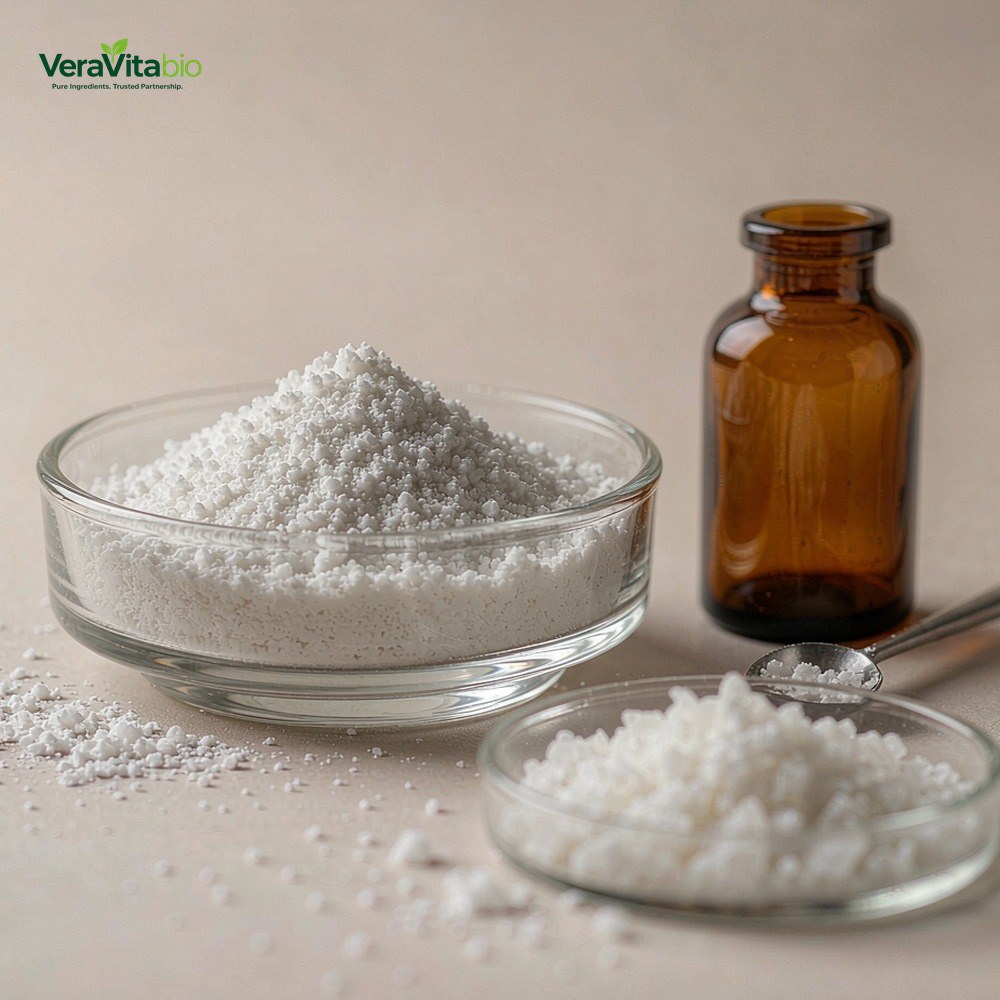
VeraVitabio supplies food-grade (E 202 / GB 1886.39-2015 / FCC) and cosmetic-grade (INCI: Potassium Sorbate) potassium sorbate in powder and granular forms — specified the way this category is actually bought: assay on the dried basis, acidity/alkalinity, aldehydes, colour-stability-after-heating, and heavy metals against the 2024-amended EU specification, not the ten-year-old limits still printed on most legacy COAs.
Key Features
- The acid-form chemistry decides everything. Only undissociated sorbic acid crosses the microbial membrane and acts; the salt is the delivery vehicle. With a pKa of 4.76, roughly half the molecule is active at pH 4.8, ~15% at pH 5.5, ~5% at pH 6.0 and under 2% at pH 6.5. Potassium sorbate is the preservative of acidic systems — buy it for pH ≤ 6 matrices, not for neutral ones.
- The EU specification was tightened in 2024 — and most COAs have not caught up. Commission Regulation (EU) 2024/2597 rewrote the E 202 purity entry of Reg. (EU) 231/2012: heavy metals moved from the old As ≤ 3 / Pb ≤ 2 / Hg ≤ 1 mg/kg to As ≤ 0.1, Pb ≤ 0.1, Hg ≤ 0.01 mg/kg plus a new Zn ≤ 0.1 mg/kg, with the description updated to “white crystalline powder or granules“. A COA still benchmarking Pb at 2 mg/kg is quoting a limit twenty times the current one — the fastest supplier screen in this category.
- Spectrum: yeast and mould specialist, weak on bacteria. Sorbate is outstanding against yeasts and moulds (including mycotoxin-forming ones, by suppressing growth and sporulation) but poor against most bacteria — so it is either the sole preservative of naturally acidic products (wine, yogurt, cheese surface, carbonated drinks) or the anti-fungal half of a blended system (paired with benzoate, sulfite, lactate or nisin for bacterial cover).
- Highly water-soluble and flavour-neutral. ~58 g dissolves in 100 mL water at 20 °C (sorbic acid: 0.16 g) — that solubility gap is the whole reason the potassium salt exists. At use levels it is taste- and odour-neutral, unlike benzoate’s faint bite in delicate matrices.
- The gentlest Annex V preservative for cosmetics. Sorbic acid and its salts are authorised preservatives in the EU at 0.6% expressed as acid (Annex V, entry 4), with a low sensitisation history — the standard partner of sodium benzoate in “mild” and natural-leaning skincare. Note the salt-to-acid conversion: 1.00% potassium sorbate = 0.75% acid equivalent (112.13/150.22 = 0.746).
- Synthetic by definition — know what that buys and what it costs. Chemically synthesised from petrochemical acetoacetate/ketene chemistry: consistent, inexpensive, contaminant-profile controlled, and non-GMO by construction (no fermentation substrate) — but it cannot support “natural” claims, and in the EU organic framework it is not a permitted preservative for processed organic food.
- Two physical forms, two use cases. Granules (now explicitly recognised in the EU spec) flow freely, shed essentially no dust — relevant for dust-exposure control and dry-blend segregation — and resist caking; powder dissolves fastest for liquid addition. Declare which one you are quoting.
How It Works
1. The pH gate. Sorbate acts as the lipophilic undissociated acid: it diffuses through the microbial cell membrane, dissociates inside the near-neutral cytoplasm, and the internal acidification plus direct inhibition of dehydrogenase enzymes in the citric-acid cycle and of germ-tube emergence and spore germination in moulds stops growth. Every formulation decision reduces to one number: how much of your dose is undissociated at the finished-product pH. At pH 4.0 about 85% is active; at pH 5.5, ~15%; at pH 6.5, under 2% — which is why “sorbate doesn’t work” complaints almost always trace to a pH above 6.
2. Spectrum by organism class. Yeasts and moulds are the primary targets (MICs typically tens to a few hundred ppm in acidic matrices); lactic-acid bacteria are moderately suppressed; most Gram-negative and Gram-positive spoilage bacteria are resistant — hence sorbate’s classic pairing with benzoate (broader bacterial cover) or nisin (Gram-positive control) in composite systems.
3. Degradation chemistry — the two real-world failure modes. The conjugated diene that makes sorbate an effective preservative also makes it reactive: oxidative degradation (accelerated by light, heat and trace metal ions) yields carbonyl fragments — crotonaldehyde, acrolein, malondialdehyde — perceived as a characteristic off-odour and a yellow/brown shift in white matrices. Sorbate also reacts chemically with sulfites and with food amines, slowly consuming the dose itself. Protect the molecule: cool, dark, oxygen-limited, metal-free handling.
4. Documented interaction cautions. EFSA’s re-evaluations noted that sorbic acid combined with nitrites (cured-meat scenario) and with ascorbic acid in the presence of iron salts can form products that are mutagenic in vitro (formation demonstrated under aqueous optimised conditions, not confirmed to a major extent in real food matrices) — still reason enough to avoid stacking those combinations or to test them deliberately. In cosmetics the same diene reactivity drives the yellowing of white emulsions over shelf life.
5. In cosmetics. Potassium sorbate dissolves in the water phase, performs across pH ≤ 6, adds potassium ions (mind electrolyte-sensitive thickeners such as carbomer), and alkaline 1% solutions (pH 7–8.5) will drift unbuffered systems upward. It is rarely the sole preservative: at 0.1–0.3% alongside sodium benzoate or phenoxyethanol, with the whole system validated by an ISO 11930 challenge test rather than assumed from the dose.
Typical Applications
- Beverages — carbonated soft drinks, juice, RTD tea and flavored water (typical 200–500 mg/kg as sorbic acid at pH ≤ 4.5); the standard pairing with sodium benzoate where bacterial cover is needed.
- Dairy and cheese — yogurt and fermented milks, and the classic sorbate surface treatment / packaging film for hard and processed cheese (mould control at the rind, GB 2760 category 01.06 at 1.0 g/kg as sorbic acid).
- Bakery — bread, cakes and tortillas (GB 2760: up to 1.0 g/kg for bread/pastry categories), where sorbate controls rope and mould without the taste penalty of propionate at equivalent pH.
- Sauces, condiments and fermented foods — soy sauce, vinegar-based dressings, jams and pickled vegetables (typical Chinese limits 0.5–1.0 g/kg as sorbic acid; chewing gum and cooked sausages up to 1.5).
- Wine and low-alcohol drinks — 100–200 mg/kg to block refermentation; strictly combined with sulfite (which does the antibacterial work) — and never in bottles destined for malolactic fermentation.
- Skincare and personal care — the mild-preservation workhorse: cleansers, creams, wipes and natural-leaning formulas, 0.1–0.3% (0.075–0.225% acid equivalent) paired with sodium benzoate or phenoxyethanol, pH 5–6 systems.
- Pet food and feed-adjacent matrices — moist treats and semi-moist kibble coatings where mould control at neutral-adjacent pH is hard.
Key Specifications
| Parameter | Specification |
|---|---|
| Product name | Potassium Sorbate (E 202, INS 202, CNS 17.004; INCI: Potassium Sorbate) |
| Identity | CAS 24634-61-5, EINECS 246-376-1; C6H7O2K, MW 150.22; potassium (2E,4E)-2,4-hexadienoate. Reference: sorbic acid CAS 110-44-1, MW 112.13 |
| Grades | Food grade (E 202 / GB 1886.39-2015 / FCC / Ph. Eur.); cosmetic grade (INCI Potassium Sorbate); powder or granules — form declared per lot |
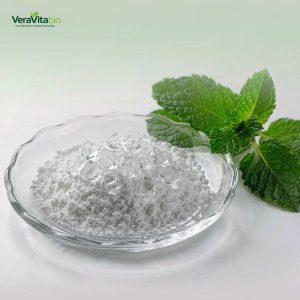
| Appearance | White crystalline powder or granules; no colour change after heating 90 min at 105 °C (an EU-spec identity/stability test — discoloration means impurity or degradation) |
| Assay | ≥ 99.0% on the dried basis (EU 231/2012, as amended); Ph. Eur./FCC window 99.0–101.0% by acidimetry — note the assay is calculated on the dried substance, so moisture must be read together with it |
| Loss on drying | ≤ 1.0% (105 °C, 3 h) |
| Acidity / alkalinity | ≤ ~1.0% (as sorbic acid or K2CO3) — excess alkalinity signals incomplete neutralisation, raising product pH and silently cutting the undissociated (active) fraction |
| Aldehydes | ≤ 0.1% as formaldehyde (EU); Ph. Eur. convention reports ≤ 0.15% as acetaldehyde — the degradation and odour marker |
| Heavy metals (EU 2024/2597, current) | As ≤ 0.1 mg/kg; Pb ≤ 0.1 mg/kg; Hg ≤ 0.01 mg/kg; Zn ≤ 0.1 mg/kg — replacing the legacy 231/2012 limits (As 3 / Pb 2 / Hg 1 mg/kg) still found on old COAs |
| pH / solubility | 1% aqueous solution pH 7.0–8.5 (alkaline — budget for pH adjustment); solubility ~58 g/100 mL water at 20 °C; practically insoluble in ethanol and oils |
| Regulatory position — food | EU: authorised preservative (Reg. 1333/2008 Annex II, E 200–202, group limits as sorbic acid, quantum by category); purity per 231/2012 as amended by Reg. (EU) 2024/2597 (applies 27 Oct 2024; heavy-metal points from 27 Apr 2025, stock through-chain dates apply). US: sorbic acid/potassium sorbate GRAS (21 CFR 182.3089 / 182.3640, GMP). China: GB 2760-2024, CNS 17.003/17.004, preservative + antioxidant functions, per-category maxima 0.5–1.5 g/kg as sorbic acid; product standard GB 1886.39-2015. JECFA group ADI (with sorbic acid) 0–25 mg/kg bw; EFSA group ADI 11 mg sorbic acid/kg bw/day (2019 follow-up opinion, replacing the 2015 temporary 3 mg/kg; NOAEL 300 mg/kg bw/day from the two-generation rat study, UF 100) |
| Regulatory position — cosmetics | EU: Annex V entry 4 — sorbic acid and its salts, max 0.6% expressed as acid (0.80% potassium sorbate equivalent); IECIC-listed in China; ISO 11930 challenge test expected. Watch item: Germany filed a CLH intention for sorbic acid in Aug 2026 (Skin Irrit. 2 / Eye Irrit. 2 / Skin Sens. 1B) — classification may tighten downstream labelling |
| HS code | 2916.19 (salts and esters of unsaturated acyclic monocarboxylic acids) — confirm the national subheading with your broker |
| Shelf life | 24 months sealed, cool and dry; assay and aldehydes at retest on the COA |
| Packaging | 25 kg PE-lined kraft bag or fibre drum; 1 kg evaluation packs; hygroscopic — line integrity is part of the spec |
| Certifications | ISO 9001 / GMP manufacturing; HALAL and KOSHER on request; non-GMO and allergen declarations (synthetic product — no fermentation substrate) |
Formulation & Handling Notes
- Buy the acid-equivalent, dose the pH window. Convert first: 1.00% potassium sorbate = 0.75% sorbic-acid equivalent (factor 112.13/150.22). Then check the finished pH against the undissociated curve — below pH 5.0 sorbate is generous; between 5.5 and 6.0 it needs partners and stronger doses; above 6.0 it is decorative. Pair it with citric acid (E 330) — the acidity tool that puts the matrix into sorbate’s working window in the first place.
- The alkalinity line is a working spec, not paperwork. Free K2CO3/KOH above the ~1% cap means the lot is under-neutralised: it pushes your product’s pH up (cutting the active fraction you paid for) and pads the batch weight. Two lots both “99%” can behave differently if one carries 0.9% alkali and the other 0.1%.
- Read moisture with assay. Assay is quoted on the dried basis; a lot with 1.0% loss-on-drying and a lot with 0.1% differ by nearly 1% in real delivered acid — enough to flip a marginal preservative calculation. Demand both numbers on every COA.
- Dissolve fully, add cool. Pre-dissolve potassium sorbate in its own portion of warm (30–40 °C, not hot) water — or dose granules into the vortex of the main batch — and add after heat processing, in the cool-down phase: extended holding above ~70 °C accelerates the carbonyl degradation that becomes off-odour and yellowing. Sorbate is not a kettle-survivor; it is a finisher.
- Guard against the yellowing path. Trace iron and copper catalyse oxidative degradation — deionised water, no bare-iron contact surfaces, oxygen-limited headspace and opaque packaging for white matrices. A lot that yellows in the 105 °C/90 min colour-stability test will yellow on your shelf.
- Know the documented combination cautions. Avoid stacking sorbate with nitrite (cured meats) and re-test any system combining sorbate with ascorbic acid plus iron; both pairings can generate in-vitro-mutagenic products under optimised conditions. In cosmetics, expect sorbate + benzoate to be your bacterial cover while sorbate handles yeast and mould.
- Mind the potassium in cosmetics. The salt is alkaline in solution and adds electrolytes: unbuffered systems drift up, carbomer and some associative thickeners lose viscosity, and crystal haze can form if you over-dose a near-saturated water phase. Adjust pH after addition, and validate with ISO 11930 — the Annex V ceiling is a legal limit, not a dose recommendation.
- Form factor for dry blends. Granules for seasonings, drink powders and dry mixes (no dust, no segregation, no caking in the bag); powder only where rapid dissolution justifies it. Declare the form on the RFQ — quotes across forms are not comparable on price per kilo of behaviour.
- Pairing logic. Composite systems that ship well from one drum: sorbate + benzoate (beverage, cosmetic), sorbate + nisin (dairy), sorbate + sulfite (wine — with the interaction limits that implies), sorbate + lactate (meat-adjacent, where permitted).
Storage & Handling
Store sealed in a cool (<25 °C), dry warehouse away from direct sunlight and heat sources; potassium sorbate is hygroscopic and cakes on moisture uptake — keep opened bags resealable or decant into airtight containers, and protect liner integrity on part-used drums. Keep away from strong oxidants and acids in storage (acidification converts the salt to free sorbic acid, which crystallises out). Use FIFO rotation, and run goods-in checks on appearance (whiteness), loss on drying and aldehydes — the three fastest degradation indicators. In production, weigh in a low-dust area; granular form eliminates most dust-handling concerns.
Why Choose VeraVitabio
- Specified against the 2024 rule, not the 2012 one. We quote heavy metals against Reg. (EU) 2024/2597 — As/Pb 0.1, Hg 0.01, Zn 0.1 mg/kg — with the assay, loss on drying, acidity/alkalinity and aldehydes lines that actually predict performance, per lot, on one COA.
- Form and grade transparency. Powder or granules, food or cosmetic grade, stated on the quote — because behaviour, dosing and price-per-performance differ across all four.
- Regulatory honesty. We tell you where the pH window ends for your matrix, what the Annex V acid-equivalent ceiling means for your label, and where the 2026 CLH watch item could move cosmetics labelling — before you build a launch on sorbate alone.
- Stack-friendly portfolio. Quote potassium sorbate together with our citric acid (E 330), xanthan gum (E 415) and personal-care ingredients — the acidity, texture and preservation of one system from one supplier, one COA pack, one shipment.
- From sample to container. 1 kg evaluation packs with the current lot’s COA, 25 kg bags for production, container-load pricing for annual programs.
Request a Quote
Send us four things and we will quote precisely rather than generically: (1) the grade and form — food or cosmetic grade, powder or granules; (2) the destination market — so the COA, heavy-metal limits and regulatory file match the rules actually in force there; (3) the pack size and volume; and (4) the matrix and its pH — we will confirm sorbate fits the working window or recommend the pairing that does. We reply with pricing, the current lot’s COA and a sample lead time.
Email: info@veravitabio.com | WhatsApp: +86 157 7194 0528
VeraVita Bio — Xi’an VeraVita Biotech Co., Ltd. | Botanical & Functional Ingredient Sourcing Partner
Email: info@veravitabio.com | WhatsApp: +86 157 7194 0528 | veravitabio.com
Disclaimer: The information provided is for general technical and commercial reference only and does not constitute regulatory, legal, medical or formulation advice. Regulatory status, maximum use levels and permitted claims vary by market and change over time; they must be verified against the requirements in force in the destination market before labelling or claims are finalised. Specifications are subject to batch confirmation from the lot COA. Potassium sorbate is a raw material supplied to qualified business customers, not a finished consumer product. Responsibility for finished-product safety, stability, labelling, claims and regulatory compliance in the destination market remains with the manufacturer.
Need pricing, a sample or full documentation?
Send your specification, target volume and destination country — our team replies within one business day.
Reviews
There are no reviews yet.