Product Overview
Citric acid (2-hydroxypropane-1,2,3-tricarboxylic acid, C6H8O7; CAS 77-92-9 anhydrous, CAS 5949-29-1 monohydrate) is the most widely used food acid in the world and one of the largest-volume organic acids in international trade. It is the acid that gives citrus fruit its sharpness, yet practically none of the commercial material is extracted from fruit: more than 99% of world supply is made by submerged fermentation of glucose or sucrose with the filamentous fungus Aspergillus niger, followed by calcium citrate precipitation or solvent extraction, acidification, crystallisation, purification and drying. China holds the largest share of global capacity — commonly estimated at 1.5–2.0 million tonnes a year — and Chinese export offers set the reference price for every other origin.
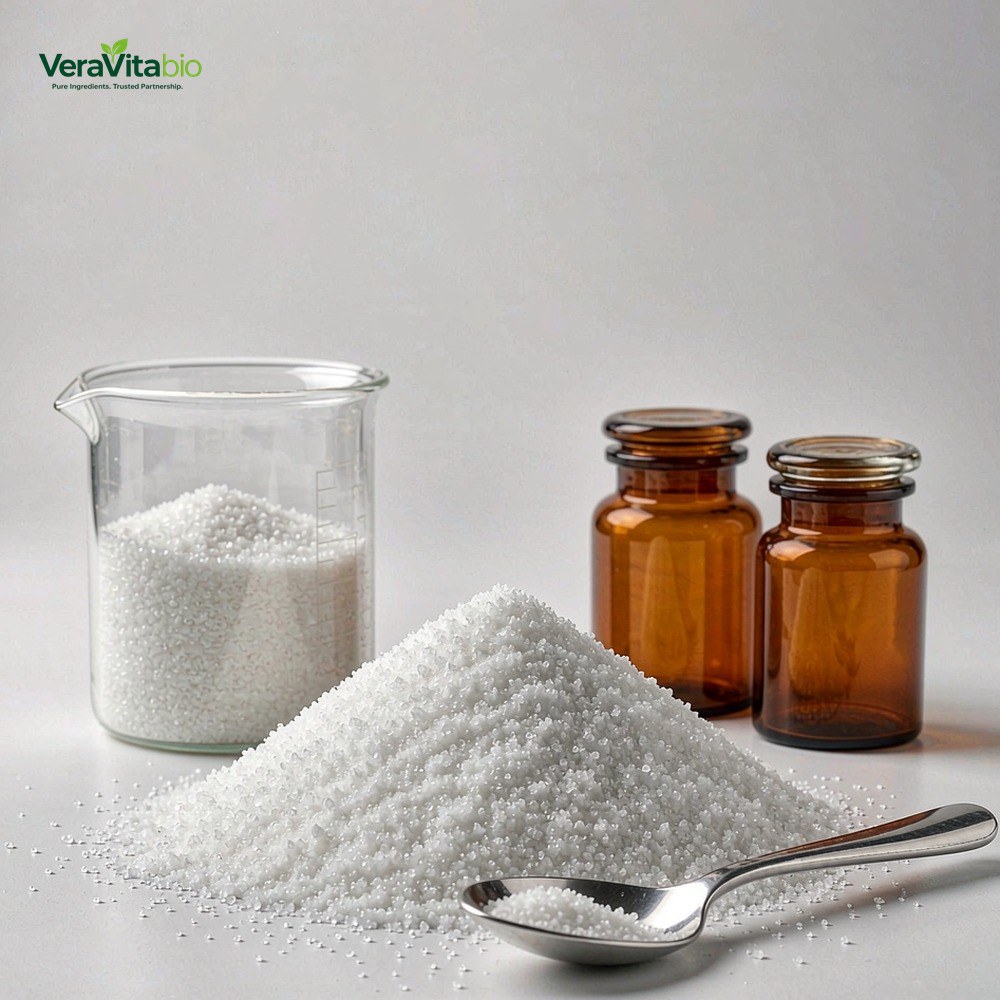
Two crystal forms dominate trade, and they are not interchangeable in a formula: anhydrous (no water of crystallisation, 100% citric acid by weight) and monohydrate (one molecule of water of crystallisation, about 91.4% citric acid by weight). Which form crystallises out of solution is decided by temperature — the anhydrous form above roughly 36.5 °C, the monohydrate below it. VeraVitabio supplies food grade to the E330 / FCC / JECFA monographs, pharmaceutical grade to USP, Ph. Eur., BP and JP, and technical 25% and 50% solutions, in granular, fine granular and powder particle sizes, packed in 25 kg bags with PE liner through to 1000 kg FIBC and full containers.
Citric acid is also one of the few commodity acids where the trade-remedy position can cost more than the FOB price. Definitive anti-dumping duties apply to Chinese-origin material in both the EU and the US, and the rate depends on which producer made the lot. We therefore ship producer-level origin documentation with every EU- and US-bound order, so that customs clearance does not become your problem.
Key Features
- Two forms, one acid — choose by process, not by price. Monohydrate carries one water molecule per acid molecule (91.4% acid by weight): 1.094 kg of monohydrate delivers the same acidity as 1.000 kg of anhydrous, and 1 kg of monohydrate equals 0.914 kg anhydrous. Buying on price per kilogram without the conversion is the most common costing error in this category.
- Triprotic buffer spanning pH 3–6. Three carboxylic groups with pKa values of 3.13, 4.76 and 6.40 (25 °C) give citric acid and its citrate salts the widest useful buffering window of any food acid; a 1% solution sits at about pH 2.1–2.5.
- True chelating agent, not just an acidulant. The citrate anion is a multidentate ligand that sequesters calcium, magnesium, iron, copper and manganese — the mechanism behind antioxidant synergy, anti-browning, hardness control and descaling.
- Globally harmonised status. EU food additive E330 (quantum satis) with purity criteria in Regulation (EU) No 231/2012; US GRAS under 21 CFR 184.1033 with no limit other than GMP; JECFA/INS 330 with ADI “not limited” since 1973; FEMA 2306 as a flavouring substance.
- Impurity-led specification, not purity theatre. Every lot is 99.5–100.5% assay, so the numbers that actually separate a beverage grade from a cheap lot are oxalate (E330 limit ≤ 100 ppm) and sulfate (≤ 150 ppm) — both reported per lot on our COA.
- Clarity and colour grades for clear beverages. “Clarity and colour of solution” not more intense than reference solution Y7, BY7 or GY7, with light transmittance typically ≥ 96–98% depending on grade — a dark lot will haze a clear RTD even though its assay is compliant.
- Full particle-size portfolio. Granular 12/40, fine granular and powder (30–100 mesh): granular for dust-free dry blending and low caking tendency, powder for fast dissolution in liquid plants.
- Manufacturing route disclosed. Citric acid is purified either through the calcium citrate route or by solvent extraction with tridodecylamine (TDA ≤ 0.1 ppm limit applies only to the solvent route). We state which route produced the lot — relevant to pharma and to customers screening amine residues.
- Pharmaceutical-grade depth. Aluminium ≤ 0.2 ppm, bacterial endotoxins ≤ 0.5 IU/mg, readily carbonisable substances, ICH Q3D elemental impurity statement, BSE/TSE-free and no animal-derived inputs in the process.
- Encapsulated and liquid options. Fat- or salt-coated grades for delayed acid release in moisture-sensitive dry mixes and confectionery; 25% and 50% solutions for descaling, passivation and pH adjustment without dust handling.
- Trade-remedy paperwork as standard. Producer name and producer-specific duty rate documentation for EU imports under Regulation (EU) 2021/607 and US entries under AD/CVD case numbers A-570-937 and C-570-938 — see Formulation Notes.
- Full documentation pack. Per-lot COA, SDS in the destination language, non-GMO / identity-preserved statement (the fermentation substrate is normally corn), allergen and vegan declarations, HALAL and KOSHER on request, FSSC 22000 / ISO 9001 / GMP manufacturing.
How It Works
1. Acidulation and pH control. The three carboxylic acid groups dissociate in steps (pKa 3.13, 4.76, 6.40), so citric acid delivers acidity progressively as pH falls rather than all at once. In beverages this produces a clean, bright sourness; in preservation it does something more important — pushing pH below 4.6, the threshold below which Clostridium botulinum cannot germinate and produce toxin, and below which most spoilage bacteria are inhibited. Lower pH also reduces the heat process needed for a given shelf life, which protects colour, flavour and heat-labile vitamins.
2. Chelation is the underrated function. Trace iron and copper are pro-oxidants: they catalyse lipid oxidation and the enzymatic browning that turns cut fruit brown. A citrate ion wraps around these metal ions and holds them in a chemically unavailable form. That is why citric acid appears in commercial antioxidant systems as a synergist — it is not itself a strong radical scavenger, but it multiplies the effect of ascorbate, tocopherols and BHA/BHT. The same claw explains its role in descaling (calcium carbonate), in controlling water hardness in detergents, and in stabilising colour and flavour of canned produce.
3. Sourness and flavour architecture. Perceived sourness tracks total titratable acidity more than measured pH, and each acid has its own temporal profile: citric is fast, sharp and clean with little linger; malic is longer and greener; lactic is softer and dairy-like; tartaric is harder and more grape-like. This is why acid blends, not single acids, are used to build realistic fruit flavours, and why a specification should state titratable acidity as well as pH.
4. Effervescence. In the presence of bicarbonate or carbonate, the protons from citric acid liberate carbon dioxide: three moles of bicarbonate are consumed per mole of citric acid, so roughly 1.2 g of sodium bicarbonate per gram of monohydrate. The reaction both generates the fizz and drops pH, which is why effervescent tablets self-dissolve and why the acid : bicarbonate ratio controls whether the finished drink tastes sour, chalky or neutral.
5. Why it is so safe. Citrate is a normal intermediate of the tricarboxylic acid (Krebs) cycle and a natural constituent of every cell in the human body, which is the basis for an ADI of “not limited”. That does not make it hazard-free in handling: it is classified in the EU as an eye irritant and respiratory irritant, fine dust can form explosive mixtures, and it reacts dangerously with hypochlorite bleach.
Typical Applications
- Carbonated soft drinks, juices, nectars, sports and energy drinks, flavoured water — the single largest application worldwide; the beverage grade supplies the sourness, the pH for preservative function, and the chelation that protects colour and vitamin C.
- Syrups, cordials and concentrates — high acid levels also act as a humectant and anti-crystallisation aid in sugar syrups.
- Confectionery — sour candies, gummies, jellies, liquorice, chewing gum coatings and sherbet; granular and coated grades for sugar-sanding and delayed release.
- Jams, jellies, marmalades, canned fruit and vegetables — pH control for sterilisation, pectin gel setting, and inhibition of enzymatic browning.
- Dairy — direct acidification in mozzarella and acid-set cheeses, processed cheese and spreads (with sodium citrate as the emulsifying salt), cultured products and dairy desserts.
- Sauces, dressings, mayonnaise, pickles and ready meals — pH and chelation for emulsion stability and shelf life.
- Meat, poultry and seafood — anti-browning and antioxidant synergy; also used in some curing and brine systems.
- Bakery and chemical leavening — the acid component of baking powders and self-raising systems, reacting with sodium bicarbonate on heating or hydration.
- Effervescent tablets, sachets, stick packs and powdered drink mixes — anhydrous grade is the norm, because water of crystallisation can react prematurely with bicarbonate in storage.
- Wine, beer and cider — acid adjustment where permitted by the destination market’s oenological rules.
- Personal care and hair care — the standard pH adjuster for shampoos and body washes (target 4.5–5.5), and a chelator at 0.05–0.2% that protects surfactants and actives from hard-water calcium and trace iron; also in bar soap, bath bombs, effervescent bath products and toothpaste.
- Skin care and cosmetics — pH adjustment for vitamin C, AHA and gel systems, and citrate buffering where a stable mildly acidic pH is required (INCI: Citric Acid).
- Household and industrial cleaning — descaler for kettles, coffee machines, boilers and heat exchangers; citric-acid passivation of stainless steel as a nitric-acid alternative; phosphate replacement in detergent builders.
- Pharmaceutical — effervescent dosage forms, oral solutions and buffers, and citrate anticoagulant for blood collection and dialysis, where the pharmacopoeial grade with endotoxin limits is required.
Key Specifications
| Parameter | Specification |
|---|---|
| Chemical name | 2-Hydroxypropane-1,2,3-tricarboxylic acid (citric acid, anhydrous); 2-hydroxypropane-1,2,3-tricarboxylic acid monohydrate |
| CAS number | 77-92-9 (anhydrous); 5949-29-1 (monohydrate) |
| E number / INS | E 330 / INS 330 (JECFA No. 218; FEMA 2306 as flavouring) |
| Molecular formula / weight | C6H8O7 / 192.12 (anhydrous); C6H8O7·H2O / 210.14 (monohydrate) |
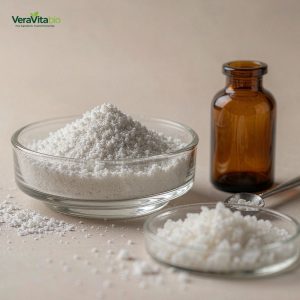
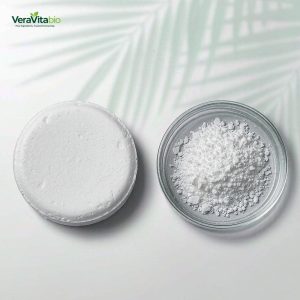
| Appearance | Colourless crystals, or white granular to fine crystalline powder; practically odourless; strongly acid taste |
| Assay | 99.5–100.5% (alkalimetric, calculated on the anhydrous substance) |
| Water (Karl Fischer) | Anhydrous ≤ 0.5% (premium grades ≤ 0.2%); monohydrate 7.5–9.0% (typically 8.5–8.8%) |
| pH | Approx. 2.1–2.5 (1% aqueous solution, 25 °C); pKa 3.13 / 4.76 / 6.40 |
| Solubility | Very soluble in water — approx. 590 g/L (monohydrate) to 750 g/L (anhydrous) at 20 °C; soluble in ethanol; practically insoluble in ether |
| Melting / decomposition | Anhydrous approx. 153 °C (with decomposition); monohydrate releases water of crystallisation on heating and melts with decomposition above approx. 135 °C; thermal decomposition to CO2 and water above approx. 175 °C |
| Bulk density | Approx. 0.8–1.0 g/cm3 loose (grade-dependent); true density 1.665 g/cm3 (anhydrous), 1.552 g/cm3 (monohydrate) |
| Particle size | Granular 12/40, fine granular, powder 30–100 mesh; sieve data stated per grade on request |
| Clarity and colour of solution | Clear and not more intensely coloured than reference solution Y7, BY7 or GY7; light transmittance typically ≥ 96–98% (grade-dependent) |
| Oxalate | ≤ 100 ppm (E 330 / JECFA); ≤ 360 ppm permitted by BP/USP — we standardise to the E 330 limit for all food and beverage grades |
| Sulfate | ≤ 150 ppm (E 330 / BP / USP); premium and pharma grades ≤ 30–50 ppm |
| Chloride | ≤ 5 ppm (E 330) |
| Heavy metals | ≤ 5 ppm as Pb (E 330); ≤ 10 ppm (BP/USP); Pb ≤ 0.5 ppm; As ≤ 1 ppm; Hg ≤ 1 ppm |
| Aluminium | ≤ 0.2 ppm (Ph. Eur. / BP; relevant to parenteral and dialysis applications) |
| Calcium / iron | Ca ≤ 75 ppm (E 330); Fe ≤ 5 ppm (E 330) |
| Barium | Passes test (no turbidity) |
| Readily carbonisable substances | Passes test (FCC / BP / E 330) |
| Sulfated ash / residue on ignition | ≤ 0.05% |
| Tridodecylamine (TDA) | ≤ 0.1 ppm — applies only to solvent-extraction material; manufacturing route declared per lot |
| Isocitric acid / PAH | Passes test (isocitric acid as fermentation marker; polycyclic aromatic hydrocarbons controlled) |
| Bacterial endotoxins | ≤ 0.5 IU/mg (pharmacopoeial grade) |
| Microbiology | TAMC ≤ 1,000 cfu/g; yeasts and moulds ≤ 100 cfu/g; E. coli absent in 1 g; Salmonella absent in 25 g |
| Standards | E 330 / Regulation (EU) No 231/2012; FCC; JECFA; USP; Ph. Eur.; BP; JP; GB 1886.235 (China) |
| Regulatory position | EU: authorised additive E 330, generally quantum satis under Regulation (EC) No 1333/2008. US: GRAS, 21 CFR 184.1033, no limit other than cGMP. JECFA: ADI “not limited”. Feed additive 1a330 in the EU, authorised to April 2032 and restricted to named production strains. Outside the scope of EU CBAM and the EU Deforestation Regulation |
| CLP classification | Harmonised EU classification since 17 December 2022 (Delegated Regulation (EU) 2021/849): Eye Irrit. 2 (H319), STOT SE 3 (H335) — signal word Warning. SDS supplied in the destination language |
| HS / CN code | 2918 14 00 (citric acid); 2918 15 00 (citrate salts). US HTS 2918.14.0000 — general duty 6.0%; EU MFN duty 6.5%, before any anti-dumping duty |
| Shelf life | 36 months unopened in the original sealed packaging under the stated storage conditions |
| Packaging | 25 kg PP woven bag or kraft bag with PE liner; 500 kg and 1000 kg FIBC; 25 kg / 250 kg drums; 1 kg and 5 kg evaluation packs; 25% and 50% solutions in IBC or drum |
| Certifications | FSSC 22000 / ISO 9001 / GMP manufacturing; HALAL and KOSHER on request; non-GMO / identity-preserved statement; allergen-free and vegan declarations; REACH registered |
Formulation Notes
- Choose the crystal form by water balance, not by price. For dry blends, effervescent tablets and powdered drink mixes, specify anhydrous: water of crystallisation from monohydrate is enough to start reacting with bicarbonate during storage, which shows up as caking, loss of fizz and a stale taste long before expiry. For liquid plants and general food use, monohydrate is cheaper per kilogram and the water is irrelevant — just remember it delivers 91.4% acid by weight, so recalculate your addition rate instead of copying an anhydrous formula.
- Anhydrous is the hygroscopic one — engineer for it. Anhydrous citric acid picks up atmospheric moisture and converts to the monohydrate, which is exactly the failure mode you were avoiding. Keep the plant environment below about 50–60% RH in handling areas, use moisture-barrier liners, reseal opened bags immediately, and never leave material in an open hopper overnight.
- Caking is the number one quality complaint in this category. Causes are humidity, over-stacked pallets, temperature cycling in transit and excess fines. Specify a granular grade rather than powder where flowability matters, respect the supplier’s stacking limit, keep containers out of direct sun, and rotate stock FIFO. If your warehouse is unheated and humid, ask for a coated grade.
- Oxalate is the impurity to negotiate on. The E 330 limit is ≤ 100 ppm, but BP and USP still permit ≤ 360 ppm — so a lot can be “pharmacopoeial compliant” and still be three times higher in oxalate than a beverage-grade lot. Elevated oxalate points to incomplete fermentation or purification. Ask for oxalate and sulfate per lot, not per year.
- Clarity matters more than assay for clear beverages. A dark or hazy lot with a 99.8% assay will still ruin a transparent RTD. Specify “clarity and colour of solution”, light transmittance, and request a photo of a freshly prepared 50% solution from the actual lot before you commit to a container.
- Do not expect citric acid alone to hold pH 5. Its first pKa is 3.13, so at pH 4.5–5.5 it is largely dissociated and its buffering capacity is poor. For real buffering in that range use sodium citrate (E 331) blended with citric acid; for pH 6 and above use the citrate salt alone. Citric acid is best understood as an acidulant plus a chelator that happens to buffer well around pH 3–4.
- Preservative pairing has a pH gate. Potassium sorbate (pKa 4.76) and sodium benzoate (pKa 4.20) only work in their undissociated form, so they need the finished product below roughly pH 4.5 and 4.2 respectively. Citric acid will often not get you there on its own — in colas, phosphoric acid does the heavy lifting; in fruit drinks, citric plus a controlled juice/malic acid blend usually does.
- Build sourness on titratable acidity. Two drinks at the same pH can taste completely different because pH measures strength, not quantity. Formulate to a target TA (expressed as citric acid monohydrate), then check pH for preservation and stability. This is also the number your customer’s sensory panel will actually notice.
- Effervescent stoichiometry. Three moles of sodium bicarbonate per mole of citric acid means roughly 1.2 g bicarbonate per gram of monohydrate (about 1.1 g per gram of anhydrous). Under-dosing bicarbonate leaves an alkaline, soapy aftertaste; overdosing leaves residual acidity and a gritty mouthfeel. Commercial systems typically run acid : bicarbonate between 1 : 1.2 and 1 : 1.5 by weight, balanced for taste and disintegration time, and are granulated under controlled humidity.
- Confectionery: add acid late and buffer for stability. In gummies and jellies, adding citric acid during cooking drives sucrose inversion and pectin hydrolysis, giving sticky, weeping textures; dose it late in the process, below about 80 °C, and consider a citrate buffer to stop the surface becoming aggressively sour over shelf life. With pectin gels, remember that citrate chelates the calcium that pectin needs to set.
- Dairy acidification is not interchangeable with culture acidification. Direct acidification with citric acid gives a different curd structure and calcium distribution from fermentation with starter cultures; for mozzarella-style products the choice changes stretch, melt and yield. Trial before scaling, and pair with the correct emulsifying salt (sodium citrate) in processed cheese.
- Personal care: pH 4.5–5.5 is the target, and citrate is how you hit it. Shampoos and body washes are buffered into that window to match scalp and skin, keep anionic surfactants mild, and hold preservative efficacy; too high and you get soap scum and dull hair, too low and you stress the cuticle and accelerate colour fade in dyed hair. At 0.05–0.2% citric acid also chelates hard-water calcium and trace iron — but be realistic: citrate is a weaker chelator than EDTA, GLDA or phytic acid, so for iron-driven discolouration in a formula, use a dedicated chelator and keep citric acid for pH and mild sequestration.
- Never mix citric acid with hypochlorite bleach. Acidifying hypochlorite liberates chlorine gas — a genuine industrial accident pattern in cleaning operations. Keep acid descalers and chlorine sanitisers physically separated, and never dose them into the same tank or CIP circuit without an intermediate water rinse.
- Trade remedies: the producer name is worth more than the discount. For EU imports, Commission Implementing Regulation (EU) 2021/607 imposes definitive anti-dumping duties on Chinese citric acid at producer-specific rates commonly reported in the 15.3–42.7% range for cooperating producers (TTCA, RZBC and COFCO hold individual rates), with the 42.7% residual rate applying to unnamed producers and to traders that cannot document the producer; the measures were extended to goods consigned from Malaysia by Regulation (EU) 2016/32. An expiry review was initiated on 14 April 2026 (OJ C/2026/2120) at the request of N.V. Citrique Belge and Jungbunzlauer Austria, so the duties remain in force while the review runs, and the review scope now also covers trisodium citrate dihydrate under CN ex 2918 15 00. In the US, the AD and CVD orders (A-570-937 / C-570-938) were continued on 26 May 2026 after the third sunset review; Commerce reported likely-prevailing countervailable subsidy rates of 60.07% (TTCA), 52.22% (Yixing Union Biochemical), 166.34% (Anhui BBCA Biochemical) and 55.53% for all others, and a dumping margin of 156.87% were the orders revoked, on top of Section 301 at 25% and an additional 10% under Section 122 from 24 February 2026. The practical consequence: obtain the producer’s name and its duty-rate documentation before you book freight, because freight booked against an undocumented origin can land at the residual rate and erase the entire price advantage. Tariff programmes change frequently — confirm the current position with your customs broker on the day of shipment.
- Non-GMO is a claim you must document, not assume. Chinese citric acid is normally fermented on corn-derived glucose, and corn in the main exporting regions is largely genetically modified. For EU non-GMO programmes, request an identity-preserved / non-GMO statement tied to the actual substrate and the production site, and verify it against your certification scheme’s requirements rather than accepting a generic letter.
- Regulatory reminders. E 330 is authorised quantum satis in the EU but purity must meet Regulation (EU) No 231/2012; in the US it is GRAS with no numerical limit but must meet FCC. Because the harmonised CLP classification (H319 / H335) applies to the substance as supplied, your own SDS and label must reflect it. For pharmaceutical use, order the pharmacopoeial grade with endotoxin and aluminium limits — food grade is not a substitute.
Storage & Handling
Store in the original sealed packaging in a cool (<25 °C), dry, well-ventilated warehouse, away from direct sunlight and away from strong bases, strong oxidisers, metal nitrates and hypochlorite. Relative humidity above roughly 65% is the practical threshold at which anhydrous material starts converting to monohydrate and caking; monohydrate, conversely, can effloresce in very dry air. Respect pallet stacking limits, avoid temperature cycling in transit, and operate strict FIFO. Prepare solutions in stainless steel, FRP or plastic equipment — citric acid attacks mild steel, galvanised surfaces and some aluminium alloys, especially hot. Dilute solutions below about 10% can support mould growth despite the low pH, so make them up fresh or add a preservative; 50% solutions should be kept above about 10 °C to avoid crystallisation. Dust control is mandatory: local exhaust ventilation, dust masks, goggles and gloves. Citric acid dust is a respiratory irritant and can form explosive mixtures in air, so bond and ground equipment, avoid compressed-air blowing, and keep the area free of accumulated dust. Do not seal hot material into bags; allow it to cool to ambient first.
Why Choose VeraVitabio
- Form and grade selection, not a price list. We quote anhydrous or monohydrate, granular or powder, food, pharma or technical — and we will tell you which one your process actually needs, including the 1.094 conversion that most quotations quietly ignore.
- Per-lot COA with the numbers that matter. Oxalate, sulfate, chloride, clarity and colour of solution, heavy metals by element, water content by Karl Fischer, and the manufacturing route (calcium citrate versus solvent extraction with TDA declared).
- Trade-remedy documentation built into the offer. For EU and US destinations we provide the producer name and producer-specific duty-rate documentation, and we flag when a shipment would attract the residual rate before you commit.
- Pharmacopoeial capability. USP / Ph. Eur. / BP / JP grade with aluminium, endotoxin and ICH Q3D statements for pharmaceutical and dialysis applications.
- Documentation for regulated markets. SDS in the destination language, non-GMO and identity-preserved statements, allergen-free and vegan declarations, HALAL and KOSHER certificates, and FSSC 22000 / ISO 9001 manufacturing records.
- Continuity of supply. Multiple qualified production sources and both crystal forms in stock, so a single plant outage or an environmental inspection in Shandong does not stop your line; term contracts with feedstock-indexed pricing available for annual programmes.
- Cross-sell that actually works. Quote citric acid together with sodium citrate (E 331), potassium citrate (E 332) and calcium citrate (E 333) for buffer systems, and with our xanthan gum, sweeteners and preservative range for complete beverage and personal-care formulations.
- From sample to container. 1 kg and 5 kg evaluation packs, 25 kg bags and 1000 kg FIBC for production, and container-load pricing with mixed packaging on request.
Request a Quote
Send us four things and we will quote precisely rather than generically: (1) the form — anhydrous or monohydrate; (2) the grade — food (E 330 / FCC), pharmaceutical (USP / Ph. Eur.) or technical solution; (3) the particle size and packaging; and (4) the destination market plus your annual volume, since EU and US duty treatment depends on the named producer. We reply with pricing, the current lot’s COA including oxalate, sulfate and clarity data, the producer and duty-rate documentation for your market, and sample lead time — so you can run a dissolution, taste and stability check in your own plant before committing to tonnage.
Email: info@veravitabio.com | WhatsApp: +86 157 7194 0528
VeraVita Bio — Xi’an VeraVita Biotech Co., Ltd. | Botanical & Functional Ingredient Sourcing Partner
Email: info@veravitabio.com | WhatsApp: +86 157 7194 0528 | veravitabio.com
Disclaimer: The information provided is for general technical and commercial reference only and does not constitute regulatory, legal, customs or formulation advice. Anti-dumping and tariff references are indicative and change by regulation and by producer; they must be verified with your customs broker and against the measure in force on the date of import. Specifications are subject to batch confirmation from the lot COA. Citric acid is a raw material supplied to qualified business customers, not a finished consumer product. Responsibility for finished-product safety, stability, labelling, claims and regulatory compliance in the destination market remains with the manufacturer.
Need pricing, a sample or full documentation?
Send your specification, target volume and destination country — our team replies within one business day.
Reviews
There are no reviews yet.