Product Overview
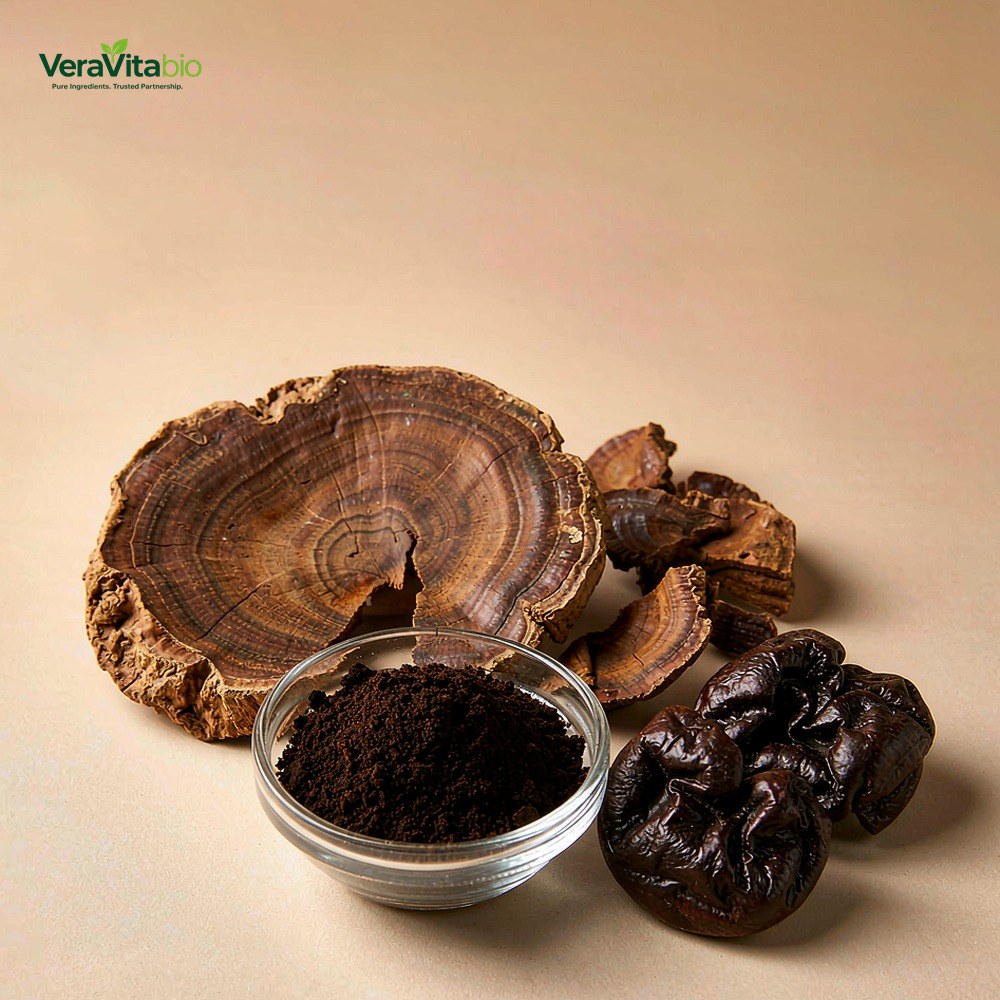
Mesima is the trade name used across the global supplement industry for the woody bracket fungus Phellinus linteus (Berk. & M.A. Curtis) Teng, a hard, perennial, hoof-shaped polypore in the family Hymenochaetaceae. It is the same fungus known in Korea as Sanghwang (상황), in Japan as Meshimakobu (メシマコブ), and in China as Sanghuang (桑黄, “mulberry yellow”). Modern pharmacological interest dates to the late 1960s, when Japanese researchers reported that hot-water extracts of the fungus strongly inhibited sarcoma 180 in mice — a result that launched several decades of research across Korea, Japan and China.
What distinguishes Mesima from the more widely traded medicinal mushrooms is that it carries two chemically distinct active fractions, and the value of a lot depends on whether your supplier has retained both. The first is the polysaccharide fraction: water-soluble β-(1,3)/(1,6)-D-glucans that engage innate immune receptors (Dectin-1, CR3, TLR2/6) and are the basis of virtually all immune-positioning for medicinal mushrooms. The second is the styrylpyrone phenolic fraction — hispidin (CAS 555-55-5) and its analogues hispolon, phelligridins, davallialactone, inotilone and interfungin A — which is responsible for the very high antioxidant and anti-inflammatory readings reported for this species in preclinical models. Because the polysaccharide fraction is water-soluble and the phenolic fraction is largely ethanol-soluble, a conventional hot-water “polysaccharide-standardized” extract captures only about half of what makes this fungus distinctive.
VeraVitabio supplies Mesima fruiting-body extract in evaluation packs through full container loads, with per-lot COA covering enzymatic β-glucan, total polysaccharides, HPLC hispidin (on dual-extract grades), moisture, heavy metals, PAH and microbiology, plus MSDS/SDS and compliance documentation on request.
Key Features
- Two active fractions, one material — β-(1,3)/(1,6)-D-glucan for immune positioning plus the hispidin styrylpyrone phenolic fraction for antioxidant and anti-inflammatory positioning; dual water/ethanol extraction grades retain both.
- Hispidin is the chemotaxonomic signature — hispidin (CAS 555-55-5, C13H10O5, MW 246.22) and its analogues are the compounds that separate this species from ordinary polypore extracts; a spec that reports only “polysaccharides” tells you nothing about them.
- Enzymatic β-glucan, not “total polysaccharides” — assayed by the enzymatic method with α-glucan/starch reported alongside, so maltodextrin-diluted material cannot pass (see Formulation Notes).
- Fruiting-body based — woody perennial bracket fruiting bodies, not grain-grown mycelium, with host-tree and species identity documented per lot.
- Species authentication offered — ITS-region DNA barcoding or sequence-verified voucher available, because the “Sanghuang / Mesima” trade involves several different fungi (see Formulation Notes).
- Premium positioning — one of the most expensive medicinal mushroom extracts per kilogram, which makes authenticity the deciding factor in supplier selection rather than the headline percentage.
- Full regulatory documentation set — heavy metals, PAH (benzo[a]pyrene, PAH4), pesticide residues against EU 396/2005 MRLs, residual solvents, and microbiology tested per lot rather than per year.
- Broad format compatibility — capsule, tablet, sachet, stick pack, RTD beverage, tea blend and cosmetic serum formats; water-soluble clarified grades available for clear drinks.
- Strong combination partner — blends naturally with Reishi, Turkey Tail, Chaga, Lion’s Mane, Cordyceps and Shiitake extracts for multi-mushroom immune and daily-wellness SKUs.
- Cosmeceutical crossover — the phenolic fraction is also used topically under the INCI name Phellinus Linteus Extract for antioxidant and soothing positioning in Korean-style skincare.
How It Works
1. The β-glucan / innate-immune axis. The water-soluble polysaccharide fraction of Mesima is built on a β-(1,3)-D-glucan backbone with β-(1,6) side branches — the same structural motif found across medicinal mushrooms. That branched architecture is what pattern-recognition receptors on innate immune cells read: Dectin-1, CR3 (complement receptor 3) and TLR2/6 on macrophages, dendritic cells and NK cells. Engagement of these receptors primes phagocytosis, cytokine signalling and NK activity. It is more accurate to describe this as immune modulation than immune “boosting”: the receptors are being engaged, not the immune system being switched on indiscriminately. Almost all of this evidence base is preclinical (in vitro and animal models); human data for this species remain limited, and that boundary should be respected in your claims.
2. The hispidin / phenolic axis. The second fraction is where Mesima separates from the pack. Hispidin is a styrylpyrone — a 4-hydroxy-2-pyrone ring linked to a 3,4-dihydroxystyryl group — and the catechol (ortho-diphenol) arrangement is what makes it a potent radical scavenger. Published work describes protection against peroxynitrite-mediated cytotoxicity and hydroxyl-radical damage, inhibition of protein kinase Cβ, and suppression of inflammatory signalling through MAPK and JAK1/STAT3 in LPS-stimulated macrophage models. Related analogues (hispolon, phelligridins, davallialactone, inotilone, interfungin A) contribute further antioxidant and anti-inflammatory activity. This fraction is largely ethanol-soluble: a hot-water-only extract standardized to polysaccharides will contain very little of it.
3. Why the extraction route decides what you are buying. Hot water efficiently pulls β-glucans but leaves most styrylpyrones behind; ethanol pulls the phenolics but leaves the glucans behind. That is why we offer dual-extraction grades (sequential water and ethanol extraction, then combined and standardized) alongside conventional water extracts. If your market position is built on antioxidant or healthy-ageing language, specification without a phenolic marker is a mismatch between your label story and your raw material.
4. Why species identity is not a technicality here. The woody, dark-bracket fungi sold across Asia as “Sanghuang / Mesima” are not one species, and modern molecular work has substantially rewritten the names (see Formulation Notes). Since activity data in the literature were generated on different taxa under overlapping names, the species in your drum determines which published evidence actually applies to your product.
Typical Applications
- Immune-support capsules and tablets — the flagship format; typically 200–500 mg of standardized extract per serving, alone or in a multi-mushroom complex.
- Daily-wellness sachets and stick packs — instant powder for direct consumption or mixing; particle size and flowability matched to your filling line.
- Functional beverages and RTD shots — clarified, low-turbidity grades for clear drinks; standard grades for cloudy juice-style formulations (see Formulation Notes on haze).
- Traditional decoction and tea blends — sliced dried fruiting body or coarse extract powder for herbal tea programmes, often blended with jujube, liquorice or roasted grains.
- Multi-mushroom immune complexes — combines with Reishi, Turkey Tail, Chaga, Lion’s Mane, Cordyceps, Shiitake and Maitake for broad-spectrum SKUs.
- Antioxidant and healthy-ageing formulas — dual-extract grades with declared hispidin content, paired with vitamin C, resveratrol, astaxanthin or CoQ10.
- Cosmeceuticals and topical skincare — under INCI Phellinus Linteus Extract, in antioxidant serums, soothing essences and after-sun or sensitive-skin formulations.
- Premium gifting and traditional-medicine channels — whole sliced dried fruiting body for decoction, where appearance and host-tree provenance drive the price.
- Pet and veterinary wellness — emerging category for senior-animal immune support; confirm local feed regulations before launch.
Key Specifications
| Parameter | Specification |
|---|---|
| Botanical name (trade) | Phellinus linteus (Berk. & M.A. Curtis) Teng |
| Current taxonomic placement | Tropicoporus linteus (Berk. & M.A. Curtis) L.W. Zhou, Y.C. Dai & Sheng H. Wu — the genus Phellinus s.l. was split in 2016 and the linteus complex moved to Tropicoporus; the name Phellinus linteus remains the trade and INCI convention |
| Common names | Mesima, Meshimakobu, Sanghwang, Sanghuang, mulberry-yellow polypore, black hoof mushroom |
| Family / order | Hymenochaetaceae / Hymenochaetales (Basidiomycota) |
| Part used | Fruiting body (perennial woody bracket); mycelium grades available on request |
| Marker compounds | β-(1,3)/(1,6)-D-glucan (CAS 9041-22-1); total polysaccharides; hispidin (CAS 555-55-5, C13H10O5, MW 246.22) and styrylpyrone analogues — hispolon, phelligridins, davallialactone, inotilone, interfungin A |
| Standard grades | Extract ratio 10:1 and 20:1; polysaccharides 30% / 40% / 50% (UV); enzymatic β-glucan 10% / 20% / 30%; dual-extract grades with hispidin ≥ 0.5% or ≥ 1.0% by HPLC |
| Extraction solvent | Water; or sequential water + ethanol (dual extract). No other solvents used |
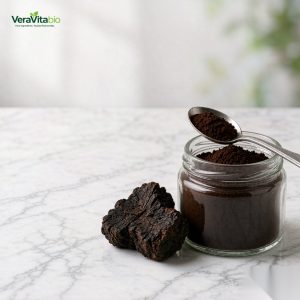
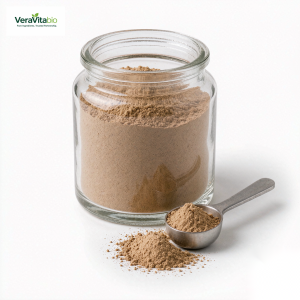
| Appearance | Fine brown to dark reddish-brown powder, characteristic fungal aroma |
| Particle size | 95% pass 80 mesh (clarified grades to 200 mesh on request) |
| Loss on drying | ≤ 5.0% |
| Total ash | ≤ 8.0% |
| Heavy metals | Pb ≤ 3 ppm, As ≤ 2 ppm, Cd ≤ 1 ppm, Hg ≤ 0.5 ppm (per lot; destination-market limits applied) |
| PAH | Benzo[a]pyrene ≤ 10 ppb; PAH4 controlled per EU Regulation 2023/915 |
| Pesticide residues | Compliant with EU Regulation 396/2005 MRLs (screened per lot for cultivated material) |
| Microbiology | TAMC ≤ 10,000 cfu/g; TYMC ≤ 100 cfu/g; E. coli absent in 1 g; Salmonella absent in 25 g |
| Mycotoxins | Aflatoxins B1 ≤ 5 ppb / total ≤ 10 ppb; ochratoxin A controlled |
| Carrier / excipients | None — 100% fruiting-body solids; maltodextrin-free declaration supplied in writing |
| Solubility | Water-dispersible; clarified grades for transparent beverages. β-glucan-rich grades produce natural haze |
| Identification | HPTLC profile per lot; ITS-region DNA barcoding available for species confirmation |
| Regulatory position | EU: not on the authorized Novel Food list — status depends on documented consumption history in the EU before 15 May 1997 and varies by member state; confirm case-by-case. US: dietary ingredient under DSHEA (structure/function claims require notification and disclaimer). Korea and Japan: long-established traditional use and mature market. INCI: Phellinus Linteus Extract |
| HS code | 1302 19 (other vegetable saps and extracts — confirm the subheading with your customs broker) |
| Shelf life | 24–36 months unopened in original sealed packaging, stored cool and dry |
| Packaging | 25 kg fibre drum with double PE liner; 1 kg / 5 kg evaluation packs; full container loads |
| Certifications | HACCP / ISO 9001 manufacturing; HALAL / KOSHER on request; organic (EU / USDA NOP) on request for eligible lots; vegan declaration available |
Formulation Notes
- Species authentication is the first specification, not an afterthought. Molecular work has substantially revised this group. Dai & Xu (1998) concluded that Phellinus linteus in the strict sense is a tropical American and African species with no Asian distribution, and that the material long sold in Japan and Korea under that name was largely Phellinus baumii. Wu et al. (2012) then described the fungus growing specifically on mulberry (Morus) as a new species, Inonotus sanghuang, which Zhou et al. (2016) moved into the new genus Sanghuangporus — Sanghuangporus sanghuang. In the same revision the linteus complex was moved to the new genus Tropicoporus. Notably, most cultivated “sanghuang” fruiting bodies on the market in China, Japan and Korea are reported to be Sanghuangporus vaninii, not S. sanghuang. These taxa are not equivalent, and reported pharmacological activity differs between them. Require, in writing: (a) the exact binomial with author citation, (b) ITS-region DNA barcode or sequence-verified voucher, (c) declared host tree, and (d) whether the material is fruiting body or grain-grown mycelium.
- Buy β-glucan by enzymatic assay, never “total polysaccharides”. The phenol-sulfuric acid method used to report “polysaccharides 40%” counts starch and dextrin as if they were active glucan. Because this fungus is scarce and expensive, dilution with maltodextrin is the most common form of economic adulteration: a heavily cut lot can still report an impressive polysaccharide number while delivering almost no β-glucan. Specify enzymatic β-glucan with α-glucan / starch reported alongside, and require a written “no carrier, 100% fruiting-body solids” declaration on the COA. A supplier who will only quote polysaccharides is quoting a marketing number.
- Standardize the phenolic side too, or you are buying half the mushroom. Hispidin and the styrylpyrones are ethanol-soluble. A hot-water extract standardized only to polysaccharides contains very little of them. If your positioning leans on antioxidant, anti-inflammatory or healthy-ageing language, order a dual-extract grade with an HPLC hispidin value — or buy the water and ethanol extracts separately and blend to your own ratio. Asking “what is the hispidin content?” is the fastest way to separate a serious supplier from a trader.
- Fruiting body versus mycelium-on-grain changes the whole COA. Grain-grown mycelium inevitably retains starch from the substrate, which inflates polysaccharide readings and dilutes β-glucan. Mycelium grades are legitimate and cheaper, but they must be declared as such and priced accordingly — never sold as fruiting-body extract.
- Test heavy metals and PAH per lot, not per year. This is a slow-growing perennial woody bracket fungus that persists on its host tree for years and bioaccumulates whatever the tree and the air contain. Screening for lead, arsenic, cadmium, mercury and for PAH (benzo[a]pyrene ≤ 10 ppb, PAH4, per EU Regulation 2023/915) should be a per-lot gate, and pesticide residues (EU 396/2005) checked for any cultivated material grown on treated substrate.
- Clarity and stability in beverages need to be engineered. β-Glucan-rich extracts give a natural haze and can thicken or sediment over time, especially at low pH or after pasteurization. For clear RTD, specify a clarified grade and validate turbidity and sediment after your thermal process and at the end of shelf life, not just at filling.
- Taste, colour and hygroscopicity are real formulation constraints. The extract is deeply brown with a distinctly bitter, woody note. Masking strategies that work: capsules and tablets first; otherwise cacao, cinnamon, roasted chicory, coffee, jujube or liquorice in beverage and sachet formats. The powder is hygroscopic — specify low-WVTR packaging, control humidity on the filling line, and keep moisture ≤ 5% through storage.
- Position it correctly against Chaga. These are not interchangeable. Chaga (Inonotus obliquus) is characterized by melanin and betulin/betulinic acid from its birch host; Mesima/Sanghwang is characterized by β-glucan plus the hispidin styrylpyrone fraction. If a supplier’s story treats them as the same ingredient, that is a red flag about the depth of their technical knowledge.
- Extraction ratios describe a process, not a potency. “10:1” and “20:1” tell you how much raw material went into a given amount of extract; they say nothing about β-glucan or hispidin content. Always anchor the contract to assayed marker values, and treat the ratio as secondary information.
- Regulatory status must be confirmed before you commit to a market. In the EU this species is not on the authorized Novel Food list; whether it can be placed on the market depends on demonstrating significant consumption in the EU before 15 May 1997, and member-state practice differs — obtain a written status opinion or pursue an Article 4 consultation before launch. In the US it is handled as a dietary ingredient under DSHEA; structure/function claims require notification and the standard FDA disclaimer. Korea and Japan have long-established traditional use and mature regulatory frameworks. No health claims should be made without confirming the rules of the destination market.
- Label cautions for an immunomodulatory ingredient. Because the material engages innate immune receptors, finished-product labels should carry standard cautionary language for people taking immunosuppressive therapy, those with autoimmune conditions, transplant recipients, and during pregnancy and lactation. Given the antioxidant and reported glucose-lowering activity seen in preclinical models, a caution for people on antidiabetic medication and advice to discontinue before elective surgery are prudent. Confirm the final wording with your regulatory reviewer.
Storage & Handling
Store in the original sealed packaging in a cool (<25 °C), dry, well-ventilated area away from direct sunlight and strong odours. The powder is hygroscopic: once opened, reseal immediately and consider desiccant and low-WVTR liners for any repacked material, because moisture pickup drives caking, colour darkening and eventual microbiological growth. Use FIFO stock rotation. Avoid temperature cycling in transit and warehousing, which can pull moisture into the drum. During handling, standard dust control applies for fine botanical powders: local extraction, gloves, eye protection and a dust mask when decanting kilogram-scale quantities. Shelf life is 24–36 months unopened under the stated conditions; re-test appearance, moisture and β-glucan content before use beyond the stated date.
Why Choose VeraVitabio
- Species confirmed, not assumed. We will tell you the exact binomial with author citation, the host tree, and whether the lot is fruiting body or mycelium — with ITS-region DNA barcoding available for confirmation. In a category this prone to mislabelling, that is the most valuable thing a supplier can give you.
- Both fractions on the COA. Enzymatic β-glucan with α-glucan/starch alongside, plus HPLC hispidin on dual-extract grades — the numbers that actually predict performance, rather than a single “polysaccharides %” figure.
- Carrier-free declaration in writing. No maltodextrin, no dextrin, 100% fruiting-body solids, stated on the lot COA and enforceable in the purchase contract.
- Full contaminant panel per lot. Heavy metals, PAH including benzo[a]pyrene, pesticide residues against EU 396/2005, mycotoxins and microbiology tested on every lot we ship, with the results before you release payment.
- Grade matched to your format. Standard, dual-extract and clarified-for-beverage grades, plus whole sliced dried fruiting body for decoction channels — quoted side by side against your actual application.
- Documentation for regulated markets. MSDS/SDS, allergen and GMO statements, HALAL/KOSHER, organic (where eligible) and vegan declarations available on request; Novel Food status support material provided for EU buyers.
- Trial-to-tonnage formats. 1 kg and 5 kg evaluation packs, 25 kg drums for production, container-load pricing for contract programmes.
Request a Quote
Tell us your format (capsule, tablet, sachet, beverage, tea blend or cosmetic), your target β-glucan and hispidin specification, whether you need water or dual extraction, and your annual volume. We will respond with a quotation, the current lot’s COA — including enzymatic β-glucan, α-glucan/starch, hispidin and the full contaminant panel — and a sample lead time, so you can verify the species and the marker profile in your own laboratory before committing.
Email: info@veravitabio.com | WhatsApp: +86 157 7194 0528
VeraVita Bio — Xi’an VeraVita Biotech Co., Ltd. | Botanical & Functional Ingredient Sourcing Partner
Email: info@veravitabio.com | WhatsApp: +86 157 7194 0528 | veravitabio.com
Disclaimer: The information provided is for general technical and commercial reference only and does not constitute medical, regulatory or legal advice. Research findings cited for this species are largely preclinical (in vitro and animal studies) and are not evidence of clinical efficacy in humans. Mesima extract is a raw material supplied to qualified business customers, not a finished consumer product, and is not intended to diagnose, treat, cure or prevent any disease. Specifications are subject to batch confirmation from the lot COA. Safety, stability, claims substantiation and regulatory compliance of finished formulations remain the responsibility of the manufacturer and must be verified against the regulations of the destination market.
Need pricing, a sample or full documentation?
Send your specification, target volume and destination country — our team replies within one business day.
Reviews
There are no reviews yet.