
Product Overview
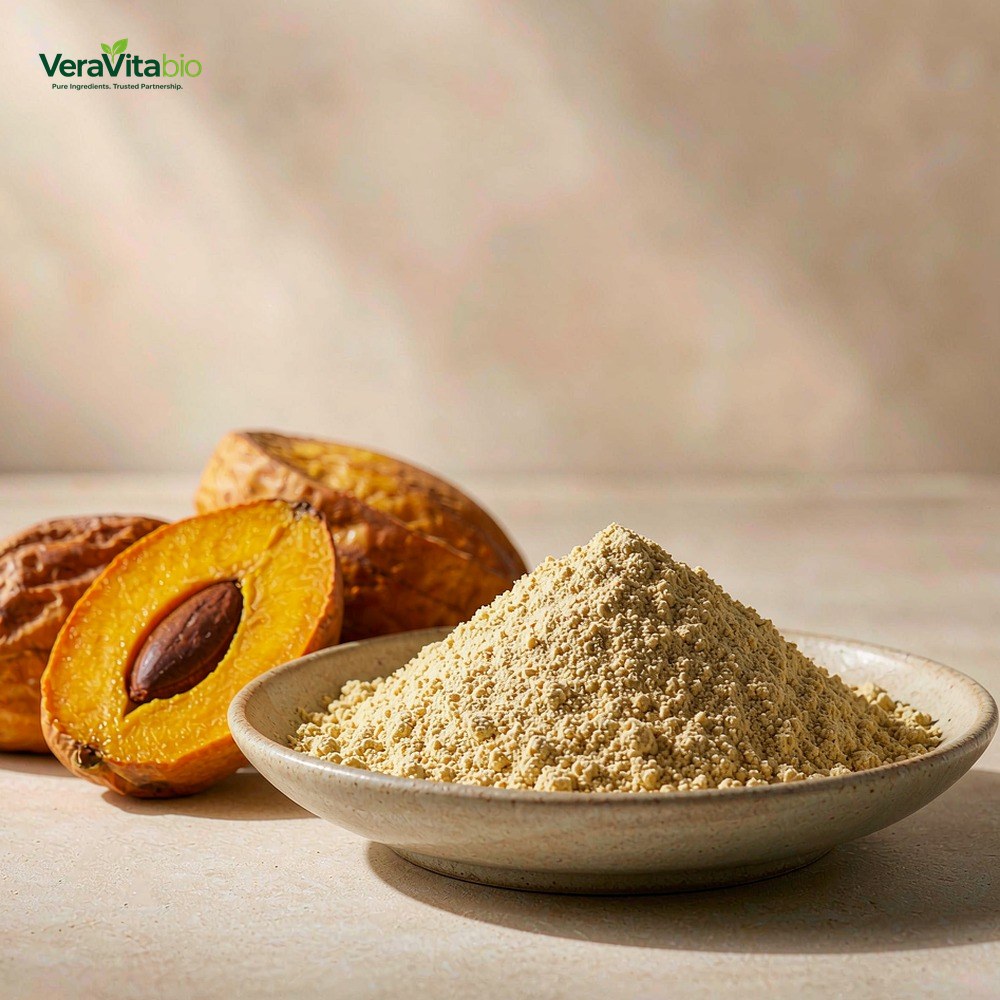
Lucuma is the fruit of Pouteria lucuma (Ruiz & Pav.) Kuntze, syn. Lucuma obovata (family Sapotaceae), a subtropical tree native to the high Andean valleys of Peru, Ecuador, Chile and Bolivia. The fruit has been cultivated and depicted in Andean ceramics since pre-Inca times — the Moche culture portrayed it repeatedly — and it is still marketed today under its historic nickname, the “Gold of the Incas”. The dense, dry, orange-yellow flesh is not eaten fresh in any volume: it is peeled, deseeded, gently dried and milled into a fine golden powder that has become one of the most distinctive natural sweetening ingredients in the global “better-for-you” portfolio.
Two facts define its commercial position. First, its flavour-sweetness profile is unique: a mild, well-rounded sweetness with maple, caramel and butterscotch notes and a faint sweet-potato character — in Peru, lucuma is the country’s most popular ice-cream flavour, outselling vanilla and chocolate. Second, its regulatory posture is unusually clean: in the European Union lucuma is classified as a foodstuff with sweetening properties, not as a food additive — it carries no E-number and is declared simply as “lucuma powder” on the ingredient list. Evidence of EU marketing before 1997 was submitted to the European Commission in 2009, so the dried fruit powder has generally not required novel-food authorisation (verify status for your specific market and process — see Formulation Notes).
VeraVitabio supplies organic (EU / USDA NOP) and conventional lucuma powder from contracted Andean-origin harvests: 100% fruit solids, no carriers, no anti-caking agents, no added sugar, no sulphur dioxide, gentle low-temperature drying below 45 °C. Available from 1 kg evaluation packs to 20 kg / 25 kg industrial bags and full container loads.
Key Features
- Naturally low-glycaemic sweetness — published glycemic-index testing for lucuma powder commonly falls in the mid-20s to mid-40s range depending on protocol (sucrose = 65–70); sweetness arrives slowly and gently. Always cite GI as a range from specific tests, never as a health claim.
- Signature maple-caramel flavour, not just sweetness — lucuma contributes flavour body, colour and a creamy mouthfeel, so it can replace flavouring additions in premium desserts and drinks rather than merely sweeten them.
- 100% fruit solids, declaration-backed — no maltodextrin carrier, no anti-caking agent, no added sugar, no sulphur dioxide, not irradiated; written declarations supplied with every lot.
- Gentle low-temperature process — dried below 45 °C, preserving the fresh maple-caramel aroma and the pale golden colour that buyers use as the fastest quality screen; “raw” process documentation available.
- Naturally contributing fibre, carotenoids and minerals — dietary fibre, β-carotene, niacin, riboflavin and the minerals potassium, iron, zinc and calcium are naturally present (values are lot-specific and must be quoted from the COA — see Formulation Notes).
- Clean label by every measure — vegan, gluten-free, non-GMO, free of the EU-14 allergens, HALAL / KOSHER available on request.
- No E-number, no additive paperwork — in the EU it is a foodstuff with sweetening properties, so labelling, specification and compliance conversations are simpler than for extracts or additives.
- Ingredient-system synergy — pairs directly with natural high-intensity sweeteners (stevia, monk fruit) and bulk polyols (erythritol, allulose, xylitol) to build complete sugar-reduction systems.
- Dual-grade supply — organic and conventional, retail co-pack pouches and industrial 20 kg / 25 kg kraft bags with food-grade PE liners.
How It Works
1. Sweetness with a fibre brake. Lucuma’s sweetness comes from its own natural sugars (sucrose, glucose and fructose) carried in a matrix that is rich in dietary fibre. That matrix slows the rate at which sugars are released and absorbed, which is why measured glycemic responses sit well below sucrose across published tests. Practically, lucuma is a bulk sweetener and flavour body, not a high-intensity sweetener: perceived sweetness is a fraction of sucrose, so it is used at meaningful percentages and often paired with a high-intensity partner for full sugar replacement.
2. Flavour is the real actives story. Lucuma’s maple, caramel and butterscotch notes come from its native aroma chemistry plus gentle Maillard development during drying — which is exactly why drying temperature is the decisive quality variable. Below 45 °C the fresh, rounded notes survive; aggressive hot-air drying drives browning reactions that darken the powder and flatten the flavour into a generic “cooked” sweetness. In formulation, lucuma binds and rounds fats and sugars in confectionery much the way maca does, helping cocoa, coconut and other strong flavours carry smoothly.
3. Function beyond taste. The fibre fraction contributes water binding and body in bakery and frozen desserts; the naturally present carotenoids (with β-carotene as the marker) give the golden hue that colours ice cream, cheesecakes and beverages without added colourants; and the fine particle size disperses evenly into dry blends. Lucuma is not fully water-soluble — in beverages it forms a pleasant creamy suspension, and clear applications need a stabiliser system or an extracted grade.
Typical Applications
- Ice cream and frozen desserts — 2–8%: the benchmark application; Peru’s favourite flavour delivers natural caramel-maple character and golden colour without flavourings or colours.
- Smoothie and protein powder blends — 3–10% of the dry blend; pairs with cacao, vanilla, cinnamon and banana profiles.
- Bakery — 5–15% flour replacement in cakes, cookies, pancakes, waffles and muffin mixes; contributes colour, aroma and moisture retention.
- Raw bars, bliss balls and energy snacks — 5–15%; the classic raw-dessert use, binding dates, nuts and cacao.
- Chocolate and confectionery — 3–10% in couverture fillings, truffles and raw chocolate.
- Ready-to-drink beverages and plant milks — 1–5%; expect a creamy suspension — pair with a stabiliser (gum blend) for body and mouthfeel.
- Breakfast formats — 3–8% in granola, porridges, cereals and yoghurt inclusions.
- Sugar-reduction systems — as the flavour-and-bulk foundation alongside stevia, monk fruit, erythritol, allulose or xylitol, reducing reliance on artificial flavourings.
- Baby food and toddler snacks — used for gentle sweetness; note that infant and toddler foods carry their own compositional rules per market — confirm locally.
Key Specifications
| Parameter | Specification |
|---|---|
| Botanical name | Pouteria lucuma (Ruiz & Pav.) Kuntze, syn. Lucuma obovata; family Sapotaceae |
| Plant part / form | Fruit pulp (peeled, deseeded), dried and milled to a fine powder — 100% fruit solids |
| Origin | Andean valleys of Peru (contracted harvests, annual supply planning); also Ecuador and Chile |
| Process | Gentle low-temperature drying below 45 °C, then milling and sieving; raw-process documentation available |
| Appearance | Free-flowing fine powder, no visible foreign matter |
| Colour | Pale golden to deep golden yellow (colour is the primary lot-quality indicator — reject dark/brown lots) |
| Odour / taste | Characteristic sweet maple-caramel aroma with butterscotch notes; no off-odours, no burnt or musty notes |
| Particle size | 100% through 80 mesh (60 and 100 mesh options on request) |
| Moisture | ≤ 6.0% (typically 3–5%) |
| Total ash | ≤ 5.0% |
| Composition (typical, lot-specific) | Carbohydrates approx. 60–87 g/100 g (of which natural sugars approx. 15–30 g); dietary fibre approx. 10–25 g (method-dependent); protein 3–5 g; fat ≤ 2.5 g; energy approx. 320–390 kcal/100 g. Composition varies with variety, ripeness and drying — quote the COA, never a generic datasheet |
| Carotenoids | Naturally present (β-carotene as marker, CAS 7235-40-7); reported per lot — degrades with heat, light and oxygen |
| Heavy metals | Pb, Cd, Hg, As tested per lot against destination-market limits; typical commercial specs Pb ≤ 1.0 ppm, Cd ≤ 0.5 ppm, Hg ≤ 0.1 ppm, As ≤ 0.5 ppm |
| Mycotoxins | Aflatoxins and ochratoxin A tested per lot; targets aligned with EU maximum levels for contaminants (Regulation (EU) 2023/915) |
| Microbiology | Total plate count ≤ 10,000 cfu/g; yeasts & moulds ≤ 100 cfu/g; E. coli absent in 1 g; Salmonella absent in 25 g |
| Pesticides | Compliant with EU Regulation 396/2005 MRLs; no ethylene oxide treatment (EU zero-tolerance enforcement) |
| Treatment / additives | Not irradiated; no sulphur dioxide; no carriers, no anti-caking agents, no added sugar or flavourings |
| Allergens | None of the EU-14 allergens; gluten-free |
| Regulatory position | EU: “foodstuff with sweetening properties” — not a food additive, no E-number; pre-1997 EU marketing evidence accepted in 2009 (generally outside novel-food scope for the dried powder); US: used as a food ingredient — buyer confirms GRAS position for intended use |
| HS code | 1106 30 (flour, meal and powder of edible fruit) |
| Shelf life | 24 months unopened in original sealed packaging, stored cool and dry below 25 °C |
| Packaging | 20 kg / 25 kg kraft paper bags with food-grade PE liner and desiccant; 1 kg / 5 kg foil pouches for evaluation and retail co-pack |
| Certifications | EU Organic / USDA NOP (TRACES electronic Certificate of Inspection issued for EU organic consignments); HACCP / ISO 9001; HALAL / KOSHER on request |
Formulation Notes
- Buy on colour first — it is the fastest honest test. Pale golden powder indicates gentle low-temperature drying; dark brown or olive tones mean Maillard browning from aggressive drying. Dark lots have lost the fresh maple-caramel top notes and much of the carotenoid content, and they taste “cooked”. Ask for lot photos before you ask for a new sample.
- Demand “100% fruit solids” in writing. Lucuma’s flavour profile (sweet potato, butterscotch) is easy to imitate by blending with maltodextrin, cheaper fruit flours or starches. Require a written no-carrier / no-additive declaration, and for first orders run identity verification (microscopy plus fingerprint) on the lot.
- COA numbers vary far more than buyers expect. Published fibre values for lucuma powder range from single digits to about 25 g/100 g. This is not necessarily supplier dishonesty: variety, ripeness, whole-fruit versus pulp-only processing, drying conditions and — above all — the analytical method all move the numbers. Compare suppliers only on the same method (e.g. AOAC 2009.01 versus older Prosky-type methods), and build your nutrition panel from your own lot’s COA.
- It is a bulk sweetener, not a drop-in sugar replacement. Perceived sweetness is well below sucrose; typical use levels run 3–12% depending on format. For true sugar reduction, pair lucuma with a high-intensity sweetener (stevia, monk fruit) and/or a bulk polyol (erythritol, allulose, xylitol) — we supply the complete system.
- Mycotoxins are the category’s real safety risk. Dried-fruit powders are exposed to aflatoxins and ochratoxin A when fruit is dried or stored poorly. Require per-lot mycotoxin results (not just a supplier-level certificate) and audit drying and storage practice on any new origin.
- No E-number — get the labelling position right. In the EU, lucuma is a foodstuff with sweetening properties, not a food additive: it is declared as “lucuma powder” / “organic lucuma powder” in the ingredients list, and no E-number applies. This simplifies both labelling and the customer conversation.
- EU novel-food status: documented, but verify per market. Evidence of EU marketing before 15 May 1997 was submitted by France in 2009, which is why the dried fruit powder has generally not required novel-food authorisation. However, the EU Novel Food status catalogue is non-binding and Member States may take different views — particularly for new processes, extracts or unusual uses. Run a documented status check (or an Article 4 consultation) before contracting significant volumes.
- EU organic logistics: TRACES before the ship sails. Organic lucuma entering the EU requires an electronic Certificate of Inspection (e-COI) issued in TRACES before shipment — consignments without it are not released at the port of arrival. Confirm the certificate workflow with your importer as a pre-shipment gate, not after.
- Beverage clarity and blend homogeneity. The powder is not fully soluble: RTD drinks show a creamy suspension (usually desirable) — for clear beverages use a stabiliser system or an extracted grade. In dry blends, match lucuma’s particle size to the other powders to prevent segregation during transport.
- Caking control. The powder is hygroscopic. Specify moisture ≤ 6%, require moisture-barrier packaging (kraft + PE liner + desiccant), and warehouse below 65% RH. Most customer complaints in this category are texture complaints caused by moisture ingress in tropical distribution.
- Sulphites: confirm the absence, don’t assume it. Dried-fruit products are sometimes treated with SO2 elsewhere in the trade; above 10 mg/kg it is an EU allergen declaration. Our specification prohibits sulphur dioxide entirely, and the declaration is supplied per lot.
Storage & Handling
Store in the original sealed, moisture-barrier packaging in a cool (<25 °C), dry (RH < 65%), odour-free area — dried fruit powders both absorb ambient odours and attract stored-product insects, so warehouse pest control and FIFO stock rotation are part of the specification, not an afterthought. Keep away from direct sunlight and strong light: the carotenoid fraction is light- and oxygen-sensitive, and colour retention is a stated quality parameter. Reseal opened bags promptly or repack into sealed containers with desiccant. Shelf life is 24 months unopened; re-test colour, moisture, water activity and microbiology before use beyond the stated date. Standard food-grade hygiene applies: dedicated scoops, gloves and dust control when handling powder at scale.
Why Choose VeraVitabio
- Organic and conventional, one source. Both grades quoted side by side, with EU / NOP organic certificates and TRACES e-COI workflow already proven on EU consignments.
- Lot documentation as default. Every lot ships with COA covering moisture, colour, microbiology, heavy metals, mycotoxins, pesticide screen, plus written declarations: no carrier, no additives, no sulphur dioxide, non-irradiated, non-GMO, allergen-free.
- Origin traceability and supply planning. Contracted Andean-origin harvests with annual volume planning — lucuma is an agricultural product, and buyers who wait for the spot market pay the harvest-cycle price.
- Format breadth from trial to tonnage. 1 kg and 5 kg evaluation pouches, retail co-pack formats, and 20 kg / 25 kg industrial bags through to container loads at production pricing.
- Complete sweetening-system support. Lucuma quoted together with stevia, monk fruit, erythritol, allulose and xylitol, so you can build and cost the full sugar-reduction system with one supplier instead of stitching together five.
- Practical formulation guidance. Use levels, stabiliser pairing for beverages, bake-stability and colour management advice provided during evaluation — before the order, not after the complaint.
Request a Quote
Tell us the grade you need (organic EU/NOP or conventional), the application (beverage, bakery, frozen dessert, snack or sweetening system), your target use level and annual volume, and we will respond with a quotation, the current lot’s COA and sample lead time. Evaluation packs are dispatched quickly so you can validate colour, flavour and dispersion in your own formulation.
Email: info@veravitabio.com | WhatsApp: +86 157 7194 0528
VeraVita Bio — Xi’an VeraVita Biotech Co., Ltd. | Botanical & Functional Ingredient Sourcing Partner
Email: info@veravitabio.com | WhatsApp: +86 157 7194 0528 | veravitabio.com
Disclaimer: The information provided is for general technical and commercial reference only and does not constitute medical, nutritional, regulatory or legal advice. Lucuma powder is a bulk raw material supplied to qualified business customers, not a finished consumer product. Specifications and composition values are subject to batch confirmation from the lot COA. Glycemic-index figures are ranges from published tests and must not be presented as health claims; no disease-related or therapeutic claims may be made for this ingredient. Novel-food status, permitted claims, contaminant limits and labelling requirements must be verified against the regulations of the destination market, and finished-product safety, labelling and claims remain the responsibility of the manufacturer.
Need pricing, a sample or full documentation?
Send your specification, target volume and destination country — our team replies within one business day.
Reviews
There are no reviews yet.