Product Overview
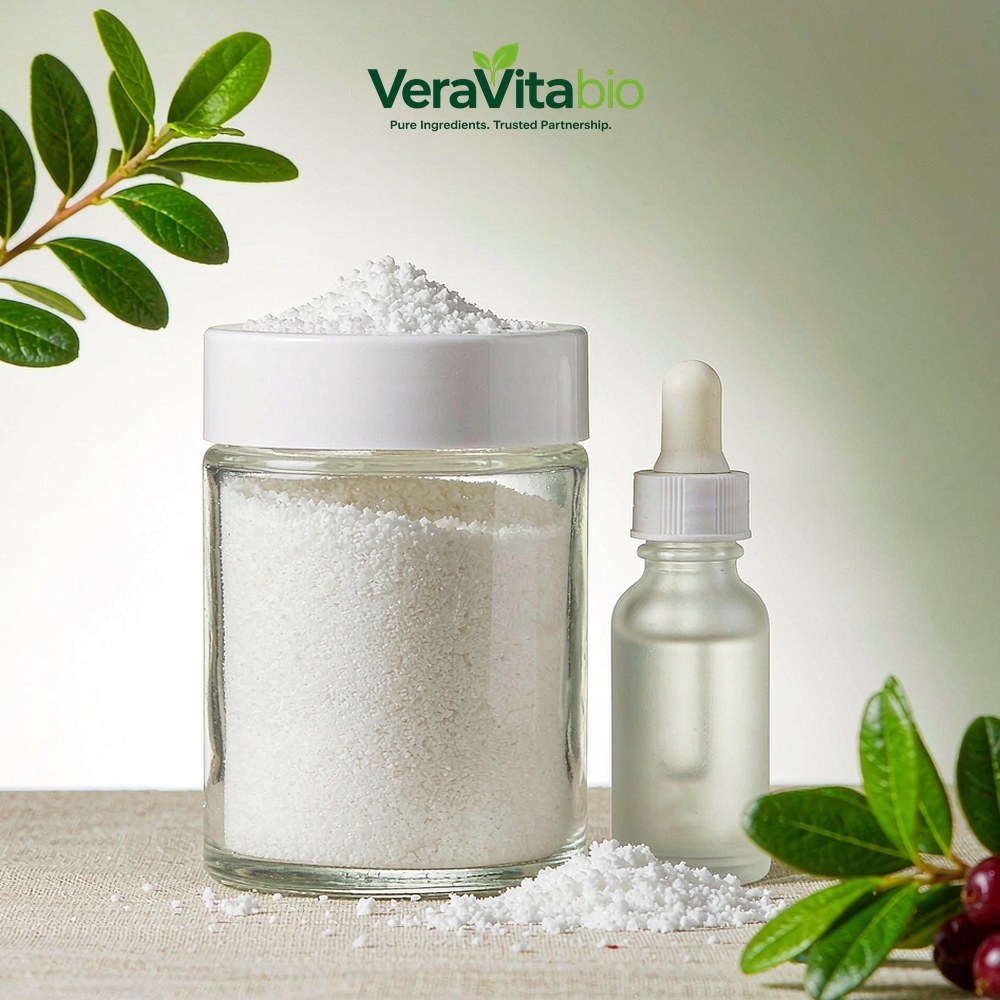
Alpha-arbutin (4-hydroxyphenyl α-D-glucopyranoside) is the α-anomer of arbutin, a glycosylated form of hydroquinone in which a glucose unit is attached to the hydroquinone molecule. That single structural difference matters commercially: alpha-arbutin is markedly more effective at inhibiting tyrosinase than its naturally occurring β-isomer, while releasing far less free hydroquinone during storage and use. It is supplied as a white, free-flowing crystalline powder that dissolves readily in water, which makes it one of the easiest brightening actives to formulate into aqueous serums, gels, essences and emulsions.
Alpha-arbutin is now produced predominantly by enzymatic biosynthesis rather than direct extraction from bearberry leaves, giving consistent purity, reliable supply and a stable cost base at commercial volumes. For brands that need a hydroquinone-free brightening position, or that need to complement an existing niacinamide or vitamin C franchise, alpha-arbutin is the reference active: it is well tolerated, it is not associated with the sensitisation profile of hydroquinone, and it is compatible with the majority of common cosmetic ingredients. It is widely used across Asia, Europe and North America in leave-on brightening products.
Key Features
- Potent tyrosinase inhibition — directly inhibits the rate-limiting enzyme in melanin synthesis; in-vitro human skin model data have reported melanin synthesis reduced to roughly 40% of control without loss of cell viability
- Significantly more effective than beta-arbutin — published comparisons commonly cite alpha-arbutin as being roughly ten times more effective than the naturally occurring β-isomer at equivalent use levels
- High purity, single molecule — ≥ 99.5% by HPLC, controlled hydroquinone residue, giving tight batch-to-batch consistency versus broad botanical extracts
- Water-soluble — freely soluble in water (approx. 150 g/L at 25 °C), so it can be added to the water phase without solubilisers, hot-processing or pre-dispersion
- Gentle on skin — widely used on sensitive and blemish-prone skin; a well-established alternative to hydroquinone in hydroquinone-free ranges
- Broad formulation compatibility — works alongside niacinamide, hyaluronic acid, tranexamic acid, vitamin C derivatives, licorice extract, ferulic acid and gentle acids
- Not photosensitising — does not increase sun sensitivity, so it is suitable for daytime products when paired with broad-spectrum SPF
- Clean, neutral sensory profile — white odourless crystalline powder, low colour contribution, no impact on fragrance strategy
- Stable under correct conditions — no measurable degradation reported over three months at 40 °C when pH is controlled; shelf life 24–36 months in sealed, cool, dry storage
- Biosynthetic, non-animal origin — enzymatic production route suitable for vegan and clean-beauty positioning
How It Works
- Tyrosinase inhibition: melanin is produced through a pathway in which tyrosinase converts tyrosine to DOPA and then to dopaquinone. Alpha-arbutin competes at the tyrosinase active site, slowing this conversion and reducing the amount of melanin formed in the first place.
- Glycosidic delivery: the glucose moiety makes the molecule water-soluble and stable in formulation, and it is gradually cleaved at the skin surface so the active is released slowly rather than all at once — the basis of its comparatively low irritation profile.
- Low free-hydroquinone release: because the hydroquinone is chemically bound within the glycoside, the amount of free hydroquinone present is minimal when pH, temperature and packaging are correctly controlled. This is the key quality parameter on any alpha-arbutin COA.
- Visible effect on existing pigmentation: by suppressing new melanin formation while existing pigmented cells are shed through normal turnover, alpha-arbutin gradually softens the appearance of melasma, solar lentigines (age spots), freckles and post-inflammatory hyperpigmentation.
- Synergy with other pathways: alpha-arbutin acts on melanin synthesis only. Combining it with niacinamide (which acts on melanosome transfer), tranexamic acid or a vitamin C derivative addresses multiple steps of the pigmentation pathway simultaneously.
Typical Applications
- Brightening and radiance serums: the primary use — typically 1–2% in daily-use aqueous or gel serums
- Spot treatments and correctors: targeted, higher-strength products for localised dark marks and post-acne pigmentation
- Tone-evening facial creams and emulsions: daily moisturisers with a brightening claim, often combined with niacinamide
- Eye-area products: under-eye creams and serums where a gentle depigmenting active is required at conservative use levels
- Sheet masks and wash-off masks: short-contact formats where a higher concentration is acceptable because contact time is limited
- Melasma and hyperpigmentation programmes: multi-ingredient regimens combining alpha-arbutin with tranexamic acid, niacinamide and daily SPF
- Sunscreens and day creams: added to UV-protection products to help limit UV-induced darkening
- Body care: body lotions, hand creams and décolletage treatments at lower use levels (SCCS reference level 0.5% for body lotions)
- Tone-enhancing colour cosmetics: BB and CC creams, primers and cushions formulated with a brightening secondary claim
- Professional and clinic aftercare: post-procedure home-care products aimed at reducing the appearance of post-inflammatory pigmentation
Key Specifications
| Product Name | Alpha-Arbutin (Cosmetic Grade) |
|---|---|
| INCI | Alpha-Arbutin |
| CAS Number | 84380-01-8 |
| EC Number | 440-470-8 |
| Chemical Name | 4-Hydroxyphenyl α-D-glucopyranoside (hydroquinone O-α-D-glucopyranoside) |
| Molecular Formula / Weight | C12H16O7 / 272.25 g/mol |
| Appearance | White to off-white crystalline powder |
| Assay (HPLC) | ≥ 99.5% (also available at ≥ 99.0%) |
| Specific Optical Rotation [α]D20 | +175° to +186° (confirms the α configuration; β-arbutin is negative) |
| Melting Point | Approx. 202–210 °C |
| Solubility | Freely soluble in water (approx. 150 g/L at 25 °C); soluble in propylene glycol; slightly soluble in ethanol; insoluble in oils |
| pH (1% aqueous solution) | 5.0 – 7.0 |
| Formulation pH Window | Optimal pH 5.0 – 7.0; avoid below pH 3.0 and above pH 8.0 |
| Hydroquinone Residue | ≤ 1 ppm (not detected) by HPLC — batch-specific value reported on COA |
| Loss on Drying | ≤ 1.0% |
| Heavy Metals | Total ≤ 10 ppm; Pb ≤ 10 ppm; As ≤ 2 ppm; Cd ≤ 1 ppm; Hg ≤ 1 ppm |
| Microbiology | Total plate count ≤ 1,000 cfu/g; yeast & mould ≤ 100 cfu/g; no pathogenic organisms |
| Recommended Use Level | 0.2% – 2.0% in leave-on facial products; up to 0.5% in body lotions per EU SCCS reference levels (confirm limits in destination market) |
| GMO / Allergen Status | Non-GMO; free from the 26 EU fragrance allergens |
| Certifications | ISO, HACCP, HALAL and KOSHER available upon request |
| Shelf Life | 24 months in unopened original packaging under recommended storage (stability data supporting up to 36 months available for qualified buyers) |
| Packaging | 1 kg aluminium foil bag with inner PE liner (sample / small lot); 5 kg / 25 kg fibre drum with double liner and desiccant |
| MOQ | Available on request |
Formulation Notes
- Phase and temperature: dissolve alpha-arbutin in the water phase and add during the cool-down stage, ideally below 40–60 °C. Prolonged exposure above 60 °C accelerates glycosidic hydrolysis.
- pH control is the critical variable: hold finished product pH between 5.0 and 7.0. Below pH 3.0 strong acids cleave the glycosidic bond; above pH 8.0 hydroquinone release increases. Citrate or phosphate buffers have been shown to reduce initial hydroquinone levels significantly.
- Hydroquinone monitoring: because free hydroquinone can form slowly over shelf life (levels in the tens of ppm have been reported in unbuffered systems stored at 40 °C), specify a hydroquinone limit on your incoming-material specification and repeat the test at the end of accelerated stability.
- Synergistic pairings: niacinamide 2–5% (melanosome transfer), tranexamic acid 2–3% (particularly for melasma), licorice extract / glabridin 0.5–2%, ferulic acid 0.5–1%, and stable vitamin C derivatives such as ascorbyl glucoside, magnesium ascorbyl phosphate or ethyl ascorbic acid. Avoid pairing with low-pH L-ascorbic acid in the same phase.
- Chelators and antioxidants: include a chelating agent (for example EDTA) and consider a small antioxidant package to limit metal-catalysed discolouration in water-based systems.
- Sunscreen pairing: alpha-arbutin is not photosensitising, but any brightening claim is undermined without daily UV protection. Pair with broad-spectrum SPF in the regimen and state this clearly on-pack.
- Claim substantiation: use “helps visibly reduce the appearance of dark spots,” “evens skin tone” or “brighter-looking skin” rather than therapeutic wording. Verify permitted claim language and maximum use levels for each destination market before launch.
Storage & Handling
Store in tightly sealed, light-resistant containers in a cool, dry, well-ventilated place; recommended temperature 15–25 °C, protected from direct sunlight, heat and moisture. Keep the inner liner closed and use the supplied desiccant. Use standard personal protective equipment including nitrile gloves, safety glasses and a dust mask when handling powder in bulk. Avoid contact with strong acids, strong alkalis and oxidising agents. For cosmetic formulation use only.
Why Choose VeraVitabio
- Bulk B2B supply of cosmetic actives, plant extracts, mushroom extracts, food additives and personal-care ingredients — from sample quantities to full container loads
- Specification-driven cosmetic grade alpha-arbutin with batch COA including HPLC assay, optical rotation and hydroquinone residue
- Complete documentation — COA, MSDS, TDS, allergen statement, non-GMO statement and regulatory support available on request
- OEM / ODM support — custom serums, creams, masks and sachets with formulation guidance and private labelling
- Contracted processors and batch-level traceability from raw material to finished drum, with pre-shipment verification
- Responsive B2B service via email and WhatsApp for quotes, samples and technical questions
Request a Quote — Sourcing alpha-arbutin for a brightening serum, spot treatment, tone-evening cream, eye product or mask line? Send your required purity, use level, target volume and destination market to info@veravitabio.com or WhatsApp +86 157 7194 0528. Samples, COA and full documentation are available for qualified B2B buyers. Web: veravitabio.com
.vv-contact-strip{display:flex;flex-wrap:wrap;gap:10px;align-items:center;margin:0;}
.vv-contact-strip a{
display:inline-flex;align-items:center;gap:8px;
padding:10px 16px;border-radius:8px;
font-size:0.9375rem;font-weight:600;line-height:1;
text-decoration:none;transition:all .25s cubic-bezier(.4,0,.2,1);
border:1px solid rgba(13,59,46,.18);
color:#0D3B2E;background:#FFFFFF;
}
.vv-contact-strip a:hover{
background:#0D3B2E;color:#FFFFFF;border-color:#0D3B2E;
transform:translateY(-1px);
}
.vv-contact-strip a svg{flex:0 0 auto;}
.vv-contact-strip.vv-on-dark a{
background:rgba(255,255,255,.06);
border-color:rgba(255,255,255,.22);
color:#FFFFFF;
}
.vv-contact-strip.vv-on-dark a:hover{
background:#7CBB3A;border-color:#7CBB3A;color:#0D3B2E;
}
.vv-contact-strip.vv-centered{justify-content:center;}
For cosmetic formulation use only. This product is not intended to diagnose, treat, cure, or prevent any disease. Specifications shown are for general reference; full Certificate of Analysis and supporting documentation are available upon request. Regulatory status, permitted maximum use levels and permitted claims for alpha-arbutin differ by destination market — reference levels commonly cited include up to 2% in face creams and up to 0.5% in body lotions per the EU SCCS opinion. Buyers are responsible for confirming compliance in their own jurisdiction before sale.
Need pricing, a sample or full documentation?
Send your specification, target volume and destination country — our team replies within one business day.
Reviews
There are no reviews yet.